Oak Park Epoxy Flooring brings 20+ years of epoxy flooring in Bridgeview and across Cook County to basement, garage and commercial slabs, and on a basement job our first question is rarely about color. We want to know what sits on the floor, what drains onto it and where that water goes. A furnace corner answers most of that before a grinder is even unloaded.
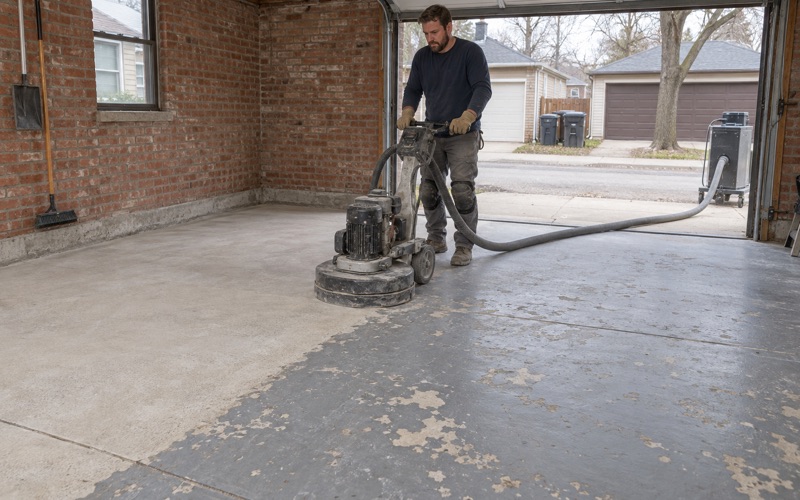
Every slab we coat is opened mechanically with a diamond grinder or a shot blaster, never acid etched, and moisture testing is written into the scope as its own line item. On a basement floor that usually means ASTM F2170 in-situ relative humidity probes or an ASTM F1869 calcium chloride test, read before a product is chosen rather than after a blister appears.
Our proposal names the product, the system build and the finished thickness, so what we quoted can be checked against what went down. Warranty exclusions are read aloud before the job is sold, with moisture named first. That matters on a mechanical corner, because a floor coating is not a drain, a neutralizer or waterproofing, and we say so in writing.
A 24-Hour Heating Base on 76th Avenue, and Why Its Furnaces Drain Acid
Bridgeview has its own round-the-clock heating and cooling base. Four Seasons Heating & Air Conditioning lists a Bridgeview service location at 9934 South 76th Avenue, which geocodes inside the village in Palos Township, and its page reads Open 24/7/365. The company says technicians reach a property in 15 to 30 minutes depending on where in the village it sits, and that it runs more than 600 trucks across Chicagoland and Northwest Indiana.
We have no relationship with Four Seasons and do no heating work ourselves. We mention the shop because a furnace replacement in a Bridgeview basement can happen fast and at any hour, and the equipment going in has changed what drips onto the floor. How Four Seasons routes its condensate lines is something we have not seen, so nothing here describes their installs.
What a condensing appliance puts on the floor
A high-efficiency furnace or a condensing water heater wrings so much heat out of its exhaust that water vapor condenses inside the unit. That water has to leave through a drain line, and it is not clean water. Trade sources written by neutralizer makers put high-efficiency gas appliance condensate at roughly pH 2.9 to 4.0, which is acidic enough to matter.
One trade article from January 2025, written by the president of a neutralizer maker, says that condensate can corrode plumbing, concrete foundations and floor drains, and it shows a photo of a badly damaged drain. Treat the range as approximate rather than a measurement of any particular furnace. We have not tested anyone’s condensate, and nobody should read the figure as a reading taken in a Bridgeview basement.
Why bare concrete hides the problem
Concrete is porous, so a slow drip from a loose fitting soaks in rather than pooling. On an uncoated floor a leaking trap or a cracked tube can go on for a long time, showing only as a dark patch near the furnace that dries out between heating cycles. By the time anyone notices, the drain grate or the concrete around it may already be pitted.
A coated floor changes how the same leak looks. Water sits on the surface as a visible wet spot instead of disappearing, which tells the homeowner it is time to call for a repair. That is the honest benefit of a coating in a furnace room, and it is a smaller claim than protection, because a coating does nothing for a line that keeps leaking.
Looking for epoxy-flooring closer to Wood Dale? See Wood Dale Epoxy-Flooring.
Neutralizers, Overflows and Condensate Pumps
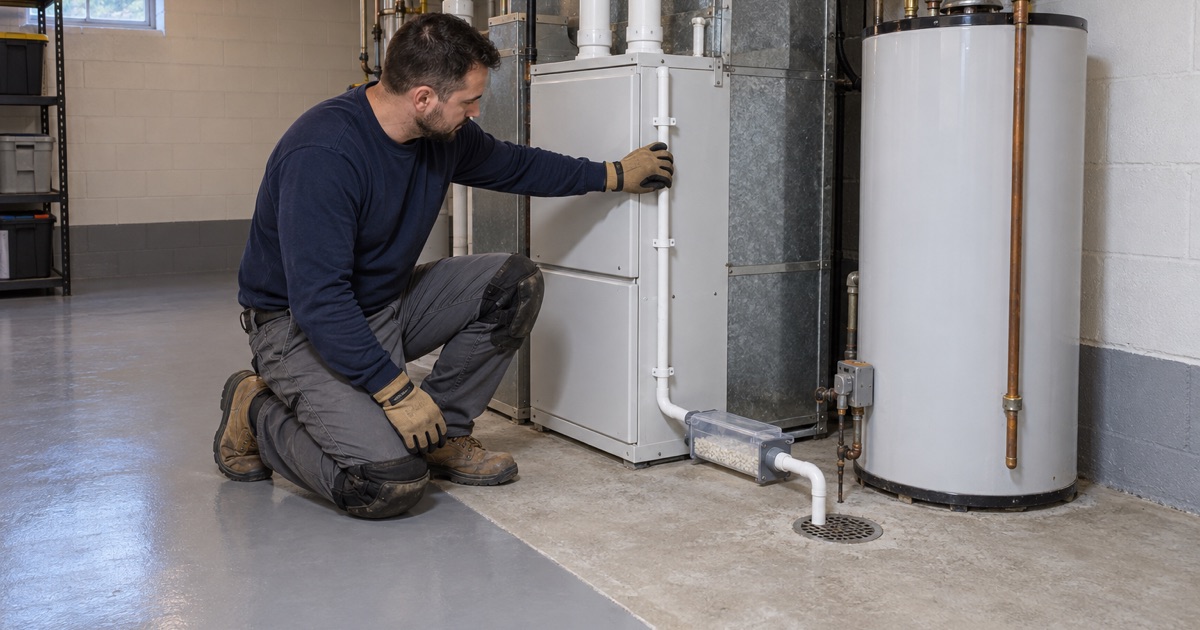
A condensate neutralizer is a capsule or cartridge filled with alkaline media that the drain water passes through before it reaches the floor drain or sewer. One maker’s installation, operation and maintenance instructions for its NC-Series kit are specific about how the unit sits in a room. We read them because each requirement touches the floor we would be coating.
Mounting and tubing
The Axiom instructions say to mount the neutralization capsule on the wall or floor, and that the kit inlet and discharge must sit lower than the condensate drain from the appliance. They call for corrosion resistant piping secured to the floor or wall to prevent movement. Where traffic poses a risk, they say to install some protection.
For a floor coating crew, that means a capsule bracket may be anchored into the very slab we are grinding. It also means tubing should be clipped down along a fixed route, not draped across the floor where a storage bin or a vacuum hose can kick it loose. A tube that moves is a tube that eventually leaks.
The safety overflow and the overflow switch
The same instructions recommend a Y or T-fitting as a safety overflow in the event that the condensate drain becomes clogged. Where there is no gravity drain, a condensate pump must be equipped with an overflow switch so the appliance stops running if the pump fails. Both details decide where water goes on the day something goes wrong.
An overflow fitting that spills at floor level tells us exactly where a coating must stay clean and where the surface should be easy to wipe dry. A condensate pump without a switch is a different situation, because a failed pump can keep the furnace firing and the tray overflowing for hours. We point that out to the homeowner and leave the fix to the heating contractor.
Annual pH checks
The instructions say to check the pH at the outlet of the neutralizing kit annually and replace the media when it drops below the local minimum. They also tell installers to check with the local water authority about discharging treated condensate to a drain or sewer. A coating has to leave room for someone to reach that capsule every year without chipping the floor around it.
Fix the Drain Path First, Then Coat Around It
Before we price a Bridgeview basement with a high-efficiency furnace or condensing water heater, we walk the condensate path from the appliance to its end point. We look at the trap, the tubing, any neutralizer, any condensate pump and the floor drain itself. If the line is loose, unclipped or wet at a joint, the coating date waits until the heating contractor has fixed it.
Reading the slab around the drain
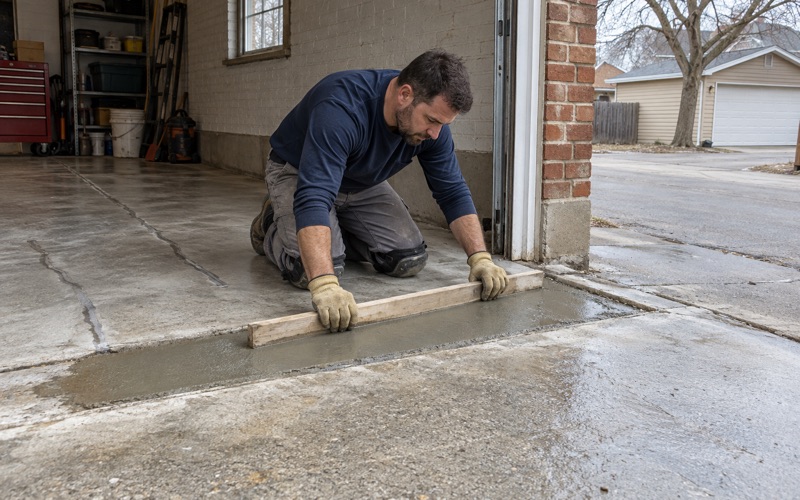
We read cracks and old coatings before we quote, and around a furnace drain that inspection is closer than anywhere else in the room. Pitting, soft concrete or a corroded drain body may mean the area needs repair before any resin goes down, and we say so plainly. Sometimes the right answer is a patch and a cure period first, and a coating appointment later.
Moisture readings get the same attention here as everywhere else on the slab. A spot that has been wetted by condensate for months can read high on an ASTM F2170 probe even when the rest of the floor is dry. We would rather find that with a meter than with a blister, and a moisture-mitigation primer is quoted only when the numbers call for one.
Where the coating stops
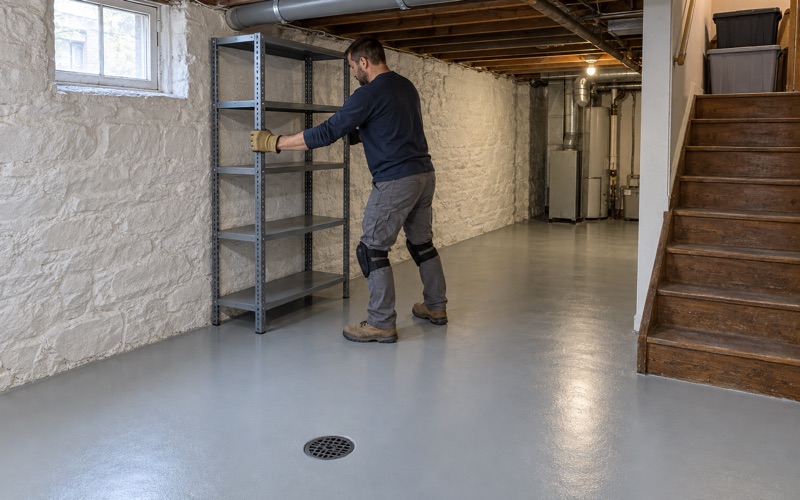
The coating runs up to the floor drain and stops cleanly at its rim rather than flowing over the grate or into the throat. It stops the same way at a neutralizer bracket, a pump base or a tubing clip anchored in the slab, so each can be removed or serviced later. We mask those points before the primer goes down and keep them masked through the topcoat.
A drain buried under resin cannot be cleaned, and a bracket sealed in place has to be cut free the first time the media is changed. Leaving clean terminations is slower on the day, but it keeps the mechanical parts serviceable and keeps the coating edge from being the first thing to lift. We would rather show a neat stop line than a seamless floor that traps the hardware.
What the coating does and does not do
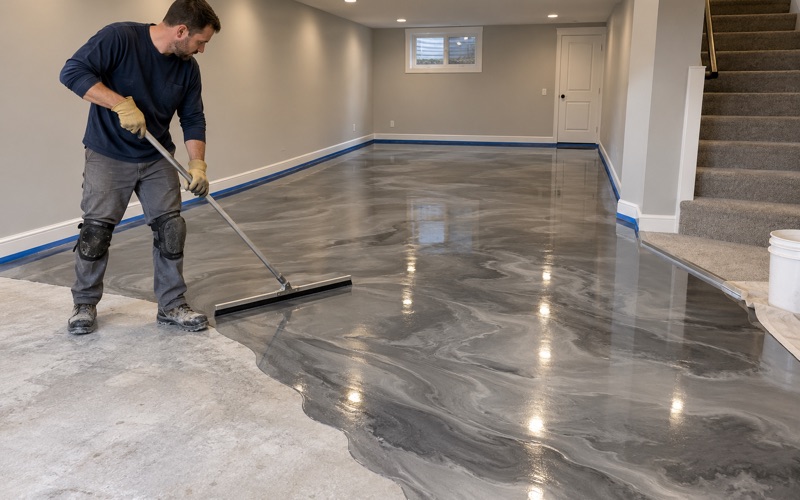
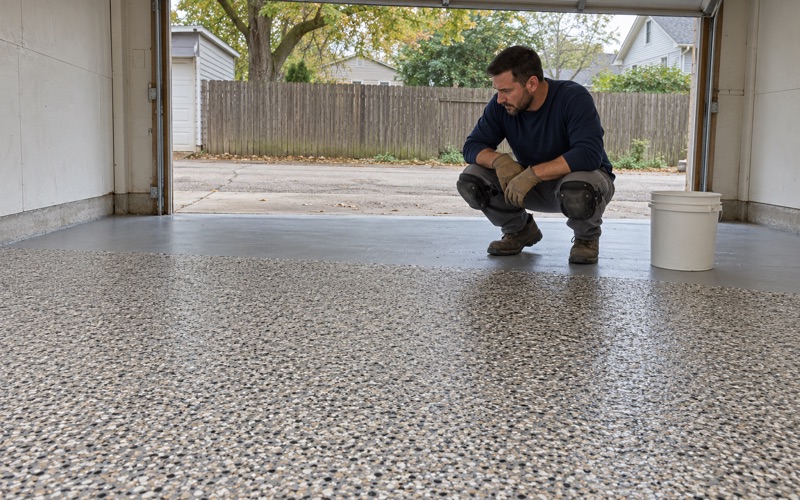
A 100% solids epoxy base with a polyaspartic topcoat gives a sealed, wipeable surface, and in a furnace room a light vinyl flake broadcast still lets a fresh drip show against an even background. It does not neutralize anything, replace a neutralizer or fix a drain line. If condensate keeps reaching the floor, the answer is a repair to the line, not a thicker coat.
Furnace Rooms and Water-Heater Corners in Bridgeview Basements
Bridgeview has 6,534 housing units by Census count, and 3,322 of them are detached single-family homes, so most basement furnace rooms here belong to an owner who decides on the floor. Those are the rooms where a high-efficiency furnace and a water heater usually share one corner with a laundry tub and a floor drain. That corner is where we spend most of our inspection time.
Older basement floors
Basement floors in older homes are checked for paint, patches and old adhesive before we choose a system. A furnace corner often carries all three, from a past repaint, a patch where a drain was moved and glue from a long-gone tile. Each one has to come off under the grinder, because a coating bonded to old paint fails when that paint lets go.
We grind to an ICRI surface profile suited to the system, collect the dust at the machine and keep it out of the floor drain. Around the furnace that means working close to equipment that may be running, so we plan the grinding route with the homeowner and keep hoses and cords clear of the condensate tubing. Nothing we do should loosen a line we just asked someone to secure.
Curing with the furnace in the room
Curing is scheduled against slab temperature and the dew point spread at the slab surface, not against the calendar. A running furnace helps keep a basement warm enough to cure, but its condensate line still has to drip somewhere while the floor is soft. We agree with the homeowner beforehand how the drain stays clear of the fresh coating and how long foot traffic waits.
Paperwork and permits
Every home job gets a written contract and the Home Repair: Know Your Consumer Rights pamphlet before work starts, as the Illinois Home Repair and Remodeling Act requires. Illinois issues no state license for flooring or coatings work, so we check the Village of Bridgeview Building Department’s rules before scheduling. Its permit submittals call for a contractor’s license, a $10,000 surety bond, an insurance certificate and drawings.
Our coatings are chosen within the Illinois VOC limits for architectural coatings, which bind the installer as well as the manufacturer, and that matters in a closed basement with little fresh air. We also do not sell a floor coating as radon reduction, since that work in Illinois needs a state radon mitigation license. When the furnace corner is ready, the floor follows.
- 20+ Years Coating Concrete
- Moisture Tested Before Quoting
- Written Contract on Every Home Job