Oak Park Epoxy Flooring has spent more than 20 years installing epoxy flooring in Brookfield and the surrounding west suburbs, and the first thing we tell anyone with a slab is what a coating can and cannot do. It seals concrete, protects it and gives it a finish that cleans up easily. It does not change the shape of the floor underneath, and on some floors that matters more than anything else.
Every job starts with the slab opened mechanically, by diamond grinder or shot blaster, and we never acid etch. Before we price anything we read the cracks, the patches and any old coating. If the concrete needs repair or replacement before it can carry a coating, we say so in writing rather than burying the problem under a new finish.
Our proposals name the product, the system build and the finished thickness, so what you paid for can be checked against what went down. On a home job that proposal becomes a written contract, handed over with the state’s consumer-rights pamphlet before any work begins, as the Illinois Home Repair and Remodeling Act requires.
Galloping Ghost on Ogden Avenue and the 6.5-Degree Pitch
An arcade and a pinball hall a few blocks apart
Brookfield is a village in Cook County, about 13 miles west of downtown Chicago, with a 2020 census population of 19,476. Along Ogden Avenue it holds something few suburbs can claim. Galloping Ghost Arcade at 9415 Ogden Avenue, which its operator calls the largest video arcade in the country, offers more than 885 games for a $25 door fee, with every machine set to free play.
A short walk east, Galloping Ghost Pinball at 9213 Ogden Avenue runs over 45 pinball machines from 3:00 p.m. to 11:00 p.m. every day. The arcade itself is open 365 days a year, until 2:00 a.m. on Friday and Saturday nights. Both addresses sit inside the village in Lyons Township, and together they hold a room full of equipment that has to be set level.
We have never worked on either building and have not seen their floors. We use them here because a pinball machine is the clearest example we know of equipment that cares exactly what it stands on, and the lesson carries straight over to garages, basements and shops across Brookfield.
Why a pinball machine cares what it stands on
A pinball machine stands on four legs, and each one ends in a threaded leg leveler. Stern’s setup guide tells the owner to adjust the front or rear levelers until the playfield bubble floats between its two black lines, which places the playfield at the recommended 6.5-degree pitch. Side to side, the playfield is meant to sit dead level, checked by rolling a ball down the center or with a separate level.
Those settings are made against whatever slab the machine happens to stand on. Collectors re-level a game every time it moves to a new spot, because the floor under the new spot is never quite the floor under the old one. A slab that dips or crowns uses up leveler travel, and a game near the end of that travel has nothing left to correct with.
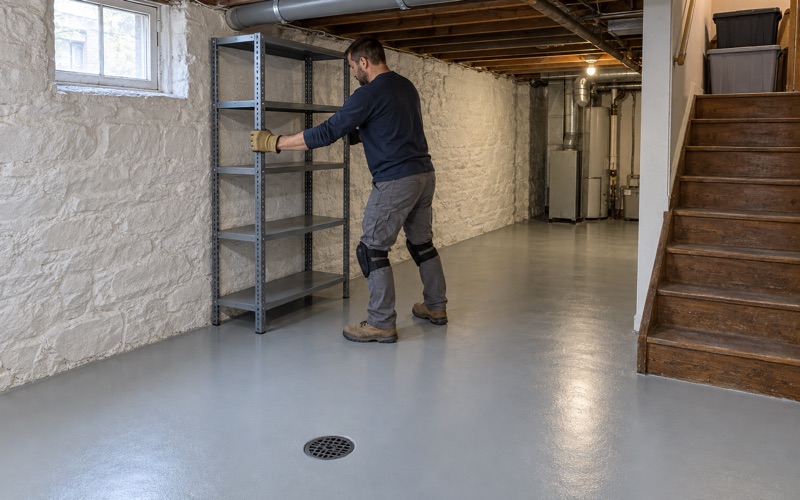
The same is true of anything set to level on a concrete floor: a workbench with a vise, a glass display case, a home gym rack or a long run of steel shelving. The flatter the slab, the less work the feet have to do, and the less resetting every move demands.
Looking for epoxy-flooring closer to Lyons? See Lyons Epoxy-Flooring.
A Coating Follows the Slab Instead of Leveling It
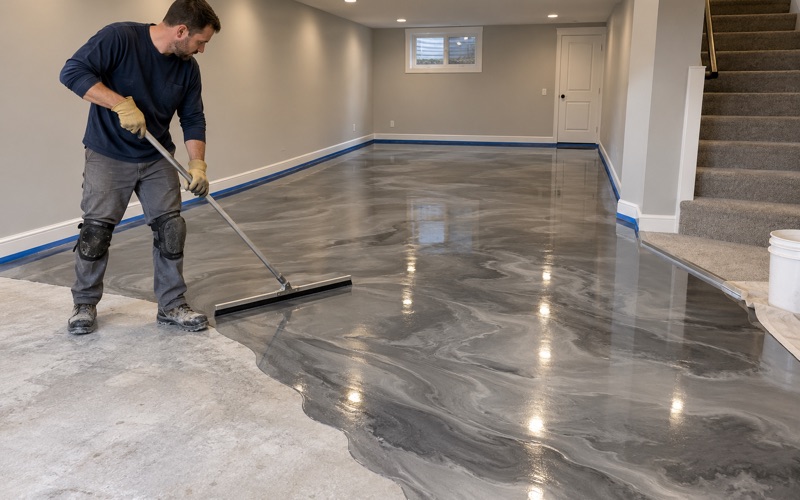
This is the point most often misunderstood about epoxy. A thin-build coating, whether 100% solids epoxy or a polyaspartic topcoat, is measured in mils, and it lies down on whatever surface it is given. Altro’s installation guide for its epoxy system puts it plainly: thin-bed synthetic resin systems follow the surface of the substrate.
So a slab with a low spot near the drain still has that low spot after coating, only now it is glossier. A ridge left by a screed still reads under a straightedge. The same guide sets a flatness tolerance for the substrate, calls for a surface improver suitable for an epoxy overlay wherever the floor falls short, and says high spots should be removed before the flooring goes in.
What self-leveling actually means
Some coatings are sold as self-leveling, and the term confuses a lot of property owners. It means the liquid flows out into an even film and hides roller marks. It does not mean the coating fills a dip or flattens a crown, because a coating simply does not carry enough material to do either one.
If you want a floor that is flatter after the job than before it, the flattening is its own step with its own line in the proposal. We would rather price that openly than let you discover later that a fresh coat made an old slope easier to see.
How we check a floor before quoting
We walk the slab with a long straightedge and a level, marking where it rocks, gaps or steps. That survey goes into the quote beside the crack reading, so the scope reflects the floor you actually have rather than an average one.
Moisture testing stays a line item no matter how flat the floor is, using ASTM F1869 calcium chloride tests or ASTM F2170 relative humidity probes on basement and garage slabs alike. Warranty exclusions are read out before the job is sold, with moisture named first, because a flat floor that blisters a month later is not a finished floor.
Grind the Highs, Fill the Lows, Then Coat
Taking the high spots down
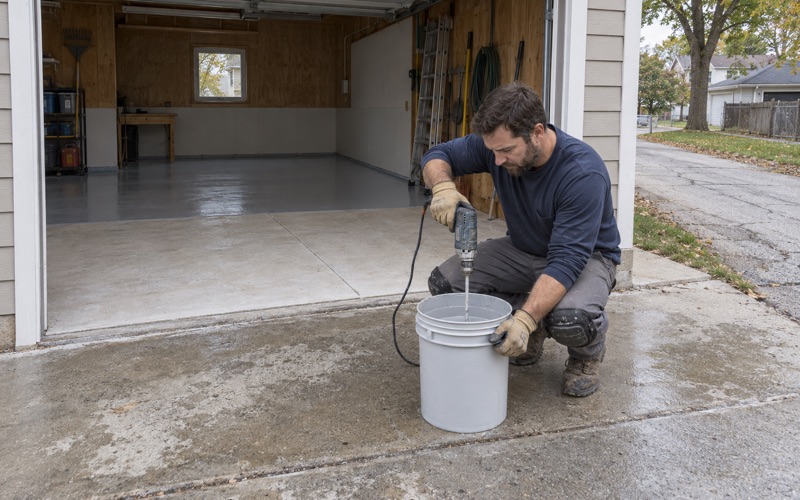
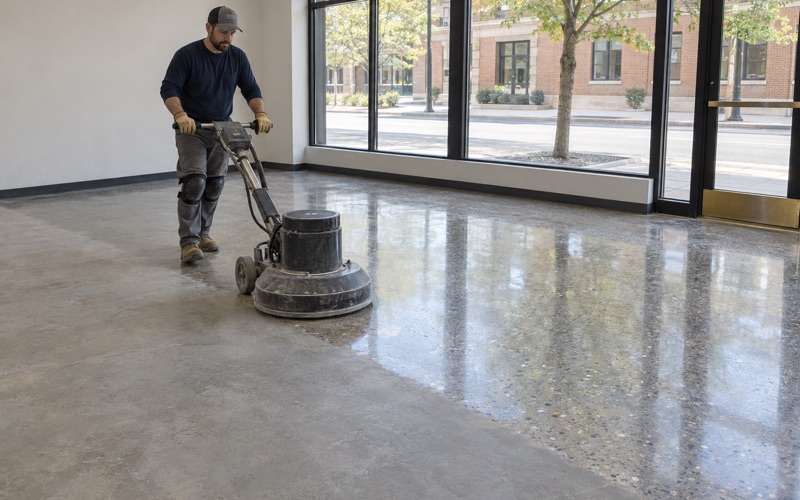
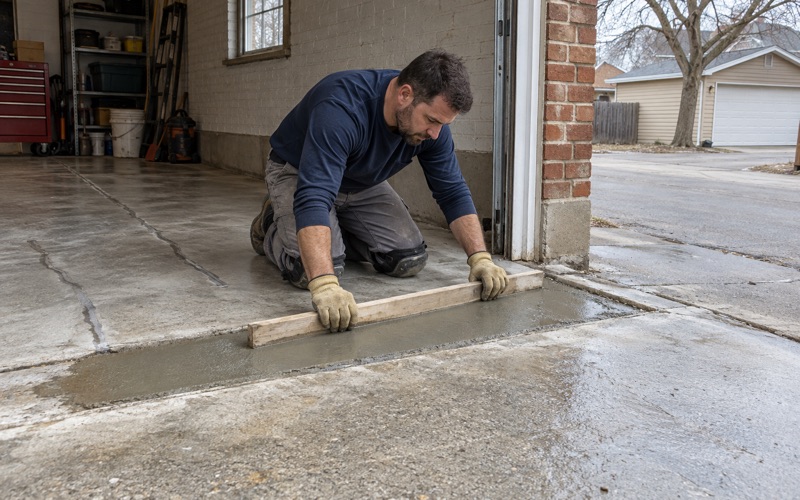
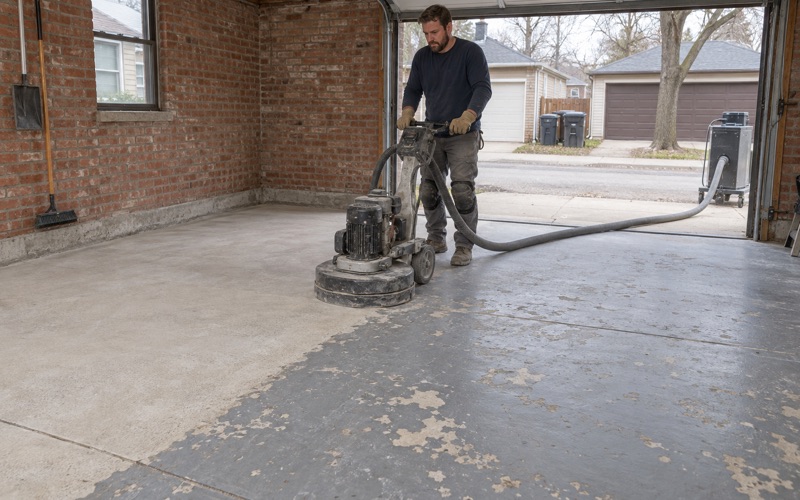
High spots come off with the diamond grinder, the same machine that opens the surface for bonding. On a crown or a trowel ridge we make extra passes and keep checking with the straightedge until it reads flat. Dust is collected at the machine with a vacuum shroud, never swept loose or washed toward a floor drain.
Grinding also leaves the ICRI surface profile the primer is written for, so the leveling work and the bonding prep happen in the same pass. On a detached alley garage we stage the grinder and vacuum from the alley, which keeps cords and hoses out of the house entirely.
Filling the low spots
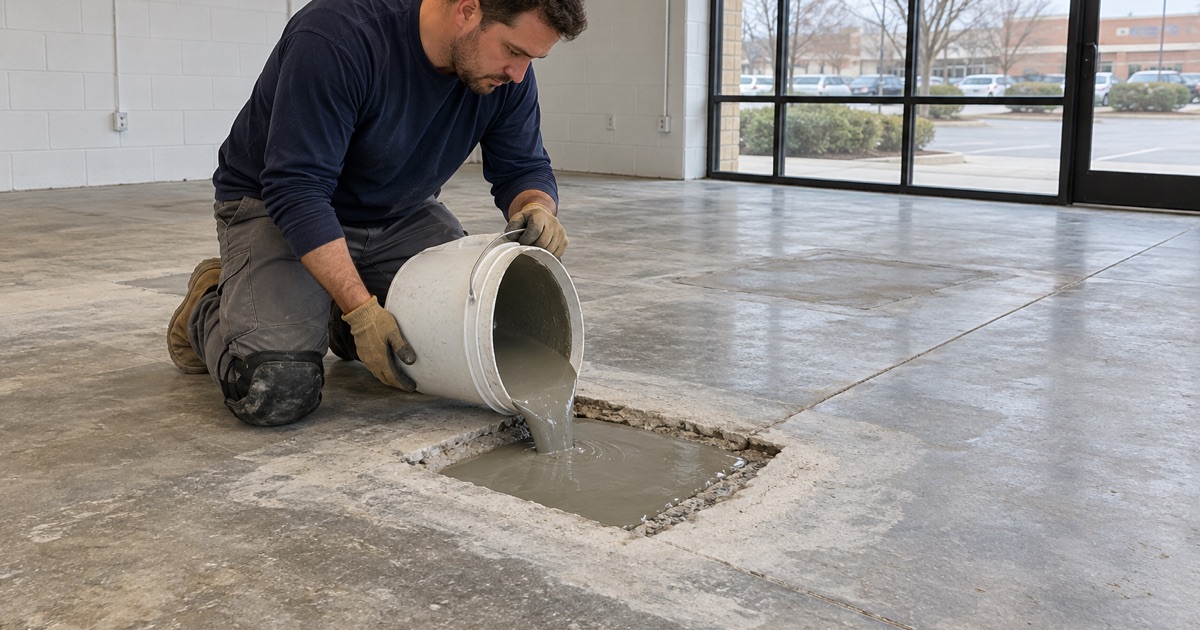
Low spots are filled, not coated thicker. Depending on the depth and the system going on top, that means an epoxy mortar, a resin patching compound, or a cementitious surfacing product the coating manufacturer approves to receive an epoxy overlay. Compatibility is the whole point, because a leveling layer the resin cannot bond to simply moves the failure up one layer.
Fills are feathered, allowed to cure and ground flush before primer goes down. Curing is scheduled against slab temperature and the dew point spread at the surface rather than the calendar. In an unheated detached garage during a Cook County winter, that sometimes means telling you plainly that the job waits for spring.
When a slab needs more than grinding
Some floors are past what grinding and filling can fix: a section that has settled and rocks underfoot, a heaved panel, or concrete that is broken through. When that is what we find, we recommend repair or replacement before any coating, because no resin will hold together a floor that is still moving beneath it.
We would rather lose a coating job than install one we know will crack along the same line within a season. The honest answer at the quote stage costs you less than a failed floor and a second round of grinding later.
Steel Leveler Feet and Heavy Cabinets on a Coated Floor
Choosing a system that takes point loads
Once the floor is flat, the next question is what it has to carry. Leveled equipment rests its whole weight on a few small steel feet, and that concentrated load is harder on a coating than tires or foot traffic. For floors like that we lean toward a full-build system rather than one thin coat.
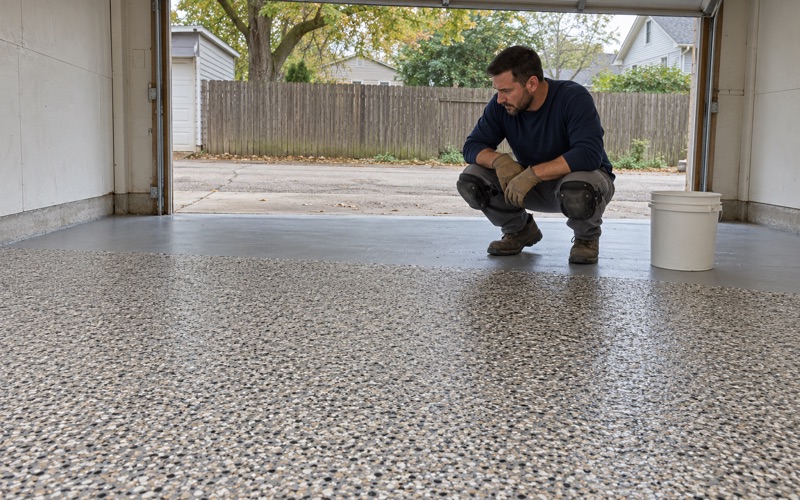
A typical build is a 100% solids epoxy base with a quartz aggregate broadcast, finished with a polyaspartic or polyurea topcoat that resists scratching. Quartz adds hardness through the thickness, so a steel foot pressing on one spot has more to push against. A vinyl flake broadcast looks good and hides dirt, and we will talk through which suits a room that holds heavy feet.
Moving cabinets without gouging the floor
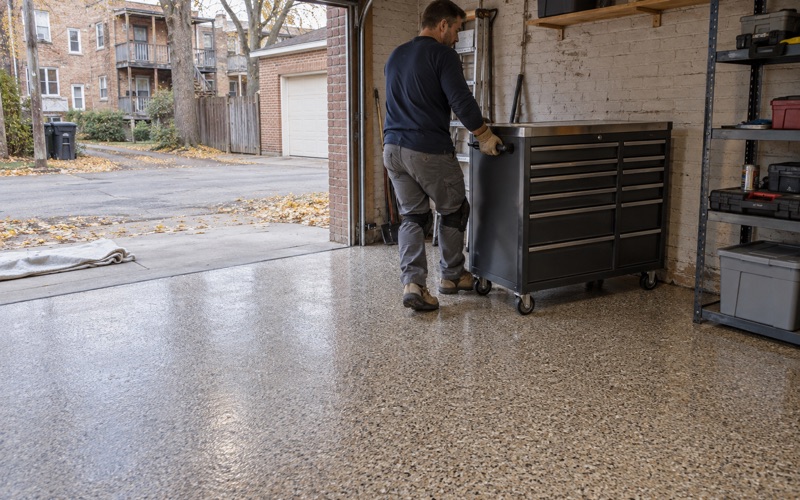
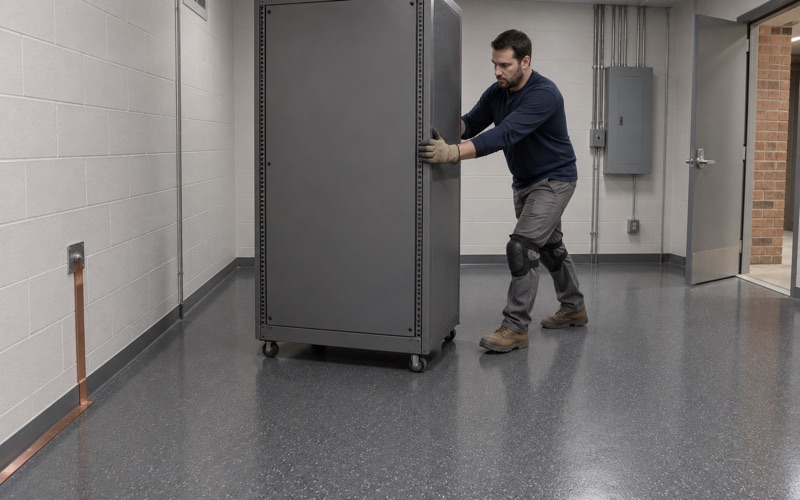
Heavy equipment should return only after the coating has fully cured, and that window depends on slab temperature, not the clock on the wall. When cabinets go back in, they should ride on dollies or furniture sliders. Dragged on bare leveler feet, they act like chisels on any resin surface, however hard it is.
Rubber or felt cups under each leveler spread the load and keep the bolt ends off the topcoat. After a move the levelers are reset on the new surface, and on a floor that was ground and filled flat first, that adjustment should be small and quick.
Working around a building that stays open
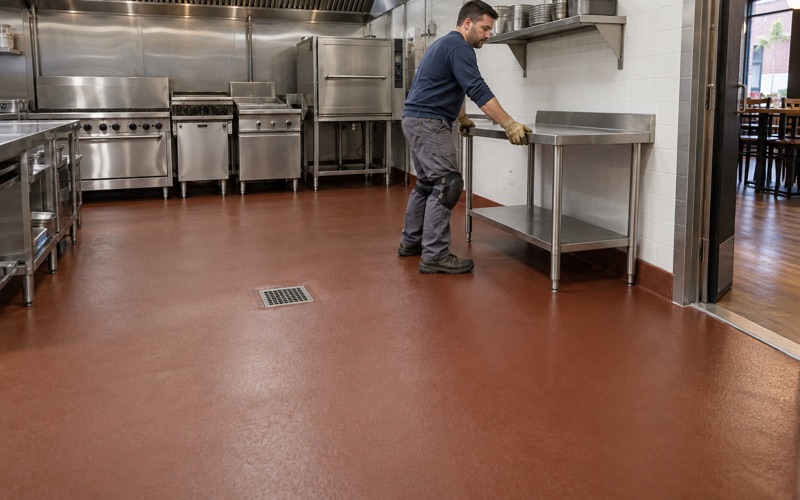
Rooms that are used every day leave little time for floor work. On storefront and commercial jobs we schedule around the hours the building has to keep running, including overnight and weekend windows, and we plan the system so the space returns to service on a predictable timeline.
Illinois issues no state license for flooring or coatings work, so we confirm the village’s own contractor rules before a job is scheduled. In Brookfield that means the village Contractor License and its License and Permit Bond, settled before our crew arrives with a grinder.
- 20+ Years Coating Concrete
- Moisture Tested Before Quoting
- Written Contract on Every Home Job