Oak Park Epoxy Flooring has spent more than 20 years putting down epoxy flooring in Burr Ridge and across the western suburbs, and the floors that teach us the most are the ones people cross in the wrong shoes. A coating that looks perfect on install day is really judged by what walks over it every afternoon for years. That is the question we start with on a home garage, a tenant space or a hospitality floor.
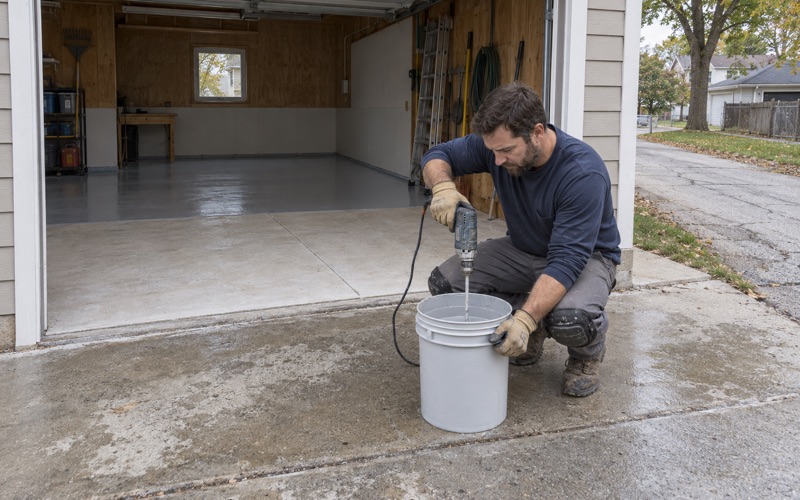
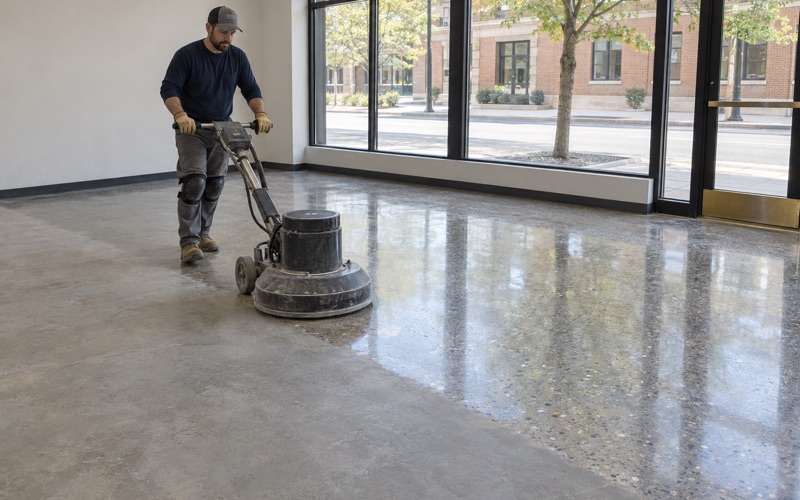
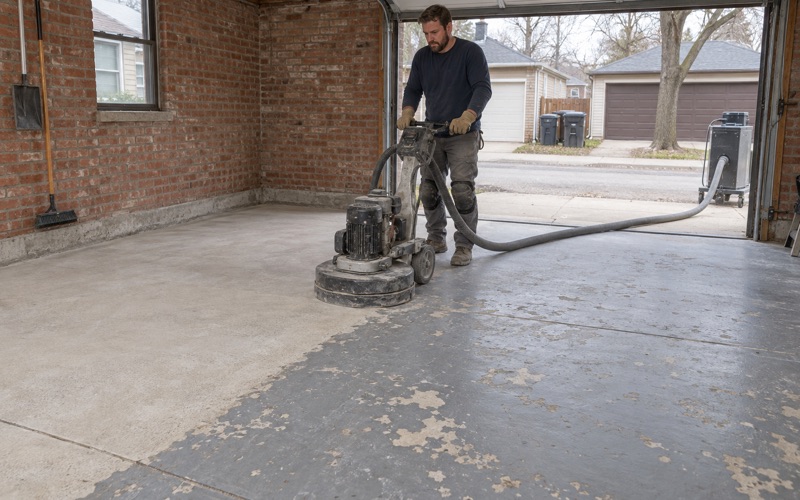
Before we price anything, we plan to open the slab with a diamond grinder or a shot blaster, because a resin is only as good as its bond, and we never acid etch. Moisture testing is written into the scope as its own line, and we read the cracks and any old coating first. If the concrete needs repair or replacement before it can carry a coating, the proposal says so in plain words.
That proposal also names the product, the system build and the finished thickness, so you can hold what went down against what was quoted. Below, we walk through one of the harder traffic patterns a floor can face here: the route a golfer takes from the course straight into a clubhouse, still wearing the shoes that gripped the fairway.
Edgewood Valley’s Rebuilt Clubhouse and the Walk In From the 18th Green
Edgewood Valley Country Club sits at 7500 Willow Springs Road, and although its mail is addressed to La Grange, the property geocodes inside Burr Ridge village on the Lyons Township, Cook County side. The club completed a significant renovation of its clubhouse in August 2024, closing out an $18 million project that Patch reported on the summer before. The builder describes restored masonry and timber trusses and a complete rebuild of the clubhouse’s two stories.
A members’ bar that opens onto the course
The club’s own account of the finished work says the members’ bar beside the dining area opens up to the patio facing the 18th green. For anyone finishing a round, that is a lovely arrangement, and for anyone planning floors, it is a design problem. A golfer can leave the last green, cross the patio and stand at the bar without ever changing shoes.
We want to be clear about what we know and what we do not. Edgewood Valley is a private club and a local landmark, not a customer of ours, and we have not seen its floors, its shoe rules or anything behind its public rooms. We use it here because it shows, in one well-known building, a traffic pattern that any clubhouse, pro shop or course-side restaurant has to plan for.
Mapping the golf-shoe route
In a clubhouse laid out like that, the path from the patio doors runs through corridors, past the bar and into restrooms and whatever bag or changing rooms the building has. Every hard floor along that path takes the same traffic: soles built to grip turf, carrying whatever the course left on them. We treat the whole path as one floor zone when we plan a coating, rather than pricing it room by room.
Carpeted dining rooms and lounges along the way are a separate question with a separate answer. Our part of the job is the hard-surface route, where a resin system over concrete carries the load. Drawing that line early keeps the transitions between carpet, rubber and coating tidy, and it stops anyone expecting one material to do another material’s work.
Looking for epoxy-flooring closer to Evergreen Park? See Evergreen Park Epoxy-Flooring.
What Spikes and Lugged Soles Do to a Floor
Golf shoes are designed to bite. Whether they carry replaceable spikes or the molded, aggressively lugged soles many players wear now, the contact points are small and hard. A golfer’s weight lands on a handful of points instead of spreading across a heel and toe, and that pin-point pressure is what dents soft finishes and wears through thin films.
Point load and grit arrive together
The second problem rides in with the first. A spiked or lugged sole packs bunker sand, soil from the tee boxes and fine grit from cart paths into its tread, then sheds it a few steps inside the door. Every step after that drags the grit across the surface like sandpaper pressed under a small, concentrated weight.
That combination is why the first few yards inside a patio door wear first and worst on almost any floor. On a coated surface it shows up as a dull lane where the gloss has been scratched away, then as scuffs that cut into the topcoat. If the coating is thin or poorly bonded, the edges of a worn patch can begin to lift and chip.
Why the slab underneath decides the result
A topcoat cannot outperform the concrete it sits on. If the slab has a weak, dusty surface, an old sealer or a patch that never bonded, concentrated heel loads will find it and the coating will fail there first. That is why we read the slab before anyone talks about color or finish.
On a commercial slab we may use ASTM F2170 in-situ relative humidity probes or ASTM F1869 calcium chloride testing, depending on the concrete and the system we are proposing. A floor that looks dry can still push vapor up from below and blister a coating from underneath. Moisture is also the first exclusion we read out on any warranty, before the job is sold rather than after.
Spike-Rated Carpet and Rubber, and Where Resin Fits
Clubs have managed spike traffic for a long time, and the traditional answers are not resin. Golf trade magazines of the 1950s and 1960s were already selling rubber floors for locker rooms, pro shops and the 19th hole. Matting suppliers today sell country-club rubber tiles described as resistant to golf spikes, dropped golf bags and heavy foot traffic.
What BS 7044 does and does not cover
Carpet for golf clubs is often specified to BS 7044, a British spike-resistance standard that one floorcovering supplier recommends for corridors where spiked or aggressively textured golf shoes pass. It is a carpet standard. It describes how a carpet holds up, it says nothing about a resin coating, and we never describe our own systems as meeting it.
If a clubhouse corridor or lounge is carpeted, the spike rating is a question for the carpet manufacturer. We are glad to plan the transitions where carpet meets a coated floor, with clean edges and no trip lip. What we will not do is answer for the carpet itself, because that would be guessing on someone else’s product.
Where a resin floor earns its place
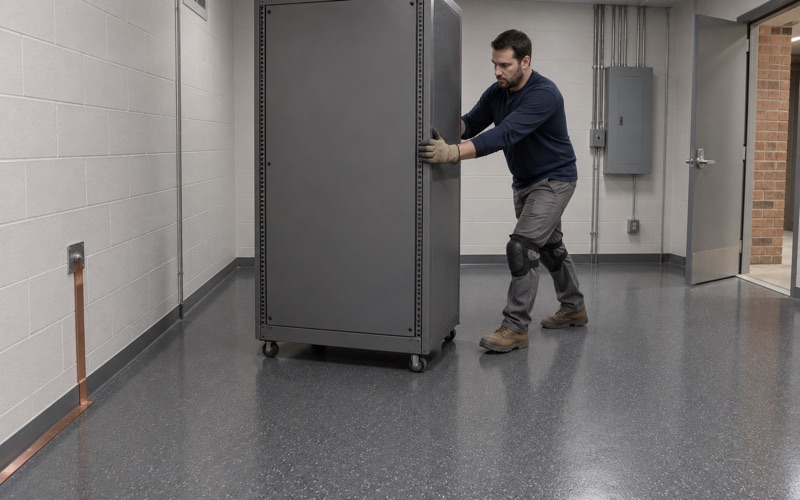
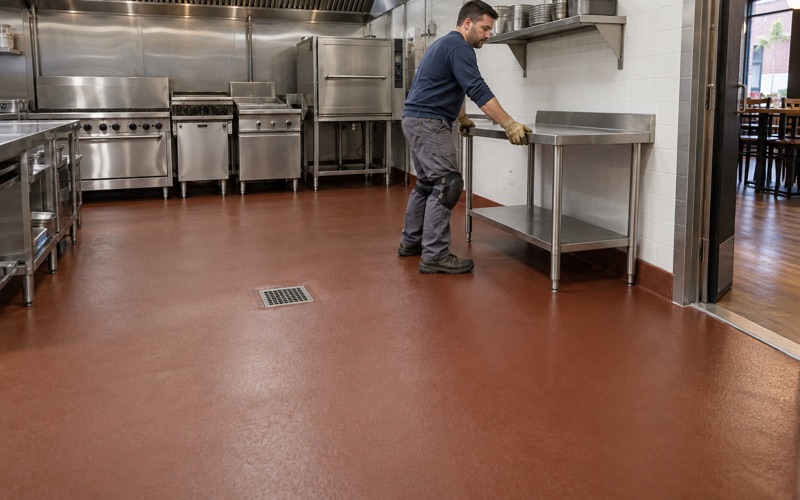
Resin makes sense on the hard-surface stretches of the route: a concrete entry, a service corridor, a restroom, a pro shop or a bag room where carpet would trap grit and rubber would need replacing. Those rooms also take spills, cleaning chemicals and constant mopping, which a sealed, seamless floor handles well. The goal is a surface that wears slowly and can be renewed.
No resin floor is immune to a golf spike, and anyone promising otherwise is overselling. What a well-built system does is resist abrasion, hold its texture and let wear show up as dulling in a topcoat that can be recoated. That is a far better outcome than chips down to bare concrete that need a patch every season.
Topcoat, Broadcast and Walk-Off Matting for a Golf-Shoe Floor
For a route that takes cleats, we start exactly as we would on any floor, by mechanically profiling the slab to the ICRI CSP range the primer calls for. Grinding or shot blasting opens the surface so the first coat bonds into sound concrete, not onto weak paste or an old sealer. Cracks and joints are repaired before the build begins.
A hard topcoat over a fine broadcast
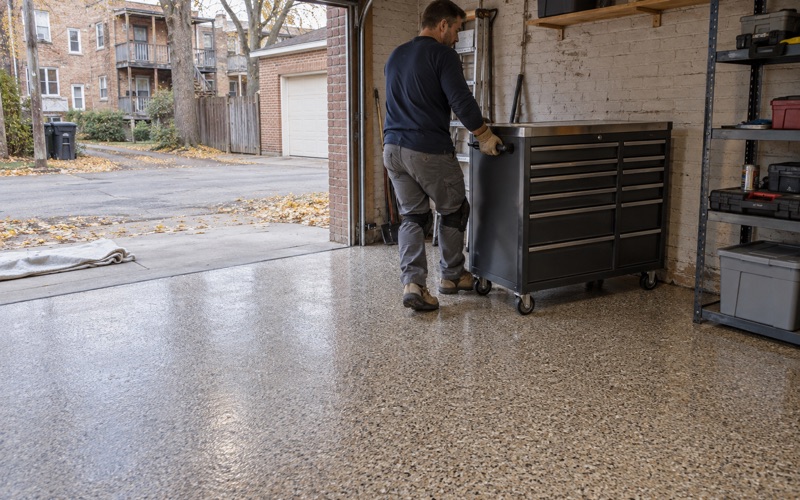
Over a 100% solids epoxy body coat we typically broadcast a fine quartz aggregate, which gives the floor both slip resistance and a hard wearing face. The broadcast has to be fine and fully locked down, because a coarse or loosely bound grain is exactly what a spike can pluck free. The topcoat seals that aggregate in place and becomes the layer that takes the wear.
For that topcoat we usually look at polyaspartic or polyurea chemistries for their abrasion resistance, chosen within the Illinois VOC limits for floor coatings. The written proposal states the product, the full system build and the finished thickness, so a manager or owner can check it years later. Cure windows are set against slab temperature and dew point, not the calendar.
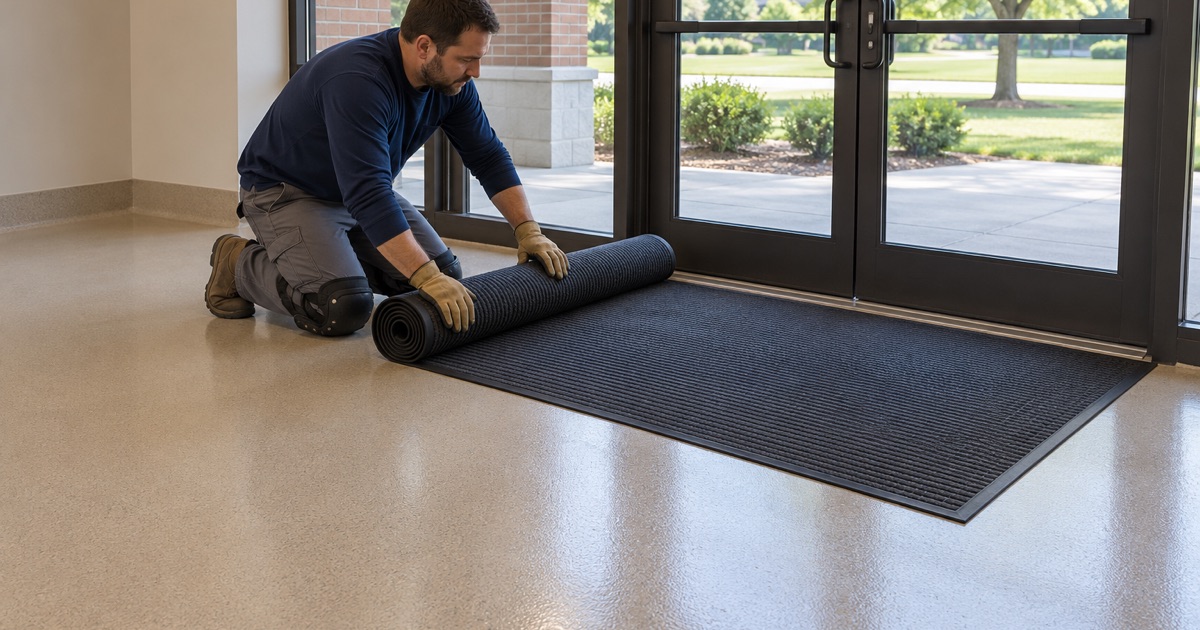
Walk-off matting at the patio doors
The cheapest protection for a coated floor is stopping the grit before it gets inside. Walk-off matting at the patio doors catches much of what golf shoes carry in during the first few strides, which is exactly where the wear would otherwise concentrate. We plan a coated route with matting at every door to the course, not as an afterthought.
Matting also needs a place that does not hold water against the coating. We detail the floor so mats sit flat, their edges do not catch a toe, and the area beneath them can be cleaned. A mat that is lifted and swept on a routine protects the topcoat far longer than one left to fill with sand.
Scheduling around a working building
A clubhouse, restaurant or pro shop cannot close for a week while its floor is redone. We schedule commercial work around the hours a building has to keep running, including overnight and weekend windows, and we phase a route so one section cures while another stays open. Because Illinois issues no state license for coatings work, we confirm the Village of Burr Ridge’s own contractor rules before the dates are booked.
- 20+ Years Coating Concrete
- Moisture Tested Before Quoting
- Written Contract on Every Home Job