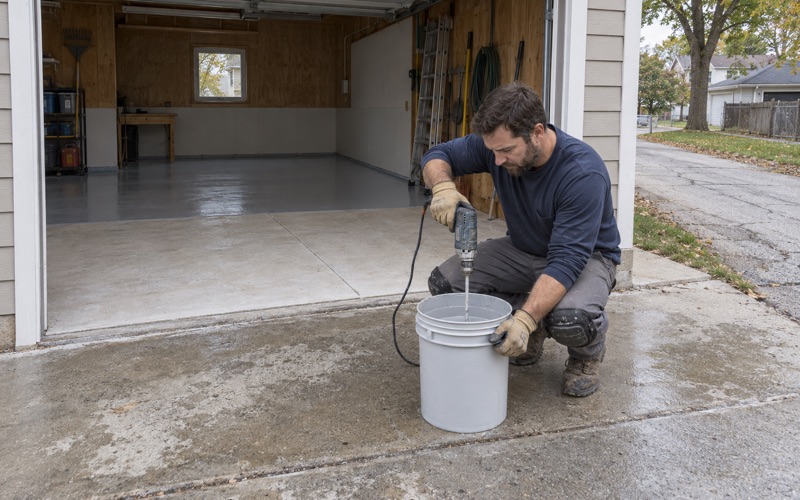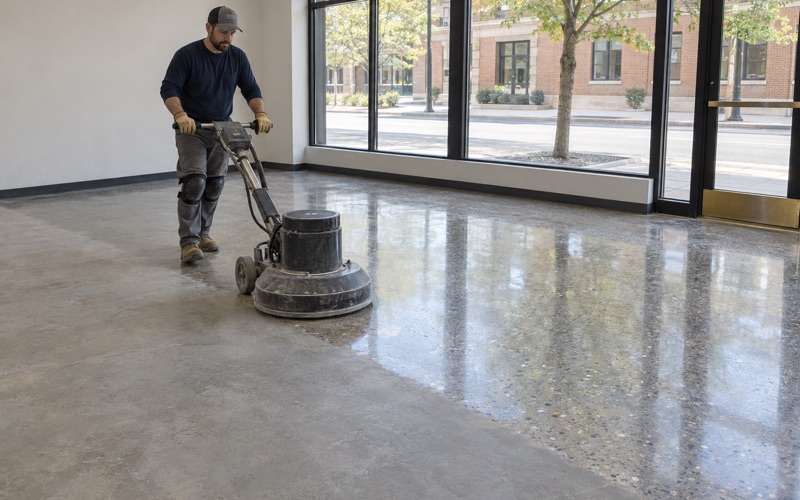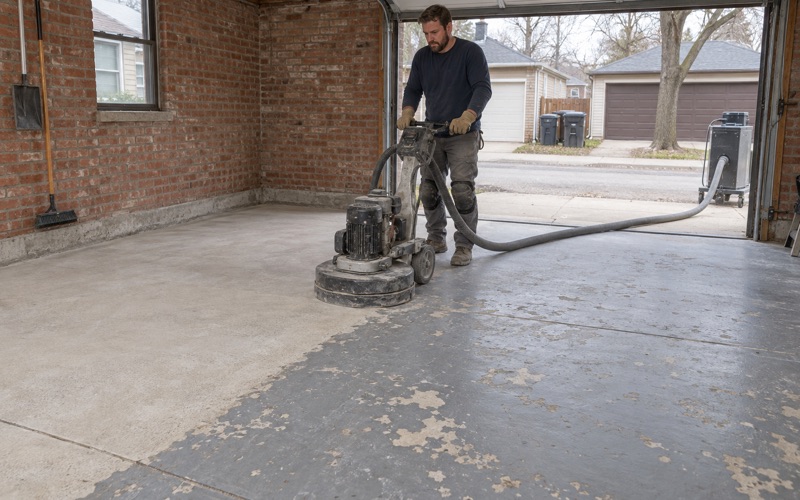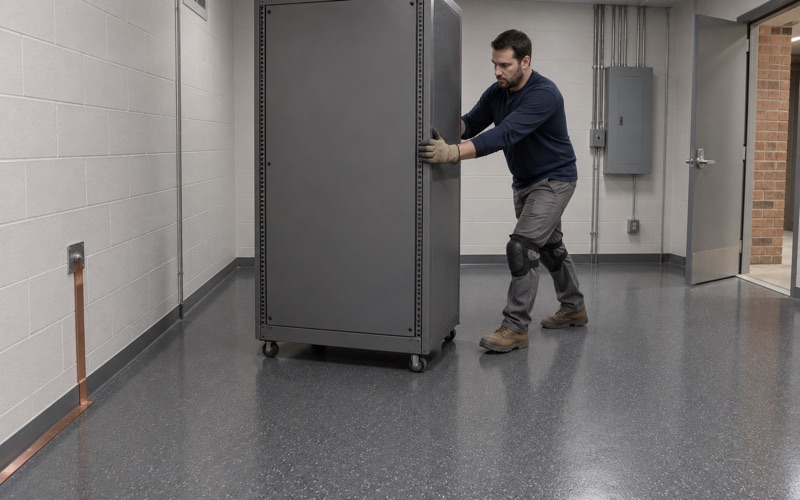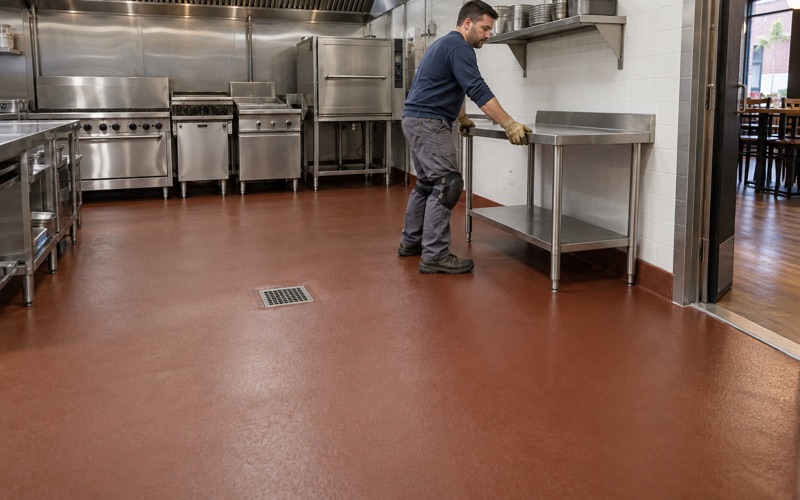
Oak Park Epoxy Flooring brings more than 20 years of epoxy-flooring in Chicago Ridge and the rest of Cook County to slabs that have to handle wet, messy work. Our jobs here run from garage and basement floors to food and service spaces, and every one starts the same way. We open the concrete with a diamond grinder or a shot blaster, and we never acid etch a slab to save time.
Before anything is mixed, we test for moisture as a priced line in the scope rather than an upsell after a floor has blistered. That might be an ASTM F1869 calcium chloride test, ASTM F2170 in-situ relative humidity probes, or a quick ASTM D4263 plastic sheet check on a garage. The written proposal then names the product, the system build and the finished thickness, so you can hold what was quoted against what went down.
This page is about one particular demand on a floor: catching what falls during meat cutting and game processing with nothing spread on top. Blood, trim fat and meltwater are hard on concrete, and the old answer to them is no longer allowed in food shops. Here is how that history shapes the floors we build.
A Butcher Shop on Ridgeland Avenue and the Sawdust That Is Gone
Jack & Pat’s and the old-fashioned trade
Chicago Ridge still has an old-fashioned butcher shop. Jack & Pat’s, at 10717 S Ridgeland Ave, describes itself as a family owned and operated shop that specializes in high-quality custom cuts and customer service. It also runs a full-service deli, sells Irish imports, caters, and puts out daily homemade dinners.
The shop keeps hours of 9:00 a.m. to 6:00 p.m. Tuesday through Saturday and 9:00 a.m. to 3:00 p.m. on Sunday, and it is closed Monday. The address sits inside the village limits in Worth Township, Cook County. We have no connection to the shop and have never seen its cutting room, so it appears here only as a reminder of a trade the village still supports.
Why butchers once kept sawdust underfoot
For generations, butcher shops strewed sawdust across the floor and refreshed it daily. It caught blood and bits of fat as they dropped from the block, and it gave cutters something to grip on a floor that would otherwise turn slick within an hour of work. In a trade built on knives and heavy carcasses, footing was a safety matter rather than a comfort.
Sanitation concerns eventually led many cities to ban sawdust floors where food was produced or sold. Tile, marble and granite replaced wood because they cleaned more easily, and the sawdust that soaked up drips also held them against the floor until someone swept it out. The old-fashioned butcher shop survived, but its old-fashioned floor did not.
The job the sawdust left behind
Taking the sawdust away did not take away the drips. Blood still runs off the block, trim fat still falls, and meltwater still comes off product moving out of cold storage. Once nothing is allowed to sit on the floor soaking all of that up, the job falls to the floor surface itself.
Looking for epoxy-flooring closer to Palos Hills? See Epoxy-Flooring Services in Palos Hills.
What the Food Code Says About Sawdust, Shavings and Salt
The FDA Food Code 2022 is blunt about this in section 6-501.17, titled Absorbent Materials on Floors, Use Limitation. Sawdust, wood shavings, granular salt, baked clay, diatomaceous earth, or similar materials may not be used on floors. The only exception it allows is the one written into 6-501.13(B).
The spill exception
Under 6-501.13(B), a spill or drippage between normal cleanings may be handled with a small amount of absorbent compound such as sawdust or diatomaceous earth. The absorbent has to be applied immediately before spot cleaning, then picked up with the spill. It is a tool for one puddle, not a standing layer across a cutting room.
Otherwise, 6-501.13(A) limits floor cleaning to dustless methods: wet cleaning, vacuum cleaning, mopping with treated dust mops, or sweeping with a broom and dust-arresting compounds. Every one of those methods assumes a floor that can be mopped and wet-cleaned without harm. Bare, porous concrete takes on whatever lands on it, and old cracked tile holds grime in its joints.
Who answers the code questions here
The Food Code is a federal model code, and a state or local authority adopts and enforces it. The village’s hazard mitigation annex lists the Cook County Department of Public Health, under a Board of Health adopted in 1978, as the public health authority for Chicago Ridge. Questions about whether a particular shop meets the code belong with that department, not with a flooring crew.
We want to be straight about the limits of our work. A floor coating on its own settles no question of compliance, and we do not advise owners on health inspections. What we can do is build a surface that is smooth, sealed and easy to wet-clean, with the antislip texture the code permits for safety reasons.
Letting the Floor Do the Sawdust’s Job
With sawdust gone, the floor has to do three things the sawdust once did. It has to keep blood, fat and meltwater out of the concrete, it has to give footing on its own, and it has to let a mop reach every edge. We build each system around those three needs.
Sealed and seamless
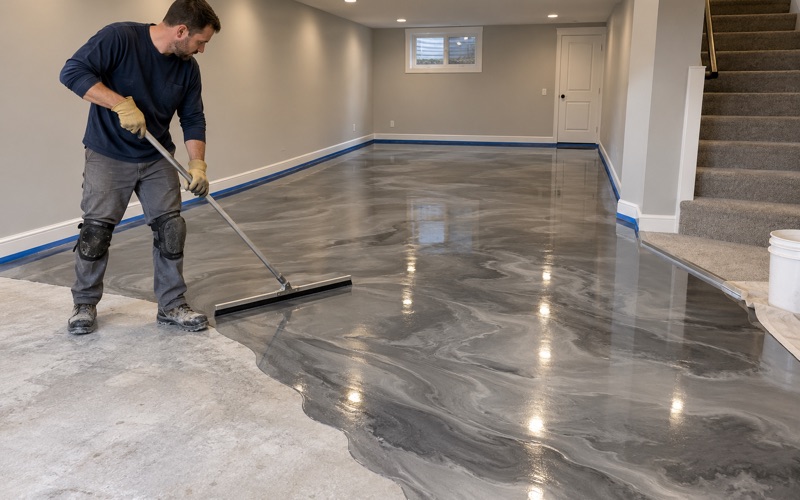
Concrete is porous, and blood and trim fat soak into an uncoated slab and stay there. A 100% solids epoxy base, laid over a slab ground to the right ICRI CSP profile, seals the surface in one continuous film with no grout lines to collect residue. Joints and cracks are filled and bridged first, so the finished floor has no seams where drips can work their way down.
Fat is the harder test. Polyaspartic and polyurea topcoats hold up well under it, and in rooms that see hot wash water or the cold of a walk-in cooler, urethane cement is often the better system. We name which one we are proposing and why, along with its finished thickness, in the written quote.
Texture in place of sawdust
Sawdust gave a cutter’s boots something to bite into, and a smooth epoxy film wet with blood gives nothing. We replace that grip by broadcasting quartz aggregate into the wet coat and locking it under the topcoat. The size of the aggregate and the number of topcoat passes set how aggressive the finished texture feels.
There is a trade-off to weigh. More texture means better footing but a floor that takes more effort to mop clean, while too little leaves a wet floor slick. We set the profile zone by zone, with heavier grip at the cutting block and the meat grinder and lighter texture where foot traffic is light.
Coved junctures a mop can reach
The corner where floor meets wall is where sawdust used to pile up and where drips now collect. A coved base, built up from the floor in the same resin and carried a few inches up the wall, turns that square corner into a curve a mop can follow. The Food Code treats coved floor and wall junctures in section 6-201.13, and we build the cove as part of the floor system rather than as an add-on.
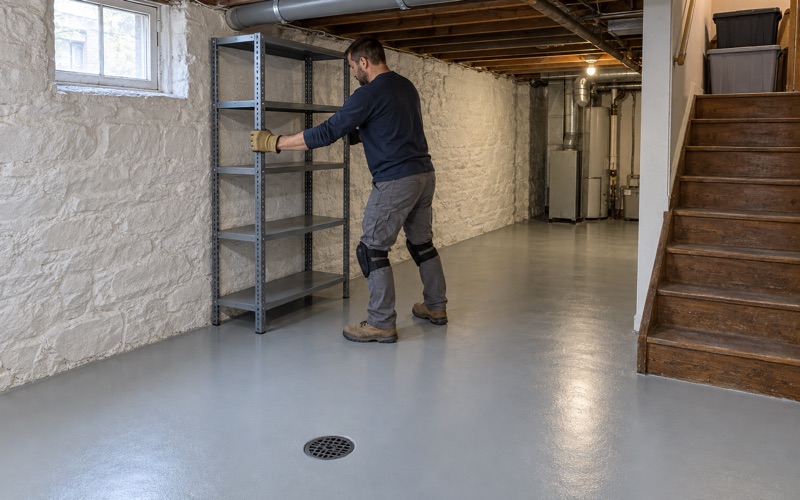
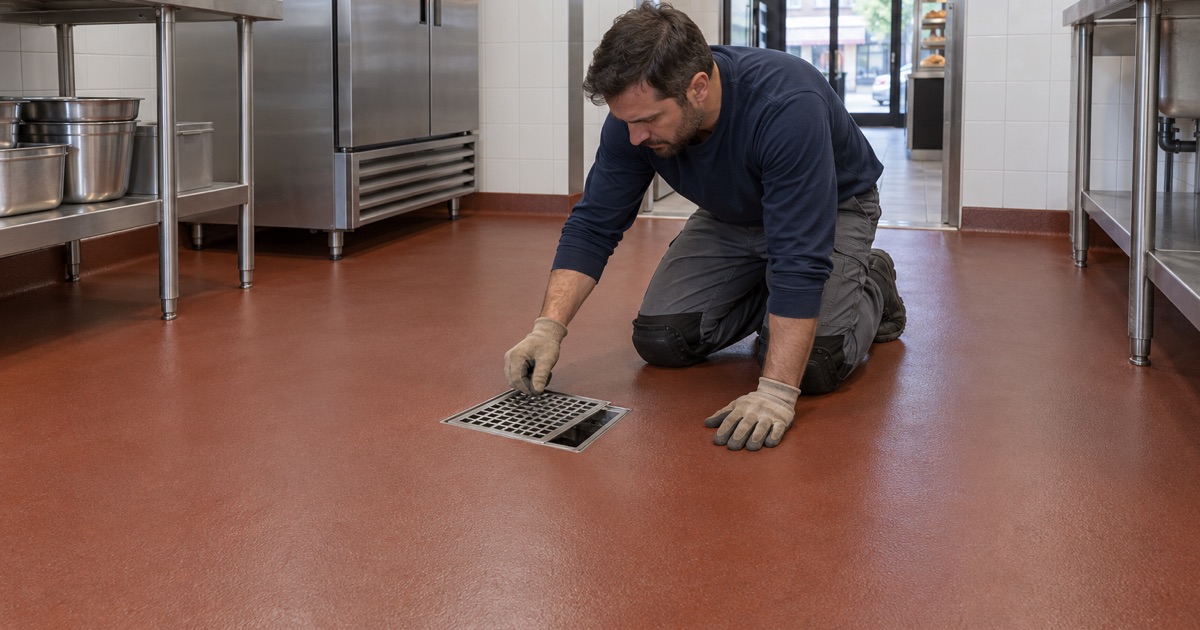
Floor drains get the same attention. The coating is turned down into the drain body and kept sloped toward it, so wash water and spilled liquid run off instead of pooling at the edges. Where a slab has no fall to a drain, we say so before the job is sold rather than after.
Processing Deer and Game on a Chicago Ridge Garage Floor
The same problem turns up at home every fall. Hunters who break down deer or other game in the garage end up with a butcher’s mess on a residential slab: blood, trim fat, bone dust and meltwater from quarters brought in from the cold. Concrete that was never sealed keeps the stain and the smell long after the season ends.
Building a garage slab for cutting work
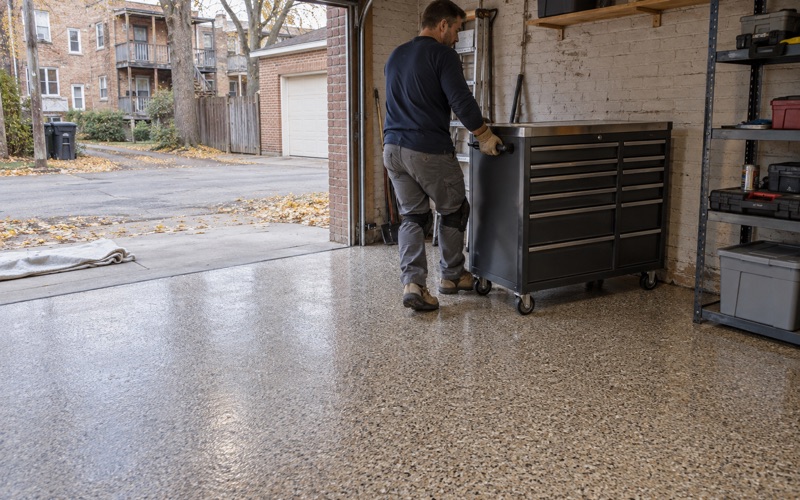
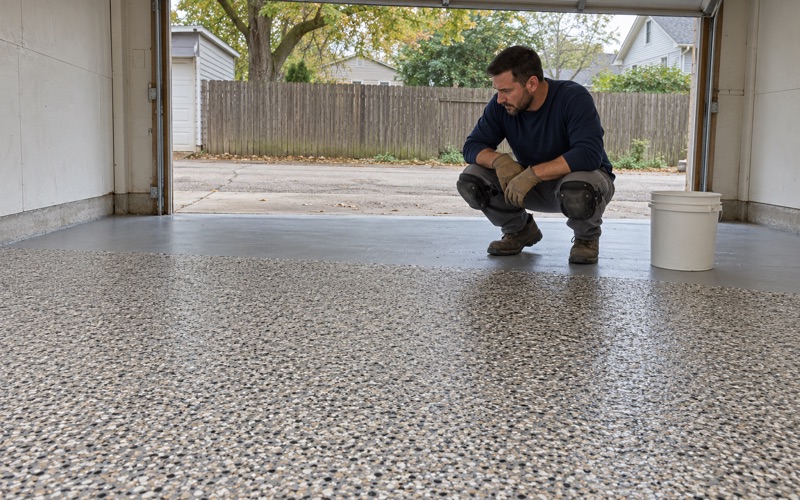
We grind the slab, fill the cracks, and lay a 100% solids epoxy base with a vinyl flake or quartz aggregate broadcast and a polyaspartic topcoat. Texture is set heavier where the processing table stands, because boots on a bloody floor need grip. A short coved base along the back wall keeps drips from settling into the joint between slab and foundation.
The same floor also has to get through winter. The calcium chloride brine and rock salt that a Cook County winter tracks in on the tires attack bare concrete, and we build the system to take them. Hot tire pickup, where a weak coating lifts under warm tires, is avoided by bonding to a properly ground profile rather than a smooth, sealed-over slab.
Moisture and curing come first
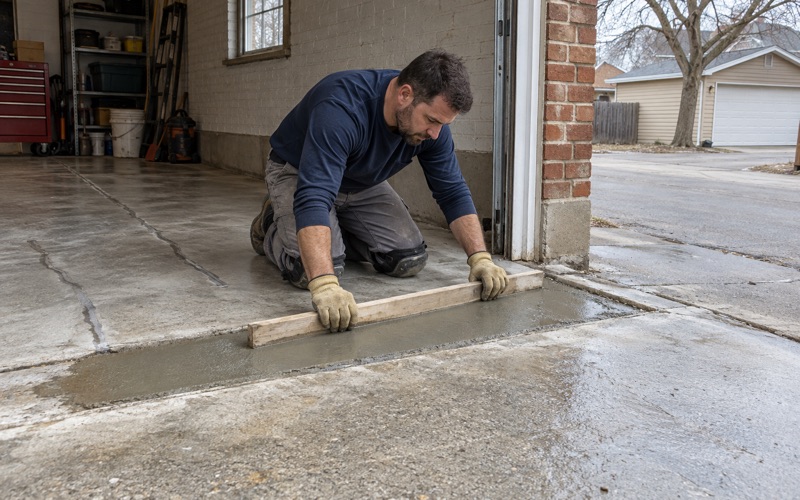
Before we quote a garage or basement processing area, we read the cracks and any old coating and test for moisture. If the slab needs repair or replacement before it can be coated, we say so plainly. Warranty exclusions are read out before the job is sold, with moisture named first, because it is the most common reason a coating lets go.
Curing is scheduled by slab temperature and the dew point spread at the surface, not by the calendar. An unheated detached garage in January will not cure a coating properly, and in that case we tell you the work has to wait for spring. Done that way, the floor is ready well before the next deer season.
Registration and the written contract
The village’s permit materials require contractors to register at Village Hall, 10455 S. Ridgeland Avenue, before a permit is issued. For a general contractor that means a $100 registration fee, a current certificate of insurance and a $10,000 surety or performance bond. The village’s permit sheet says construction or remodeling work on or in any building needs a permit, and it does not list floor coating as exempt.
Illinois issues no state license for flooring or coatings work, so we confirm the village’s rules before a job goes on the schedule. Every home job also gets a written contract and the Home Repair: Know Your Consumer Rights pamphlet before work starts, as the Illinois Home Repair and Remodeling Act requires. Our coatings are chosen within the Illinois VOC limits, which bind the installer as well as the manufacturer.
- 20+ Years Coating Concrete
- Moisture Tested Before Quoting
- Written Contract on Every Home Job