
Oak Park Epoxy Flooring installs commercial kitchen flooring in Oak Park, IL, serving surrounding cities including River Forest, Forest Park, River Grove, Bellwood and Brookfield. In more than 20 years of resin floor work, we have seen that kitchens are where ordinary coatings fail first, so we build kitchen floors from systems made for hot water, grease and daily scrubbing.
A restaurant or institutional kitchen floor takes boiling spills, hot oil, steam cleaning, sanitizers, dropped pans and rolling racks, often all in one shift. It also has to pass health inspection, drain properly and stay safe to walk on when it is wet and greasy.
Our proposals for kitchen floors specify the system, the thickness, the cove height and detailing, the texture and the closure schedule. We walk the kitchen with the owner or chef and plan around equipment, drains and the hours the business needs to stay open.
Systems Built for Commercial Kitchens
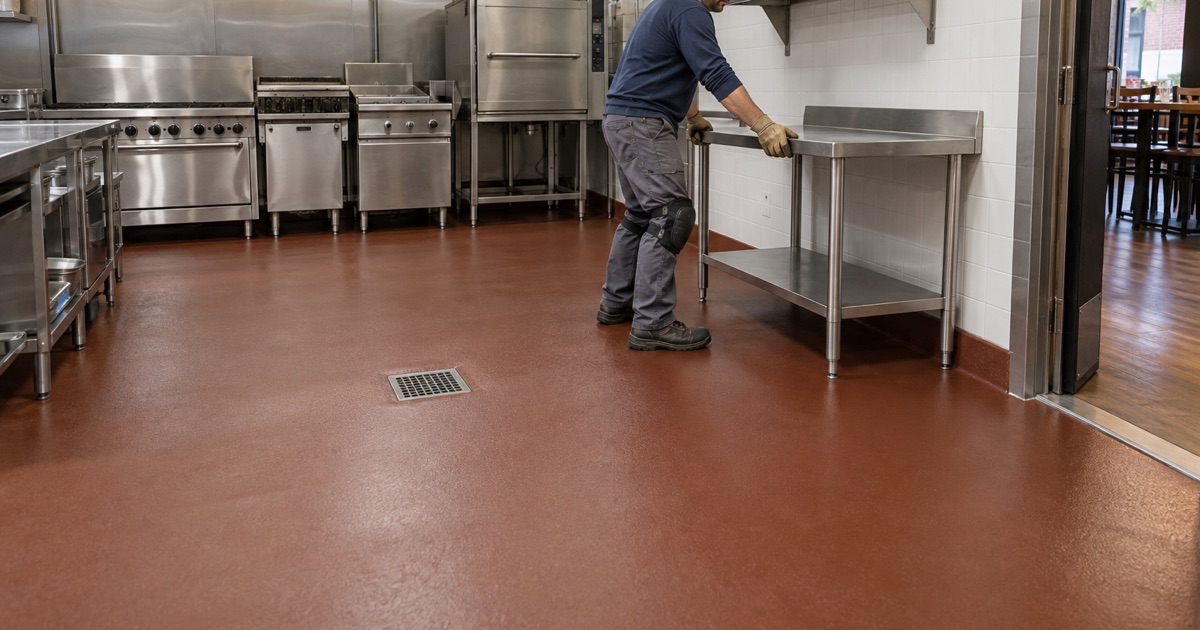
Urethane Cement
Urethane cement, sometimes called urethane mortar or urethane concrete, is the standard resin system for busy commercial kitchens. It combines a urethane resin with cement and aggregate, and it handles thermal shock, hot water and steam cleaning that would soften or crack a standard epoxy.
It also tolerates more moisture in the slab than most epoxies, which helps in older buildings without a vapor retarder. Depending on the area, we install it as a troweled mortar for heavy-duty zones or as a thinner slurry with broadcast aggregate.
Epoxy Systems in Dry Food Areas
Not every food-service area sees hot washdown. Dry storage rooms, front-of-house counters, bakeries and some prep areas can use epoxy systems with quartz or flake broadcast, which offer a wider range of colors and a smoother finish.
We look at where hot water, steam and oil actually land and split the kitchen into zones, so each area gets the system it needs rather than paying for urethane cement where it is not required.
Quartz Broadcast and Slip Resistance
Kitchen floors need texture. Colored quartz aggregate broadcast into the system and locked in with a topcoat gives slip resistance that does not wear away, and the amount of texture can be adjusted by area.
The FDA Food Code requires floors to be smooth, durable and easily cleanable, but it expressly allows antislip floor coverings or applications used for safety reasons. We balance grip against cleanability so the floor is safe and can still be scrubbed and squeegeed quickly.
Coves, Drains and Details
Integral Coved Bases
The joint between a floor and a wall is where dirt, grease and water collect and bacteria grow. An integral cove carries the resin floor up the wall in a continuous curve, typically several inches high, so the floor and base are one seamless surface.
The Food Code calls for floor and wall junctures to be coved and closed where floors are cleaned without water flushing, and for a sealed coved base where water flushing is used. We form coves around walls, columns, equipment curbs and door frames.
Floor Drains, Trench Drains and Slope
Kitchen floors must drain. We tie the resin system tightly into floor drains and trench drains so water and grease cannot get under the coating at the drain edge, which is one of the most common failure points. Where water ponds because of low spots, we can correct the slope toward the drains with a sloped mortar layer before the topcoat.
Equipment Curbs and Transitions
Walk-in coolers, freezers, cooking lines and dish areas all have curbs, thresholds and edges that need careful detailing. We terminate the system in saw-cut keyways at transitions and doorways so the edges stay locked down under carts and foot traffic.
Health Review and Compliance
Oak Park Public Health Department Plan Review
Food businesses in Oak Park answer to the village’s own Oak Park Public Health Department, a state-certified local health department that reviews construction plans for new and remodeled food businesses. They do not go through the Cook County health department. We coordinate the floor, cove and drain details with your plans and confirm requirements with the department rather than assuming another jurisdiction’s rules.
Food Code Floor Requirements
The FDA Food Code sets the framework most health departments follow for floors: smooth, durable, easily cleanable and nonabsorbent surfaces, coved and sealed floor and wall junctures, and floors that can be kept in good repair. A seamless resin floor with an integral cove meets those goals better than tile with grout lines.
VOC Limits on Kitchen Coatings
Illinois limits the VOC content of floor and industrial coatings, and those limits apply to the contractor applying them. We use compliant products and keep the data sheets available for your records.
Installing Around a Working Kitchen
Preparation and Removing Old Floors
Old quarry tile, failed coatings and grease-soaked concrete have to come out or be ground off before a new system can bond. We remove tile, grind or shot blast the slab and degrease contaminated areas, because grease left in the concrete will push a new floor off from below. We test the slab for moisture with ASTM F1869 calcium chloride kits or ASTM F2170 relative humidity probes and choose the system accordingly.
Scheduling Closures and Phased Work
Restaurants and institutional kitchens rarely want to close for long. We phase the work, schedule overnight and weekend shifts and use fast-curing urethane cement systems so the kitchen returns to service as quickly as possible. The proposal lists each phase, the hours we will work and the time each area can take foot traffic, equipment and full operations again.
Care and Cleaning
Urethane cement and textured resin floors clean well with a deck brush or auto-scrubber and a degreasing cleaner. We leave written cleaning guidance, and we recommend inspecting cove edges and drain connections periodically so small repairs are made before water can get under the floor.
- 20+ Years Coating Concrete
- Moisture Tested Before Quoting
- Written Contract on Every Home Job