Oak Park Epoxy Flooring brings more than 20 years of epoxy flooring in Forest Park to the floors that take the steadiest abuse: the narrow working aisle behind a bar, the hosed corner of a back room, and the basement where someone keeps a kegerator. These are small floors with large demands, and they fail first at the edges, the drains and the places nobody can see.
Our work starts with the slab rather than the color card. Before we price anything, we read the cracks and whatever coating is already down, test for moisture as its own line in the scope, and say so plainly when a floor needs repair before it can be coated at all. The written proposal names the product, the system build and the finished thickness, so you can hold the result up against the quote.
On a commercial bar, we work around the hours the room has to stay open, which usually means overnight or across a few mornings before service. On a home bar, you get a written contract and the state’s consumer-rights pamphlet before any grinder comes through the door.
A Madison Street Bar Open Until 1:00 a.m.
The floor behind a bar is a different job from the dining room in front of it, and Madison Street makes a good place to see why.
Bar hours leave short work windows
Duffy’s Tavern at 7513 Madison Street posts its hours as 1:00 p.m. to 1:00 a.m., seven days a week, and answers the food question honestly: there is no kitchen, but you can bring food in. We have no connection to the tavern and have never seen its floor. We mention it because that schedule describes the problem any bar on the street shares. Twelve hours of service a day leaves a short window for floor work, and a bar with no kitchen still has a wet floor, concentrated in one strip.
That strip is the working aisle between the back bar and the bar die. It holds the ice bin, the speed rail, the hand sink, the glass washer and the taps, and it is where a bartender stands for an entire shift. For a floor contractor it means the job is sized in a few hundred square feet but scheduled like a much larger one, because the room cannot lose a night of service for it.
Holed bar mats: where the beer and ice melt actually go
Rubber bar mats are made with a honeycomb or holed surface for a sensible reason. Spilled beer, melting ice, rinse water and the drip from the glass washer fall through the holes, and the person standing on the mat stays drier and steadier. One mat supplier describes its mats as easy to lift and drain into a sink when they are full.
The liquid that passes through the mat does not disappear. It lands on the floor underneath and sits there, in the dark, between cleanings. A coffee-bar glossary advises lifting and rinsing a bar mat once a day because oils build up underneath. That is vendor and glossary advice rather than a lab result, but the mechanism is plain enough: the mat keeps the bartender dry by handing the mess to the slab.
On bare concrete, sugary and acidic drinks soak into the surface and the joints. On old quarry tile, the grout lines are where the liquid goes. On a painted floor, the paint lifts at the first low spot. None of those surfaces gives you a floor that can be rinsed down and actually come clean.
Looking for epoxy-flooring closer to River Grove? See River Grove Epoxy-Flooring.
Removable and Easily Cleanable: The Food Code on Mats and Duckboards
The FDA Food Code, adopted in Illinois, has a short section written for exactly this corner of a building, and it shapes how we approach the floor beneath the mats.
What 6-201.15 asks for
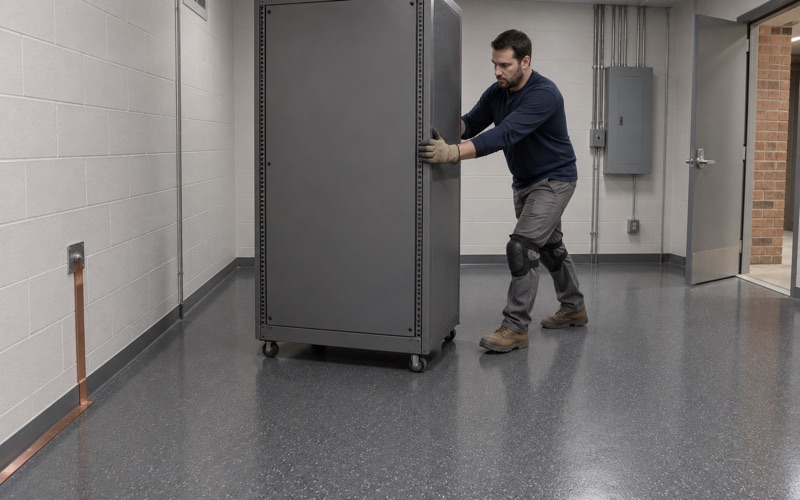
Section 6-201.15 covers floor coverings, mats and duckboards, and its instruction is direct: mats and duckboards shall be designed to be removable and easily cleanable. The code assumes the mat comes up. It does not treat a mat or a wooden duckboard as part of the floor, and it does not let either one hide the floor from cleaning.
Whether a bar with no kitchen is held to every line of the Food Code is a question for the health authority, not for us. In suburban Cook County that is the Cook County Department of Public Health, with the Village of Forest Park’s own Health and Safety Department administering local public health and safety code. What we can do is build the floor so that the rule is easy to follow on any night of the week.
The mats come up; the floor has to stand on its own
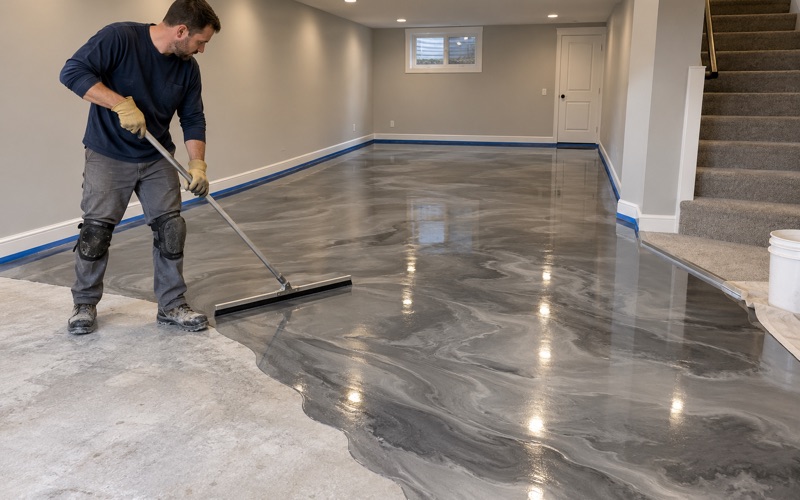
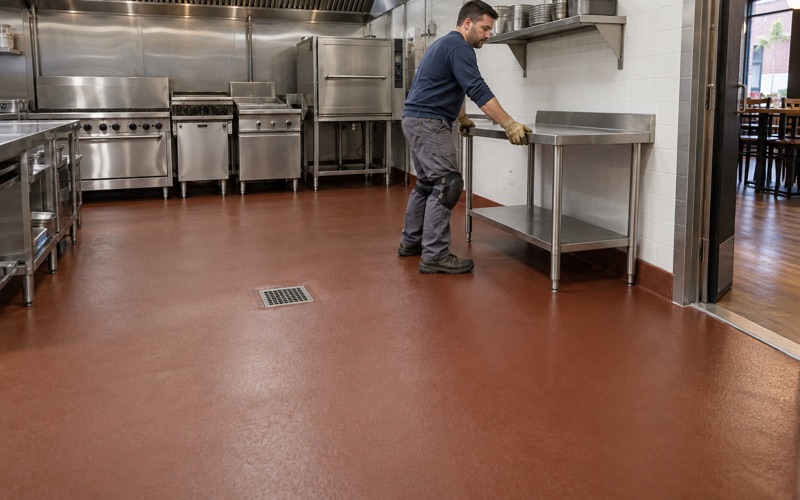
A removable mat is only half of the arrangement. Once it is lifted, the floor underneath has to take a rinse, a deck brush and a squeegee without soaking anything up. That is the job of a seamless resinous floor: no grout lines, no open joints, no low spots where rinse water lingers.
The routine that goes with it is simple. Lift and rinse the mats at close, rather than leaving them down for weeks, and give the floor beneath the same attention. A coating does not make a bar compliant on its own, and we will not describe one that way. It gives the staff a surface where the cleaning the code expects can actually be done in a few minutes at 1:00 a.m.
Antislip without trapping dirt
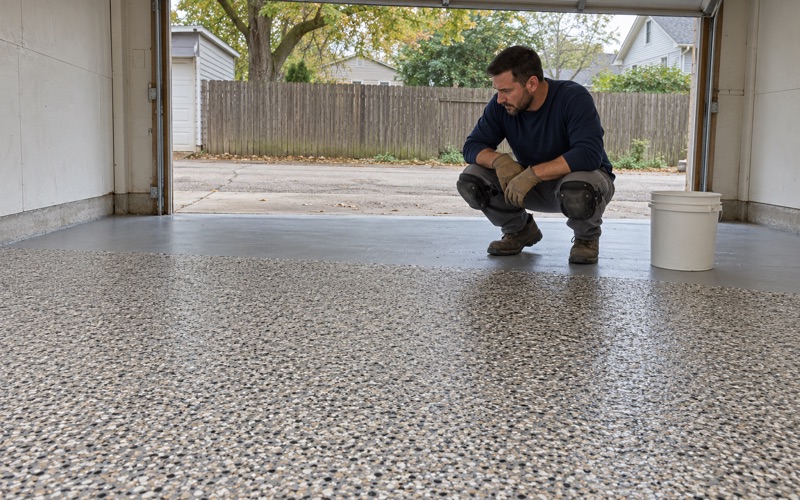
Section 6-201.11 asks for floors that are smooth and easily cleanable, with an exception for antislip floor coverings or applications used for safety reasons. Behind a bar, traction is a safety reason. We tune a quartz aggregate broadcast so the floor grips a wet shoe but still lets a squeegee clear it, because a texture too coarse to clean defeats the purpose of the exception.
Coved, Sealed and Graded Behind the Bar
Most bar floors that fail do not fail in the middle. They fail where the floor meets the bar die, the back wall, the sink base and the drain.
A cove up the bar die and the back wall
Under Food Code 6-201.13(A), floor and wall junctures in areas cleaned by methods other than water flushing are coved and closed to no larger than 1 mm, one thirty-second of an inch. Under 6-201.13(B), where water flushing is used, the junctures are coved and sealed. Either way, the corner is a curve rather than a crack.
We build that curve as an integral cove, troweled in resinous mortar and run up the bar die, the back wall and the bases of fixed equipment, then tied into the floor in one continuous coat. Spilled beer that runs to the edge meets a sealed radius instead of a seam where the old base molding used to be.
Graded to a drain where the floor is hosed
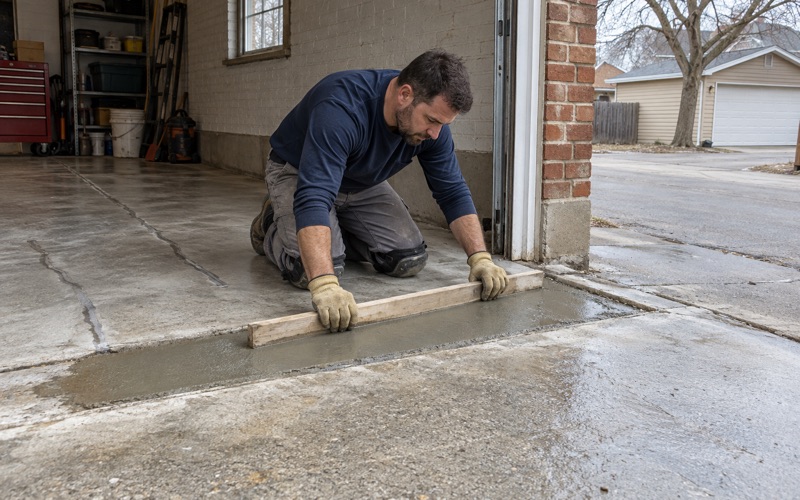
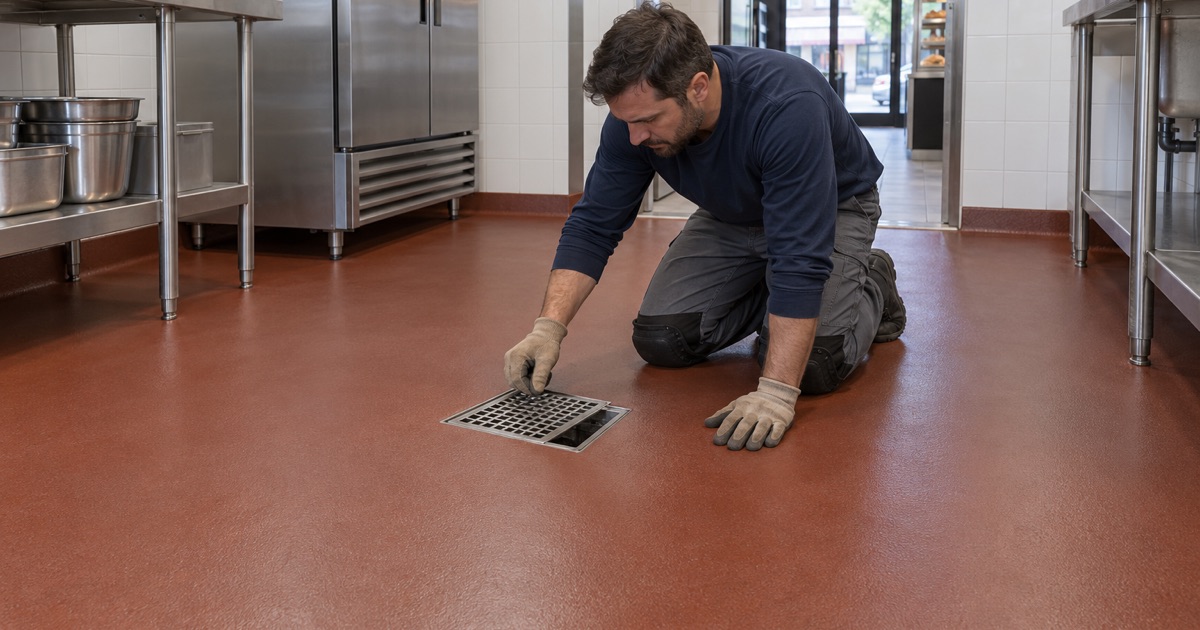
Section 6-201.13(B) goes further: where a floor is cleaned by water flushing, it shall be provided with drains and be graded to drain. If the area behind your bar gets hosed at close, we check where the existing floor drain sits and whether the slab actually falls toward it. Where it does not, we correct the slope with a troweled mortar layer before the finish goes down, so rinse water leaves the room instead of pooling under the mats.
Preparation and system choice
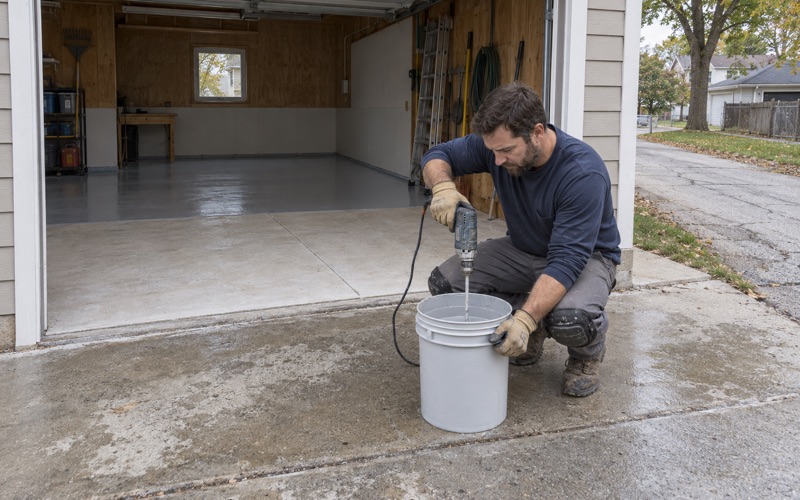
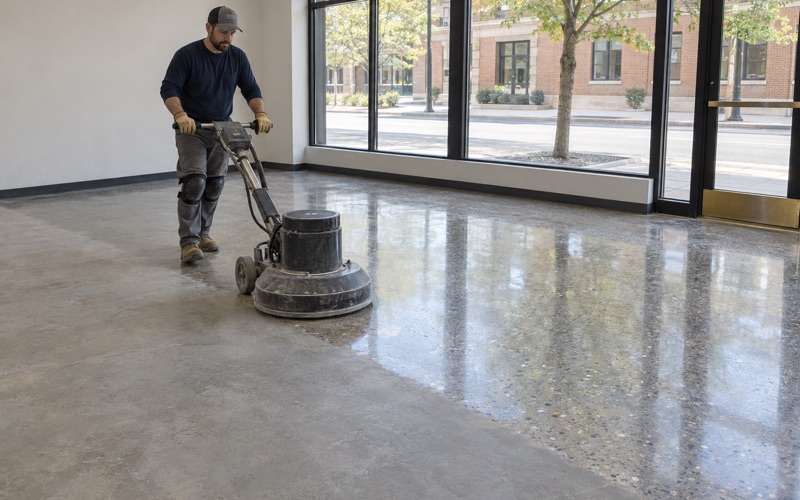
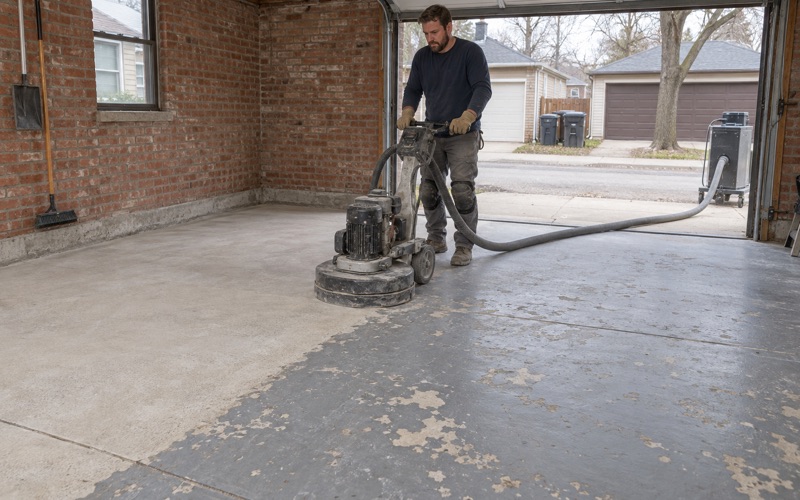
We open every slab mechanically, with a diamond grinder or a shot blaster, to the surface profile the system calls for, and we do not acid etch. For a wet bar aisle that sees hot rinse water, cleaners and sugar, urethane cement is often the right body coat, with its tolerance for heat and constant moisture. Where the exposure is lighter, a 100% solids epoxy with a broadcast and a tougher topcoat can do the job.
Moisture testing comes before any of that, usually with ASTM F2170 in-situ relative humidity probes, because a coating on a damp slab is a warranty problem waiting to happen, and moisture is the first exclusion we read out before the job is sold. Products are chosen within Illinois limits on VOC content, which bind the installer as well as the manufacturer.
A Home Bar or Kegerator Corner in a Forest Park Basement
The same physics follows a bar into a house. A basement home bar has a smaller crowd, but the beer, ice and condensation behave the same way.
Older slabs need reading first
Forest Park’s housing is old. Of 7,649 housing units, 3,653 were built in 1939 or earlier, and another large block went up in the 1960s and 1970s. A basement slab from either era rarely arrives bare: we routinely find paint, patching compound and old adhesive from a floor that came up years ago. We check for each of them before choosing a coating, because a new system bonds only as well as whatever it sits on.
Older basement slabs were often poured without a vapor retarder underneath, so moisture testing here is part of the scope rather than an upsell. An F2170 probe reading or an ASTM F1869 calcium chloride test tells us whether the slab can take a standard epoxy or needs a moisture-mitigation primer first.
Kegerators, drip trays and condensation
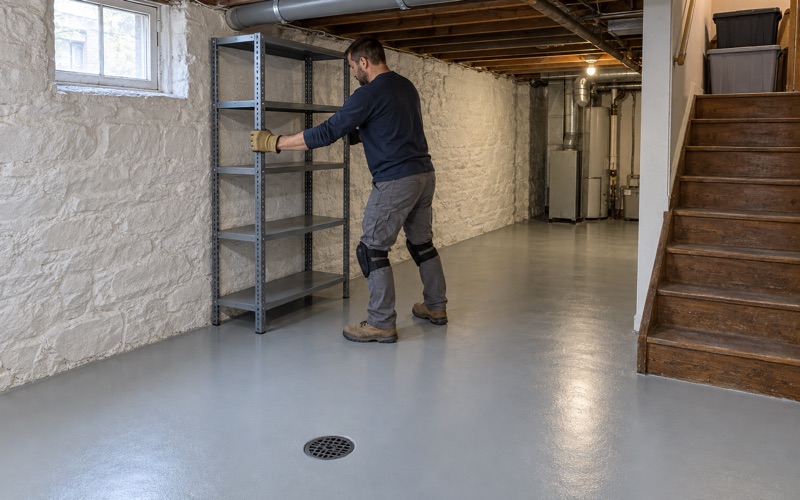
A kegerator or a back-bar refrigerator sheds condensation, and a drip tray overflows on the nights it matters. Glass rinsers and small bar sinks add water the basement floor was never designed for. We cove the floor up the face of a built-in bar, seal around the base of fixed cabinets, and leave the floor drain open and reachable rather than coating over it.
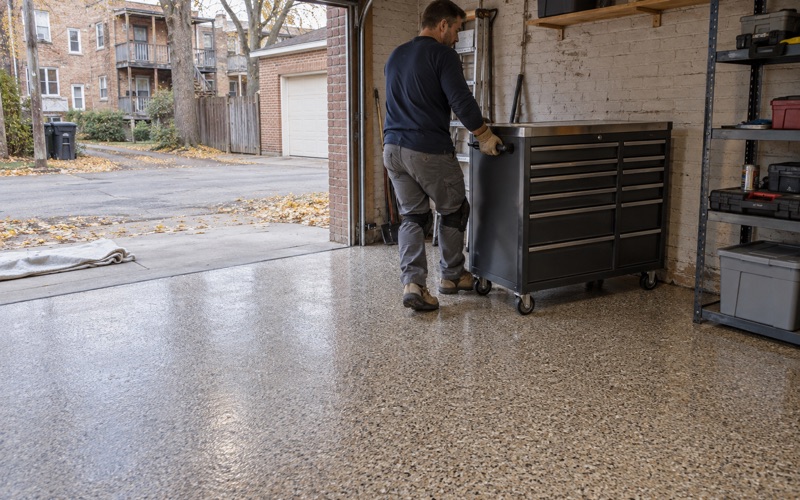
For a home bar, a flake or quartz broadcast under a polyaspartic topcoat gives a surface that cleans with a damp mop and grips a wet sock. We will also tell you what a floor coating will not do: it is not radon reduction, which in Illinois takes a state radon mitigation license.
What to expect from the job
Forest Park sits in Proviso Township, Cook County, and Illinois issues no state license for flooring or coatings work, so we confirm the village’s contractor rules before a date is set. Curing is planned against slab temperature and dew point rather than a calendar, which matters in a cool basement in March. You get the scope, the product names and the finished thickness in writing before the first pass of the grinder.
- 20+ Years Coating Concrete
- Moisture Tested Before Quoting
- Written Contract on Every Home Job