Oak Park Epoxy Flooring has spent more than 20 years installing epoxy flooring in Franklin Park and the surrounding west suburbs, and the floors that teach us the most are the ones where something heavy sits still for a long time. A tire is the clearest example. Rubber resting on a coated slab for days does something rolling traffic never does, and the color chosen at the start decides whether anyone notices.
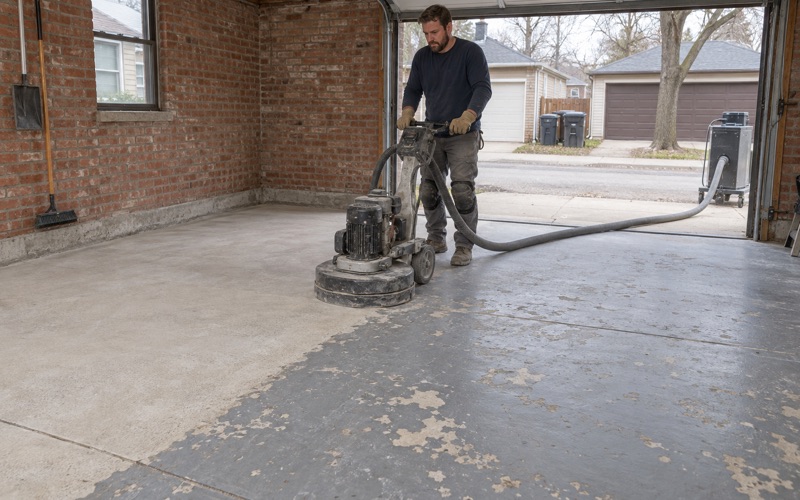
That makes this page less about gloss and more about chemistry, color and cure. We open every slab with a diamond grinder or a shot blaster rather than acid, test for moisture as a quoted line item, and write the product, system build and finished thickness into the proposal. Those habits matter most when a floor will carry stored inventory, because an underbuilt or undercured coating shows it first under weight.
Below we walk through why a parked or stacked tire marks a floor, how storage rows are specified differently from the aisles beside them, and what the same mechanism means for a house garage. We are also plain about the limit: no coating on the market is immune to tire staining, and we say so before a job is sold rather than after.
Tire Storage on River Road and Why a Resting Tire Stains

A tire distributor in the village
Franklin Park has a working example of the problem on River Road. Dealer Tire LLC, a distributor that supplies tires to automotive dealerships, lists a location at 3708 River Rd., and the company has posted a Material Handler/Delivery Driver opening there at a base of $21.00 an hour. The address geocodes inside the village, in Leyden Township, Cook County.
We have not seen how Dealer Tire stores its stock or what its floor is finished with, and we will not pretend otherwise. What the address tells us is that tire distribution is part of the local economy, and the block has a history with it. A 2009 trade report had Hercules Tire moving its Chicago warehouse branch to 3710 River Rd. with 17 loading docks, though that is a dated report rather than a description of the space today.
What migrates out of tread rubber
Tire rubber is compounded with antiozonants, additives that protect it from cracking by working their way to the surface over time. A coatings manufacturer’s technical note names two of them, 6PPD and IPPD, and describes them migrating through the rubber matrix onto the face of the tire. Where that tire rests on a coated floor, the additives transfer and oxidize on the coating.
The result is a black, brown or yellow stain printed in the tread pattern, and the note is specific that it appears where a tire sits for some duration rather than where it rolls. How bad it gets depends on the tire’s age and compound, how long it rests, the temperature, and the coating’s type, cure and color. Lighter colors show the staining to a greater extent than darker ones.
Stain versus softening
Two separate things can happen under a resting tire. The stain is a discoloration of the surface, and epoxy and polyurethane systems resist being softened by these additives even when they do discolor. Vinyls, chlorinated rubber, acrylics, alkyds and single-pack polyurethanes can sometimes be softened as well, which turns a cosmetic mark into a damaged film.
That note is Australian manufacturer literature, not a US code or standard, and its maker offers no warranty against tire staining. We cite it because it explains the mechanism clearly, not because any rule dictates a particular floor. Hot tire pickup, where a warm tire lifts a weak coating off the slab, is a different failure with a different cause, and we treat the two separately.
Looking for epoxy-flooring closer to La Grange Park? See La Grange Park Epoxy-Flooring.
Color, Cure and Catalyzed Systems for Tire Rows
In a typical tire storage area the parked-car case turns sideways. Instead of four contact patches under one vehicle, new tires stand or lie in stacks and rows on the floor or the bottom rack level for days or weeks at a time. Every one of those contacts is a chance for the same migration, so whole rows can print tread-shaped marks that no cleaner removes.
Choosing color by zone
Our usual recommendation is to split the floor by use. Storage rows get a mid or dark color, where a brown or yellow print reads as a shadow rather than a defect, while walk lanes and forklift aisles can stay lighter for visibility. Darker shades are the first mitigation the manufacturer lists, and the decision is made before anything is mixed.
A light gray floor throughout looks clean on the day it is finished. In a tire row it tends to look worse every month, and the owner ends up chasing marks that are chemically part of the coating surface rather than dirt sitting on top of it.
Catalyzed chemistry and full cure
We specify a catalyzed system for tire rows, typically a 100% solids epoxy base with a polyurethane or polyaspartic topcoat, rather than a single-pack floor paint. Because the proposal names the product, the build and the finished thickness, a facility manager can check what went down against what was quoted. A one-part acrylic may look identical on day one and still soften under a season of stacked stock.
Cure is the other half. A catalyzed coating that has not reached full cure is softer and more absorbent than the same coating a week later, so loading racks or stacking tires early invites both marking and indentation. We schedule cure against slab temperature and the dew point spread at the surface rather than the calendar, and we give the owner the date the floor can take stock.
Surface preparation under the weight
None of that works on a poorly bonded film. We open the concrete by diamond grinding or shot blasting to a measured ICRI CSP profile, never by acid etching, and we read existing cracks and old coatings before quoting. If a slab needs repair before it can carry a coating, we say so in writing rather than burying the problem under a fresh topcoat.
Mats, Slip Sheets and Recoatable Topcoats Where Tires Sit
The second mitigation in the manufacturer’s note is physical: put something between the tire and the coating. Mats or an impermeable sheet material where tires rest keep the additives from reaching the floor at all. Nothing changes how fast a tire releases them, so separation is the only way to stop the transfer rather than hide it.
Slip sheets on the bottom level
In a storage row that usually means sheets or mats under the bottom tier of each stack or on the lowest rack level, sized to the footprint rather than the whole aisle. They are easy to replace when they stain, and they protect the coating beneath from both discoloration and scuffing as tires are pulled and restacked. Material handlers working at pace rarely set a tire down gently.
We point out one caveat. An impermeable sheet left in place over a slab with moisture coming up through it can hold that moisture against the coating. That is one reason we test before quoting, with ASTM F1869 calcium chloride kits or ASTM F2170 in-situ relative humidity probes depending on the slab, and price the result into the scope.
A sacrificial topcoat
Where an owner wants a lighter floor anyway, the practical answer is a recoatable topcoat treated as a wear layer. The base system stays bonded and intact while the top layer takes the staining, and after a few years the storage rows are abraded and recoated rather than the whole floor being ground back to concrete. We build that maintenance cycle into the conversation from the start.
We would rather plan a recoat than promise a floor that resists tire marks forever. The coating makers do not make that promise, and the warranty exclusions we read out before anything is signed say so plainly, with moisture named first among them.
Working in the village
Commercial work in Franklin Park starts with paperwork. Illinois issues no state license for flooring or coating work, but the village requires every contractor performing work there to be licensed, insured and bonded. The license runs May 1 to April 30 at $100 a year, or $250 for a general contractor, with a $10,000 trade-specific license and permit bond and liability insurance of at least $1,000,000.
The Village of Franklin Park Building Department at 9500 Belmont Avenue handles that licensing and the permits that follow. We confirm the village’s current rules before a job goes on the schedule, since a contractor without the license cannot pull a permit here. Warehouse floors are then scheduled around shifts, including overnight and weekend windows when freight has to keep moving.
The Same Chemistry in a Franklin Park Home Garage
The chemistry does not care whether the tire belongs to a distributor or a family. A car parked in the same spot every night rests on the same four patches for years, and on a light-colored garage coating those patches can turn yellow or brown in the tread shape. Homeowners often read that as a failed floor when it is the tire’s own additives at work.
Franklin Park’s housing makes this a common conversation. Of the village’s owner-occupied homes, 4,304 are single-family detached houses, and 62.0 percent of the housing stock predates 1960, so many garage slabs are decades old and some carry earlier paint. We read that history before choosing a system, since an old one-part paint has to come off completely.
Picking a garage color and finish
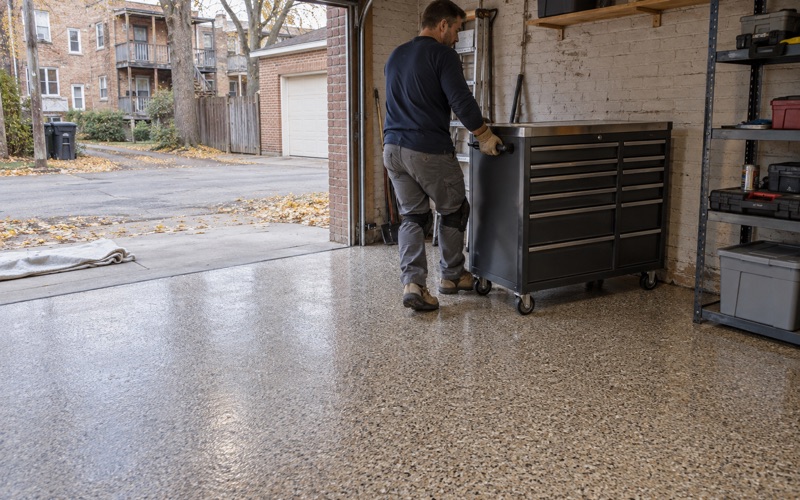
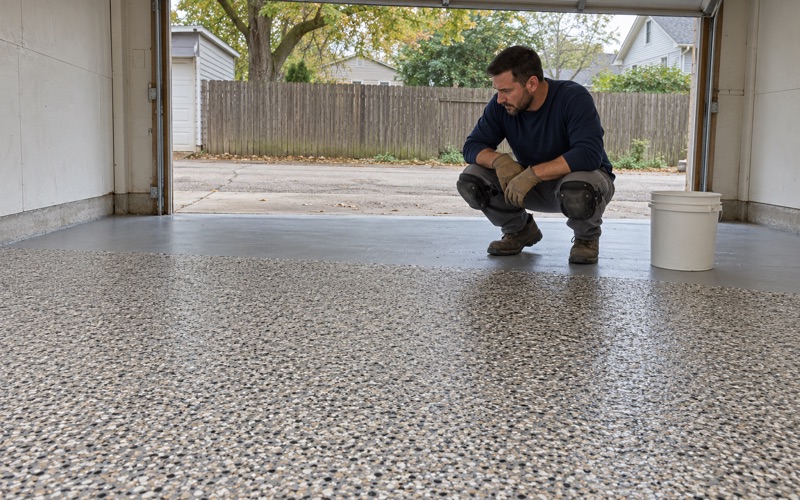
For a garage, a vinyl flake broadcast in a mid-tone blend hides tire marks far better than a solid light gray, and a polyaspartic or polyurethane topcoat over an epoxy base resists softening. If you want a pale floor, we suggest mats under the parking spots, which also catch the calcium chloride brine and rock salt a Cook County winter carries in on the tires.
Garage systems we install are built for that deicer load, with a full broadcast and a topcoat chosen for salt exposure. The coatings themselves are chosen within the Illinois limits on VOC content, which bind the installer as well as the manufacturer. That narrows the product list, and we would rather explain why than substitute quietly.
Cure time before the car comes back
The most common cause of an early garage mark is impatience. A coating usually needs about seven days before a vehicle parks on it, and a cold slab stretches that further, so we schedule by slab temperature and dew point and tell you plainly when an unheated detached garage should wait for spring. Parking on an undercured coating invites both staining and hot tire pickup.
Contracts and moisture at home
Every home job gets a written contract and the Home Repair: Know Your Consumer Rights pamphlet before work begins, as the Illinois Home Repair and Remodeling Act requires. Moisture testing is in the quote for a garage slab just as it would be for a basement. A coating does not fix a wet slab, and we would rather learn that from a test than from a blister.
- 20+ Years Coating Concrete
- Moisture Tested Before Quoting
- Written Contract on Every Home Job