
Oak Park Epoxy Flooring has installed epoxy garage floor systems in Oak Park, IL for more than 20 years, serving surrounding cities including River Forest, Forest Park, River Grove, Bellwood and Brookfield. We grind the slab, test it, repair it and then build a coating made for cars, road salt and an unheated winter, rather than rolling a coat of paint onto bare concrete.
A garage floor is the hardest-working residential slab we coat. It takes hot tires, dripping slush, dropped tools and the calcium chloride brine every plow truck spreads, and in this area it usually sits in a detached building that drops to winter temperatures every night from November to March.
That is why our proposal for every garage lists the product, each coat in the system and the finished thickness. When the job is done you can hold the floor up against the paper and see that what was quoted is what went down.
What Goes Into an Epoxy Garage Floor System
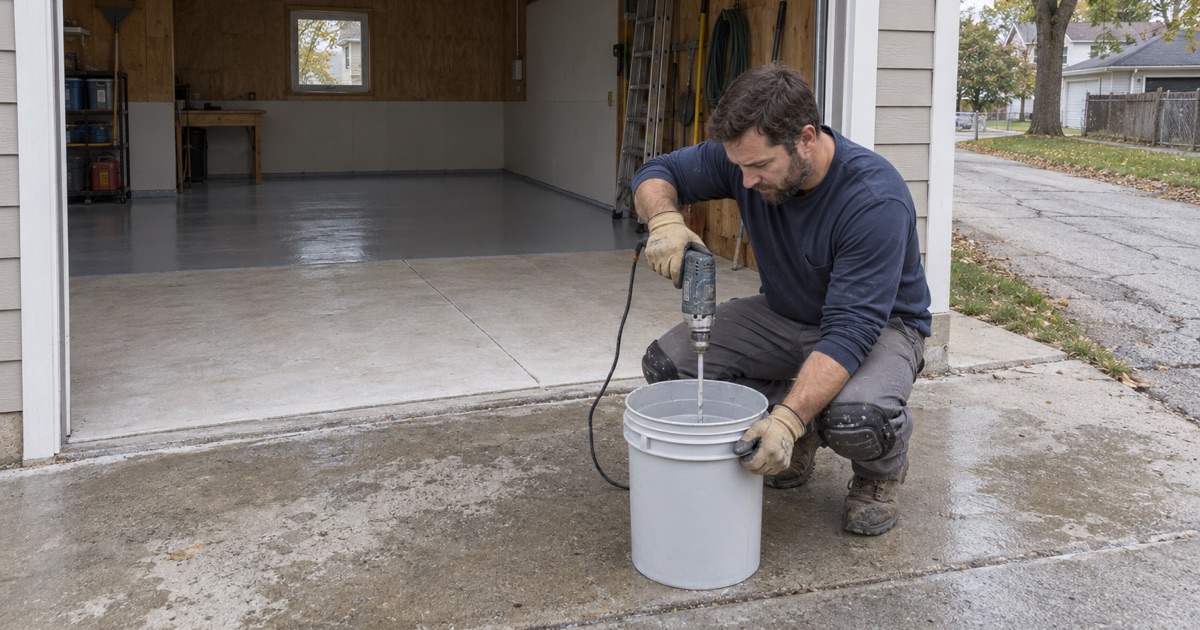
Mechanical Surface Preparation for Garage Slabs
The bond between coating and concrete is made before any resin is opened. We diamond grind the slab, or shot blast larger floors, to an ICRI concrete surface profile matched to the product, which opens the pores and removes sealers, paint, oil stains and the weak top layer of cement paste.
We never acid etch. Etching leaves a thin, uneven profile and salts that can sit under the new coating, and it is the step most often found under garage floors that started lifting at the tire lines within a couple of years.
Base Coat, Flake Broadcast and Topcoat
Most of our garage floors are built in three layers: a 100% solids epoxy base coat, a vinyl flake broadcast into that base while it is wet, and a clear topcoat that locks the flake in. A full broadcast covers the base completely and gives the most texture and the best camouflage for dirt and salt residue.
A partial broadcast scatters less flake for a lighter look and a smoother finish. Either way the flake is scraped and vacuumed before the topcoat goes on, so the finished surface has an even feel rather than loose chips catching under a broom.
Polyaspartic and Urethane Topcoats
The topcoat is what your tires touch, so it decides how the floor wears. A polyaspartic or polyurea topcoat cures quickly, holds its color in sunlight from an open door and resists the hot tire pickup that pulls thin coatings off the slab.
We size the topcoat to the floor’s use. A garage that doubles as a workshop or a place to store a snowblower gets a tougher build than one that just parks a car, and we write the choice into the proposal so you know which one you are getting.
Garage Conditions Specific to Oak Park
Detached Alley Garages and Unheated Slabs
Most garages on Oak Park’s residential blocks are separate buildings that open onto an alley, and they are not heated. We set up from the alley side with the grinder, dust collector and material, collect grinding dust at the machine and bag it, and keep it out of the alley drain entirely.
An unheated slab also controls the calendar. Epoxy needs the concrete itself, not just the air, to be warm enough to cure, so we measure slab temperature and the dew point spread at the surface before scheduling.
Cold-Weather Scheduling and When to Wait for Spring
Late fall and winter can leave a detached garage slab below what a coating needs for days or weeks at a time. When the readings do not work, we tell you the job waits until spring rather than coating a cold slab that cures soft, clouds over or stays tacky.
Attached garages that share heat with the house can often be coated later in the season. We look at each garage on its own rather than applying one rule to every address.
Brine, Rock Salt and Chloride Exposure
Calcium chloride brine and rock salt come into the garage on every tire through a Cook County winter. On bare concrete that salt works into the surface with each freeze and thaw and slowly scales it away, which is why so many local garage floors look pitted near the door.
We build garage systems for that exposure with a chemical-resistant topcoat and edges that are sealed at the door and the walls, so salt water cannot creep under the coating where it ends.
Condominium and Shared Garage Floors
In a condominium or apartment building the garage slab is usually common property, so the association has to approve the products, the schedule and how residents park while the work is underway. We supply product data sheets, cure times and a phasing plan that coats one bay or row at a time where the building cannot empty the whole garage.
Shared garages also see more traffic and more salt than a single-family garage. We usually specify a heavier topcoat and textured drive lanes there, and we mark stalls and walkways between coats if the board wants them.
Moisture, Cracks and the Condition of the Slab
Testing for Vapor Under the Garage Floor
The residential code has long let garage slabs go in without a vapor retarder, and plenty of older garages here were poured that way. We test before quoting, using a calcium chloride kit to ASTM F1869 or relative humidity probes to ASTM F2170, because moisture vapor pushing up from below is the leading cause of blisters and lifting.
The test is part of the scope, not an upsell. It is also the basis for the warranty: moisture is the first exclusion on almost every coating warranty, and we go over those exclusions with you before the job is sold.
Cracks, Spalls and Slabs Past Coating
We map every crack and spalled area during the first visit. Narrow shrinkage cracks are routed and filled before coating, and spalls are patched with a repair mortar, but a slab that has heaved, sunk or broken into loose pieces is still moving, and no coating will hold it together.
When a section needs to be cut out and replaced first, we say so in plain terms. Slab replacement needs a village permit, while the coating itself is a finish treatment the village exempts, so the two are often separate jobs.
Our Step-by-Step Epoxy Garage Floor Process
Step 1: Slab Inspection and Written Proposal
We look at the slab, test for moisture, map cracks and old coatings and measure the floor. Then you get a written contract with the system, products, thickness, schedule and warranty terms, along with the state’s consumer-rights pamphlet required for home repair work.
Step 2: Grinding, Repairs and Edge Work
On the first install day we grind the full slab, cut in the edges by hand, fill cracks and patch spalls. The dust collector runs the whole time, and the floor is vacuumed clean before any coating goes on.
Step 3: Base Coat and Broadcast
The epoxy base coat goes down and the flake is broadcast into it while it is wet. Once it cures, we scrape the excess, vacuum and inspect the surface for any thin spots before the topcoat.
Step 4: Topcoat and Return to Service
The clear topcoat seals the system. We leave written times for walking on the floor and for parking on it, and those times follow the slab temperature rather than a fixed number of days.
- 20+ Years Coating Concrete
- Moisture Tested Before Quoting
- Written Contract on Every Home Job