Oak Park Epoxy Flooring has spent more than 20 years on epoxy flooring in Hickory Hills and the surrounding suburbs, and the commercial rooms we think hardest about are the ones where people arrive dressed for an evening. Our first question on an event or hospitality floor is not how many carts will cross it. We ask what the sharpest thing standing on the surface will be, and how hard it will press.
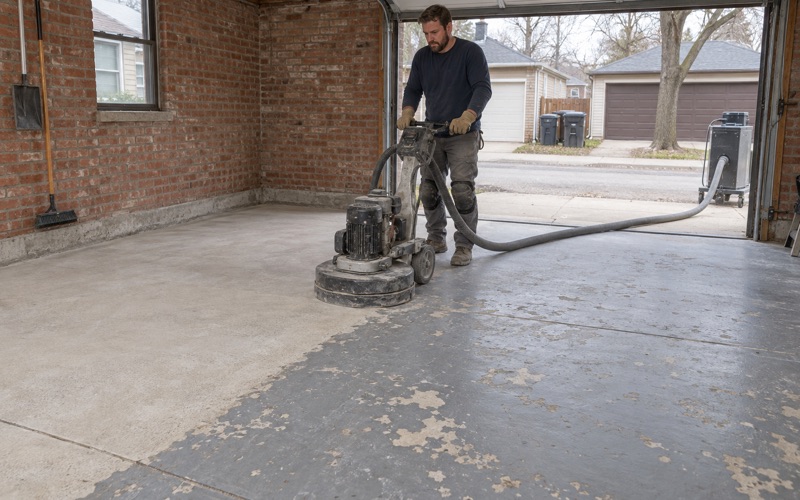
Every slab we coat is opened mechanically with a diamond grinder or a shot blaster before any resin goes down, because we do not acid etch. The written proposal names the product, the system build and the finished thickness. That way an owner or facility manager can hold what was quoted against what was installed, layer by layer.
Moisture testing appears as its own line in the scope rather than as an upsell after a coating has blistered. Before a job is sold we read the warranty exclusions aloud, and moisture is the first one named. We also read the cracks and any old coating first, and we say so plainly when a slab needs repair before it can carry a resin floor.
Three Ballrooms on 95th Street, and the Load That Decides Them
Chateau Del Mar sits at 8301 W. 95th Street, an address the Census geocoder places inside Hickory Hills city, in Palos Township, Cook County. The operator describes three unique venues for parties of 200 to 1,000 guests, each room with a large dance floor and customizable lighting. It is one of the clearest examples on the 95th Street corridor of a building whose floors are tested by formal shoes rather than forklifts.
We want to be precise about what we know. Chateau Del Mar is a local landmark we use to explain a floor problem, not a customer, and we have not seen its slab, its finishes or how its dance floors are built. What its published description tells us is the kind of traffic a banquet house carries, and that traffic is what this page is about.
A Dance Floor in Every Room Changes the Traffic Map
When every ballroom has a dance floor, guests do not sit through an evening. They cross from tables to the dance floor, out to the lobby, into the restrooms and back again, many times over several hours. Each crossing is made in dress shoes, and a meaningful share of those shoes carry a narrow heel.
The dance floors themselves are the venue’s own choice of wood or panel system, and we would never tell a hall to replace one with epoxy. Our subject is everything around them. The concrete under the lobby, the restroom tile and the ring of floor at the dance-floor edge all take the same heels without any of the attention a dance floor gets.
Why the Heel Outweighs the Cart
A loaded serving cart is heavy, but its weight is spread across several wheels and each wheel spreads it again across a contact patch. A guest standing on one heel puts most of their weight onto a point smaller than a fingernail. Measured as pressure rather than weight, the guest is the harder load on the floor.
That is why we specify banquet floors around the heel. A surface that shrugs off a rolling cart can still pock under a single evening of narrow heels if it is soft enough to indent. The material question becomes how hard the top layer is and how completely it is bonded to the concrete underneath.
Looking for epoxy-flooring closer to Burr Ridge? See Epoxy-Flooring Services in Burr Ridge.
2,500 psi on a Capped Heel, Several Times That on a Bare Pin
A trade-press rule of thumb in Floor Trends puts the working numbers on this. A capped stiletto heel bears on roughly 1/20 square inch, which multiplies the wearer’s weight about twenty times. For a 125-pound guest that comes to roughly 2,500 psi at the heel.
These are approximate figures from a rule of thumb, not a measurement taken on any particular floor. A heavier guest, a narrower cap or a heel planted at an angle all move the number. We use them to compare surfaces against one another, not to promise a result.
What a Capped Heel Does to a Softer Floor
The same article notes that some resilient flooring is rated to static loads of up to about 2,500 psi, depending on the maker and the test method. That places an ordinary capped stiletto at or near the limit of those products. Repeated across hundreds of guests and many evenings, a load near the limit shows up as small round dents clustered where people stand and turn.
Historic-preservation practitioners report heel divots in softwood floors after a single event. Their advice is harder finishes, protective coverings or restricting narrow heels. A banquet house cannot restrict what its guests wear, so in practice the surface has to be the hard part of the equation.
When the Cap Comes Off
The worse case is a heel that has lost its cap. Floor Trends puts the bare pin at about 1/80 square inch, which works out to roughly 10,000 psi for the same 125-pound wearer. Over the course of a long reception, a worn or missing heel cap is not unusual.
We say plainly that no floor we install is promised to survive a bare heel pin without a mark. A hard resin system resists it far better than a soft one, but a steel pin at that pressure can scuff or nick almost any finish. Any contractor who tells a venue otherwise is selling a claim, not a floor.
Pre-Function Lobbies, Restrooms and the Dance-Floor Edge
In a hall where every room has a dance floor, the damage from heels tends to collect in three places that rarely get a renovation budget of their own. Each one is a room people stand in rather than pass through, and standing is where a heel does its work. These are the floors we are usually asked to look at.
Pre-Function Lobbies
The lobby outside a ballroom is where guests wait, greet, hold a drink and shift their weight from one heel to the other. On a soft resilient sheet or tile, that pattern leaves a field of dents near the doors and the coat check. A hard resin system with a quartz aggregate broadcast and a polyaspartic or polyurea topcoat gives that zone a dense, uniform surface that can be finished in a color and sheen suited to an event space.
Before we price a lobby, we test the slab. An ASTM F2170 in-situ relative humidity probe or an ASTM F1869 calcium chloride test tells us whether the concrete can carry a bonded coating or needs a moisture-mitigation primer first. A floor that delaminates from below will fail under heels long before its surface wears.
Restrooms
Restrooms take the same heels plus wet mopping several times an evening. Resilient tile here tends to fail twice, once by denting and again at the seams where mop water works underneath. A seamless resin floor removes the seams, and a cove at the wall keeps water off the base of the partitions.
We grind the existing surface down to sound concrete and fill the cracks before building the system. Old adhesive, patches and thin paint layers come off rather than being coated over. A restroom floor that bonds to the slab itself, not to whatever the last renovation left behind, is what lets a hard topcoat stay hard.
The Ring Around the Dance Floor
The band of floor surrounding a dance floor sees the most concentrated heel traffic in the building. Guests step on and off the dance floor, pause at its edge and turn sharply there. If that ring is a softer floor than the dance floor itself, it is often the first surface in the room to show pocking.
We can coat the concrete surround up to the dance floor’s own edge trim, leaving the venue’s dance system untouched. The transition is detailed so that no lip or gap forms where the two surfaces meet. The aim is a ring that wears as slowly as the floor it borders.
A Hard, Bonded Resin Floor, and What It Cannot Promise
The property that resists a capped heel is not thickness alone. It is a hard top layer fully bonded to sound concrete, so that the load passes through the coating into the slab instead of pressing the coating down into itself. Every step of our process exists to make that bond complete.
Bond Comes From the Slab Preparation
We grind or shot blast to an ICRI CSP profile that matches the system, then build with 100% solids epoxy, a broadcast layer and a hard topcoat. Curing is scheduled against slab temperature and the dew point spread at the surface, not against the calendar. A coat applied too close to the dew point risks amine blush, a waxy film that weakens the next layer’s grip.
Our proposal states the finished thickness and names every product in the build. If a slab is cracked, spalled or too wet to take a bonded coating, we say so in writing before quoting the resin. Coating over a slab that will move or push moisture only creates a surface that fails under the first heavy evening.
Service Corridors That Cannot Close
Forbo’s hospitality flooring guidance calls service corridors the lifeline of back-of-house areas and warns that restricting access for refurbishment hurts business. A banquet house booked most weekends feels that directly. We schedule commercial work around the hours a building must keep running, including overnight and weekday windows between events.
A fast-curing polyaspartic topcoat lets a corridor or restroom return to service sooner than a slower system would. We phase large areas so that one route stays open while another cures. Grinding dust is collected at the machine and never washed toward a drain.
Working Within the City’s Contractor Rules
Illinois issues no license for flooring or coatings contractors, so the City of Hickory Hills contractor license is the rule that binds us. The city charges $100 per calendar year, running January 1 to December 31, with no half-year licenses. A certificate of insurance naming the city as certificate holder goes with the application, and a copy goes to the building owner before work begins.
No bond is required, and the city’s hauler does not collect contractor debris, so we remove our own. We confirm those requirements before a job is scheduled. Holding the license is a requirement for working in the city, not a credential, and we present it that way.
What We Will Not Promise
We will not describe any floor as heel-proof. A hard, fully bonded resin system takes the capped stiletto far better than a soft resilient floor, and it is the surface we recommend for pre-function areas, restrooms and dance-floor surrounds. A bare heel pin pressing at several times that load can still mark it, and we tell a venue so before the contract is signed.
The same honesty applies to the warranty. Its exclusions are read out before the job is sold, beginning with moisture rising through the slab. An owner who knows exactly what the floor is built to resist, and what it is not, can plan maintenance and touch-ups around a busy event calendar.
- 20+ Years Coating Concrete
- Moisture Tested Before Quoting
- Written Contract on Every Home Job