Oak Park Epoxy Flooring brings more than 20 years of coating work to epoxy-flooring in Justice, and some of the floors we plan for here are judged less by how they look than by how well they hold a boot. A shop where wire is pulled, a truck bay where reels are loaded and a garage where a homeowner stages a weekend rewiring job all see spills that a showroom finish was never built for.
We open every slab with a diamond grinder or a shot blaster instead of acid, and we list moisture testing as its own line in the scope. Our written proposal names the product, the system build and the finished thickness, so a customer can hold what went down against what was quoted. That paperwork matters most on a floor where texture is part of the specification.
This page covers one problem in particular: a water-based gel that does a coating no chemical harm and still makes a smooth floor treacherous underfoot. It explains how we build the surface, how the spill gets cleaned up and which topcoats stand up to the cleanup itself.
An Archer Road Electrician and a Gel That Is Mostly Water
A commercial contractor at 7640 Archer Road
Justice is a Cook County village established in 1911, and much of its business life grew up along Archer Road, where the village hall still sits at 7800 Archer Road. The road carries a mix of small trade firms rather than large plants. That mix is exactly where shop floors get treated hardest.
Cable Electric Co., Inc. is at 7640 Archer Road, listed in a contractor association directory with a business description of commercial work and on the 2023 Justice Chamber member list at the same address. We have no relationship with the firm, and we have not seen its floor or learned which products it keeps. We name it because the trade it represents brings one specific material onto concrete.
Commercial electrical work means pulling long runs of cable through conduit, and that job is commonly eased with pulling lubricant scooped from a pail. Wherever pulls are staged, wherever reels are loaded and wherever pails are opened, the floor eventually catches some of it. The same is true of a work truck parked overnight in a garage with a half-used pail behind the seat.
What one maker’s safety data sheet says
Polywater J is one common product, and its maker publishes the details in a safety data sheet, revision 11, dated March 15, 2024. It describes an opaque, cream-colored, stringy gel whose volatiles are more than 95 percent water, not flammable and with no reportable hazardous components. Other brands are formulated differently, so we read the sheet for whatever product a shop actually keeps.
The same sheet is blunt about the floor. It says the lubricant is extremely slippery, that it should be washed, swept or squeegeed from the floor using wet mops, and that spills should be avoided and cleaned up immediately. That is a manufacturer warning its own customers, not a coating contractor hunting for a problem to sell.
Traction, not chemistry
Nothing in that description suggests the gel attacks epoxy or polyurethane. It is not a solvent, and a cured coating has no reason to soften or lift because a pail tipped over on it. The risk is about footing, and it is a real one.
A smooth, high-gloss coating is the worst surface for this kind of spill. Bare concrete has some tooth, but a glassy topcoat gives a film of gel nothing to grip through, so a puddle beside a reel stand can be as slick as ice. That is why the finish we specify in a pulling area looks different from a showroom garage.
Looking for epoxy-flooring closer to Bridgeview? See Epoxy-Flooring Services in Bridgeview.
Texture That Stays in the Topcoat Where Pails Are Opened
Aggregate broadcast, held in place
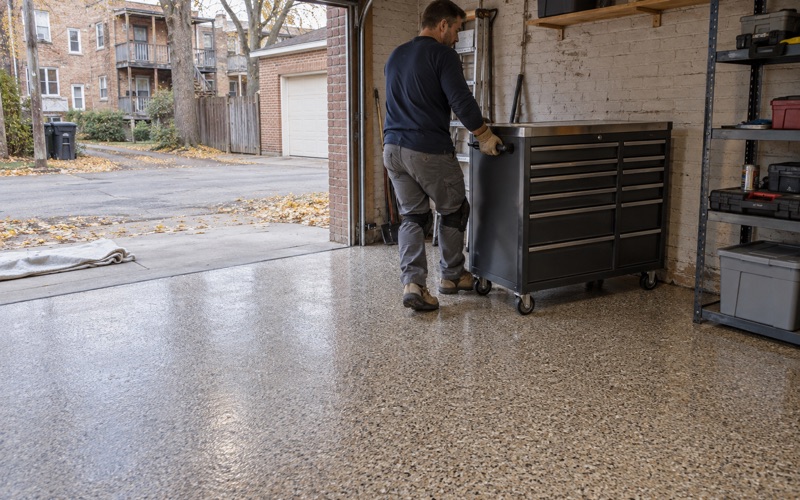
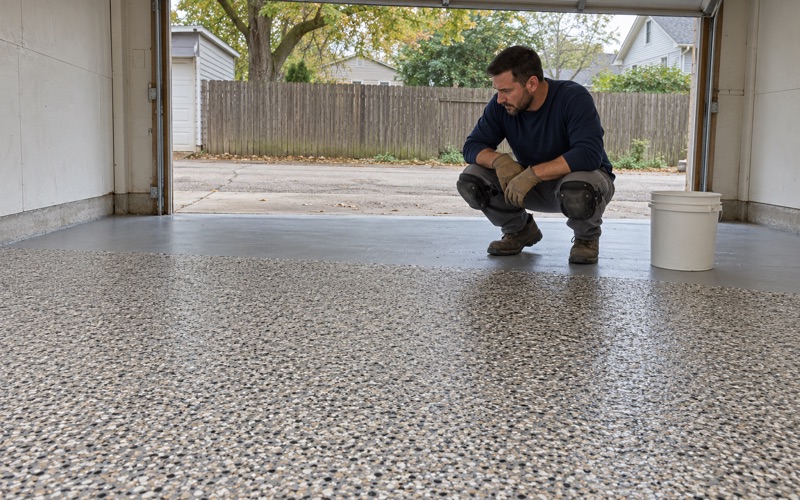
Our answer is an aggregate broadcast locked into the system rather than grit sprinkled on top. Into a fresh coat we broadcast quartz aggregate, let it set, scrape away the loose grains and then seal it under a topcoat that wraps each particle. The texture becomes part of the floor instead of sand that wears loose under a cart wheel.
Grain size and the number of coats over it decide how aggressive the finish feels. A coarser grain under one thin topcoat grips hard but is harder to mop, while a finer grain under a fuller topcoat cleans easily and still improves footing. No coating is slip-proof, so we describe texture as better footing and never promise a rating.
Where the texture goes
Not every square foot needs the same profile. We usually concentrate the heavier texture where pulls are staged, around reel stands and at the spot where pails are opened and refilled, then step down to a lighter texture in the walkways. In a home garage the same logic applies to the workbench and the shelf where supplies live.
The proposal draws those zones on a sketch and states the broadcast, the topcoat and the finished thickness for each one. A customer can check the floor against the paper after the work is done. That matters because a textured zone and a smooth zone can look alike from across a room once both are sealed.
The base under the texture
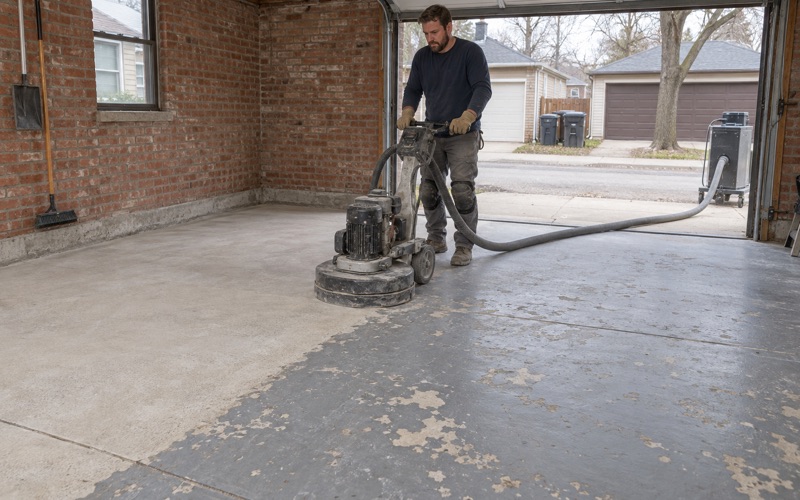
Texture only holds if the base coat holds. We open the slab mechanically to a measured ICRI CSP profile, never by acid etching, and we read the cracks and any old coating before quoting. If the concrete needs repair, or outright replacement, we say so before anything is sold.
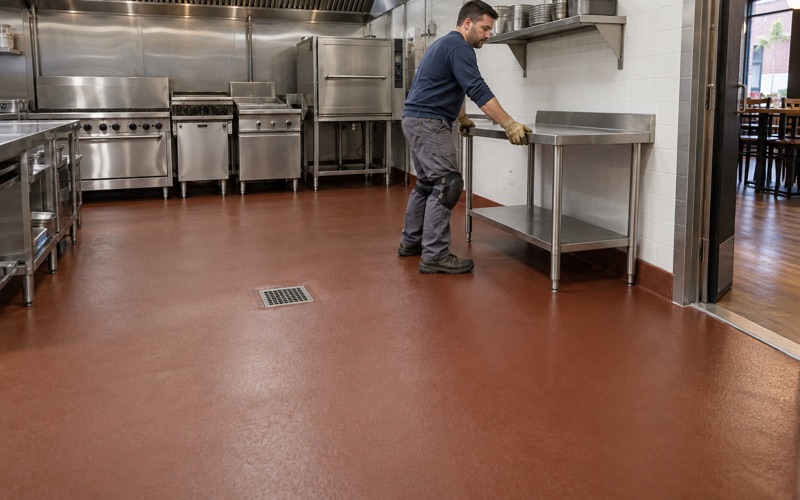
The base and the topcoat are chosen together, because the topcoat is also where cleanup chemistry gets decided. On a floor that will be bleached after spills we build on a solvent-free, 100% solids epoxy and finish with a topcoat whose maker publishes resistance data for hypochlorite. The next section explains why that data matters.
Wet Mop, Squeegee, Then Bleach: the Maker’s Own Cleanup
Water first, and right away
The cleanup the safety sheet describes is simple: wet mops and a squeegee, used right away. A dry rag tends to smear a gel into a wider film, while plenty of water dilutes it and a squeegee pulls it toward one spot where it can be picked up. Outdoors the sheet suggests covering a spill with sand, dirt, gravel or calcium chloride, which is no method for a finished interior floor.
The sheet adds one more step that matters to anyone choosing a coating. It says oxidizing agents, such as household bleach, can be used to eliminate the slippery character. On a coated floor we would follow that bleach pass with a clean water rinse once the bulk of the gel has already been mopped up.
A topcoat rated for hypochlorite
If bleach is part of the cleanup, the topcoat has to tolerate it, and not every system does. One manufacturer’s chemical resistance chart, dated 2021, gives sodium hypochlorite at 15 percent available chlorine a 5, its top mark, on its solvent-free epoxy and polyurethane coatings. The same chart rates its water-borne epoxy coating a 1.
That gap is the reason we name the product line in writing rather than calling a floor epoxy and leaving it there. A water-borne system can be a reasonable choice elsewhere, but not on a floor that will be bleached after every spill. The same chart gives soap and a 3 percent detergent solution its top mark on every coating it lists, so routine washing is never the issue.
Pails in a tray, out of the cold
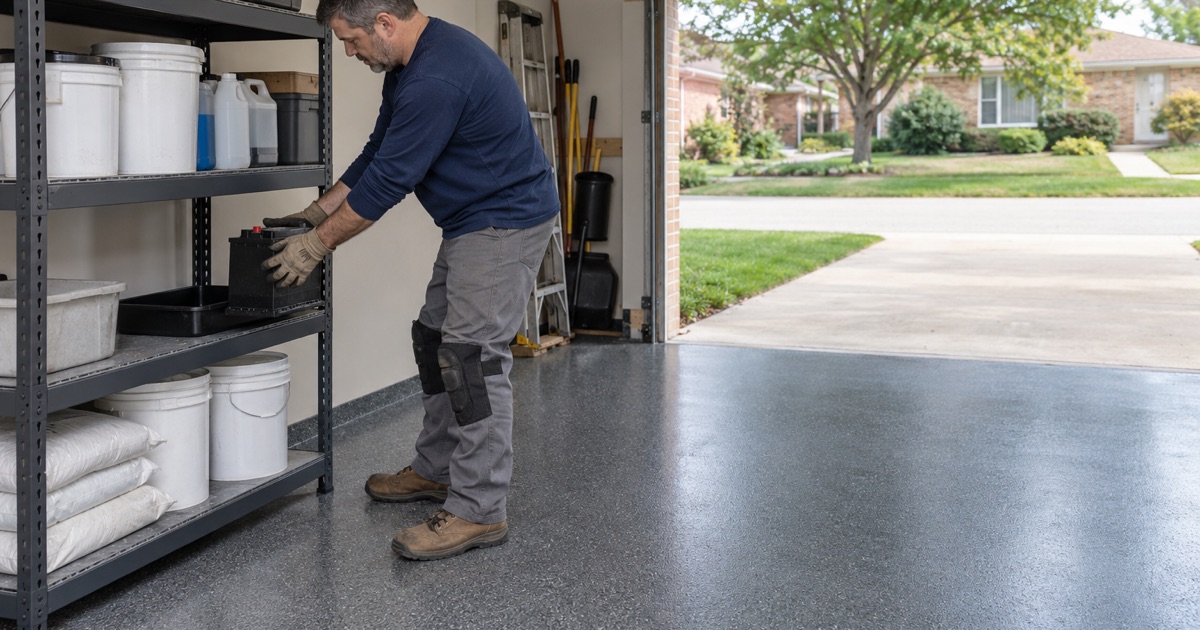
The cheapest fix is keeping spills off the floor in the first place. We suggest pails stand in a shallow tray or on a shelf with a lip, so a drip or a cracked lid ends up in the tray instead of the walkway. It costs almost nothing and spares the floor most of its cleanup.
Temperature is the other storage question. Because the gel is mostly water, it freezes near 32 degrees, and an unheated garage in a Cook County winter gets there easily. A frozen pail is not a floor problem as such, but it does argue for keeping lubricant in a heated space rather than on a cold garage slab.
Electricians’ Trucks and Home Workshops in Justice Garages
Truck bays and small shops
The village describes itself as home to hundreds of small businesses with no major industries, and its industrial park holds truck repair shops and body shops. Those floors take fluids, jacks and creepers rather than forklift traffic. A trade truck that carries reels and pails home at night brings the same spill risk into whatever bay or garage it parks in.
For a commercial bay we schedule around the hours the building has to keep running, including overnight and weekend windows. Curing is planned against slab temperature and the dew point at the surface rather than a calendar date. In an unheated detached garage that sometimes means telling a homeowner the job has to wait for spring.
Moisture, salt and the rest of the slab
Moisture testing sits in the scope as a line item, and the warranty exclusions are read out before the job is sold, with moisture named first. A garage floor here also lives with the calcium chloride brine and rock salt that winter tires carry in. So the system is built for that brine as well as for the gel, and the texture zones are placed so salt slush and lubricant are both mopped toward the same squeegee path.
Registration before the permit
Illinois licenses no flooring or coatings contractor, so the Village of Justice’s own rules are the credential that binds. Its Building Department, at 8748 W. 82nd Place, runs a Contractor’s Work Permit Program: contractors under a permit must be registered and bonded, with a $10,000 permit bond for most trades over a licensing year from February 1 through January 31. No permit issues until every listed contractor is registered.
Concrete work is a listed permit item and needs a plat of survey, so a job that includes slab repair goes through that process before coating starts. We confirm the village’s requirements before scheduling, and every home job gets a written contract and the Home Repair: Know Your Consumer Rights pamphlet that the Illinois Home Repair and Remodeling Act requires.
We do no electrical work and offer no opinion on how any shop runs its pulls. Our part is the floor underneath: a prepared slab, texture placed where the gel lands, and a topcoat that can take bleach when it does.
- 20+ Years Coating Concrete
- Moisture Tested Before Quoting
- Written Contract on Every Home Job