Oak Park Epoxy Flooring has spent more than 20 years on epoxy flooring in La Grange and the rest of the near west suburbs, and the floors we think hardest about are the ones a building cannot close to fix. A coating is only as good as what it is asked to resist, so every job starts with one question: what actually lands on this floor every day?
In a care building the answer is often hand sanitizer, dripped in a ring under every dispenser. In a garage it is road brine and solvent, and in a basement it is water and whatever the shelves hold. We match the topcoat to that list, then put the product, the system build and the finished thickness in writing so the floor that goes down can be checked against the floor that was quoted.
Every slab is opened mechanically with a diamond grinder or shot blaster to a measured ICRI CSP profile, and we never acid etch. Moisture testing is priced into the scope from the first visit, and the warranty exclusions are read aloud before anything is signed, with moisture named first.
A Nursing Home on 9th Avenue and a Dispenser at Every Door
Meadowbrook Manor and buildings like it
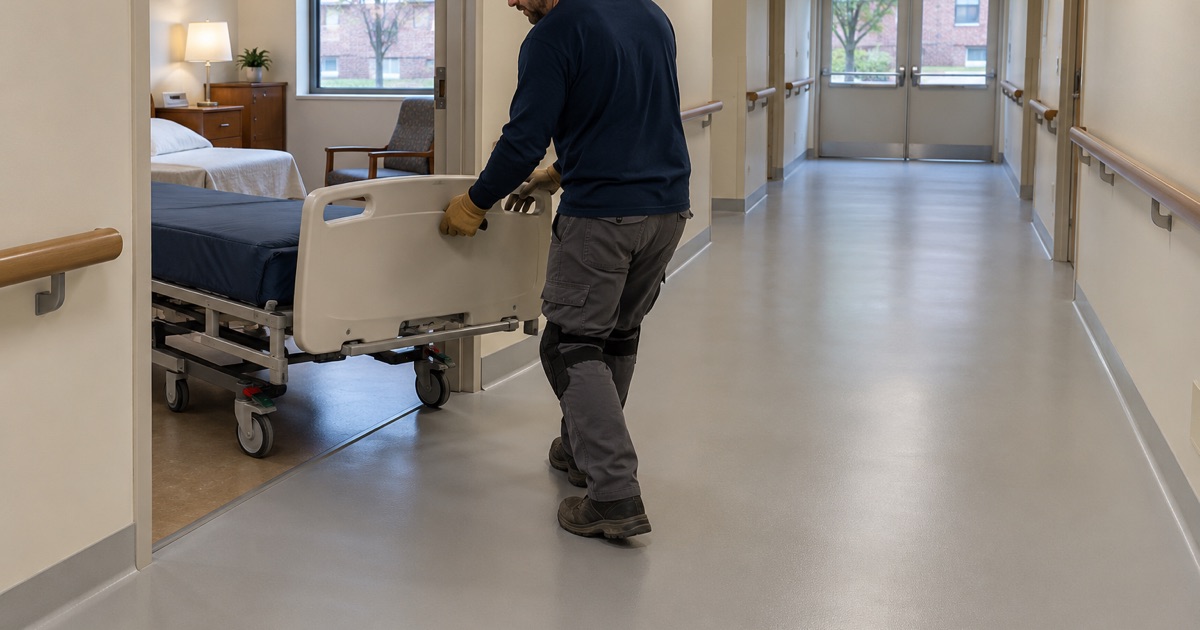
Meadowbrook Manor sits at 339 9th Avenue, a skilled nursing home of about 197 beds inside the village and inside Lyons Township. It also appears on the village’s principal-employer table, among the larger workplaces in La Grange. We have no relationship with the facility and have never seen its floors, but it is a clear example of the kind of building where floor finish turns into a daily maintenance problem.
A skilled nursing home never closes. Residents live there around the clock, staff move along the same corridors on every shift, and infection control asks everyone to clean their hands at almost every doorway. That last habit is the one that should decide what a corridor floor is made of, and it is rarely part of the conversation when a floor is chosen.
Where the drips land
Health Facilities Management, a trade journal, described the pattern in a 2022 report on a hospital in California. People dispense the sanitizer and walk away rubbing their hands, dripping the product on the floor as they go. The report says those drips often create white spots, dark spots and sticky residue on a floor’s finish.
Now picture that in a nursing home, where an alcohol hand-rub dispenser hangs beside nearly every resident room, unit entrance and dining room door. The result is a ring of damage under each one, trailing off in the direction people walk away. Along a long corridor the floor ends up carrying dozens of separate spotted patches, each one marking where a dispenser sits.
Drawing the dispenser map first
Before we recommend a system for a care or clinic building, we walk the floors and mark every dispenser on a plan, wall-mounted and freestanding alike. The map shows where the drip zones sit, which doorways see the heaviest traffic, and where a topcoat will be tested hardest. It also shows where drip trays and mats under dispenser stands are worth keeping.
Trays and mats help, but they are not a complete answer. Floor-care trade sources note that alcohol leaches dye out of the mats, so a mat can stain the very floor it was meant to protect. We would rather the floor itself shrug off the drip and treat the tray as a second line of defense.
Looking for epoxy-flooring closer to Western Springs? See Western Springs Epoxy-Flooring.
Why Alcohol Spots a Waxed Floor, and What Stripping Costs a Building That Never Closes
Acrylic polish meets hand rub
Most vinyl corridor floors in care buildings are maintained with acrylic floor polish, a sacrificial film laid down in several coats and burnished to a shine. Alcohol softens and clouds that film. Floor-care trade sources say the spotting is usually removed only by stripping the finish and laying it down again, because buffing cannot reach damage that runs into the coat itself.
The strip-and-recoat cycle
A strip and recoat is a wet, chemical job. The old finish is dissolved with stripper, scrubbed and picked up, the floor is rinsed, and fresh coats go down one at a time with drying between each. In an office building that happens over a weekend with the doors locked, but a nursing home has no weekend and no locked doors.
So the work runs corridor by corridor, with sections roped off, residents and carts routed around wet floor, and the smell of stripper hanging in an occupied building. Then the dispensers keep dripping, and the spotting starts again on the new finish. A floor that needs that cycle because of a product used dozens of times a shift is a floor working against the building.
What a resin floor changes
A resin floor removes the sacrificial layer altogether. An epoxy or urethane cement body carries the traffic, and a urethane topcoat forms the wearing surface, chosen for its resistance to the chemicals that actually reach it. There is nothing to strip, so routine care falls back to a neutral cleaner and an auto-scrubber on the housekeeping schedule the building already runs.
Alcohol-Resistant Topcoats, and Why a Coated Floor Should Never Be Waxed
Matching the topcoat to the hand rub
Hand rubs are not all the same product. Some are built on ethanol and some on isopropanol, and the gels and foams carry thickeners and skin conditioners that leave a film of their own. We ask for the product the building actually stocks, read its label, and choose an alcohol-resistant topcoat against that chemistry rather than against a generic brochure claim.
Manufacturers publish chemical-resistance charts for exactly this reason. One epoxy sheet we work from rates ethanol at 93 percent and lists isopropanol as resisted, which tells us the base coat will hold if a drip gets through. The trade journal report describes the California hospital answering its drip problem with a high-performance polyurethane coating, the same family we look at first for a corridor finish.
Never wax a coated floor
This is the step facilities teams most often get wrong. Out of habit, a crew will lay acrylic polish over a new resin floor to make it shine, and the moment they do, the corridor is back to a wax surface. The alcohol spots the wax exactly as before, and the strip-and-recoat cycle starts running on top of a floor that never needed it.
So the handover includes a written maintenance sheet for housekeeping that names the cleaner, the pad and the dilution, and says plainly that no finish goes over the topcoat. If the gloss fades in the heaviest lane after years of traffic, the fix is a fresh topcoat over a lightly abraded surface, done in sections. That is a far shorter closure than any stripping cycle.
Reading the existing floor before quoting
Care, clinic and school floors are scheduled around the hours the building has to keep running, which usually means overnight or weekend windows taken zone by zone. Grinding dust is captured at the machine by an extractor rather than swept up later. Before any of that is booked, we read the existing floor, because vinyl tile, old adhesive and patched concrete all change what the slab needs.
The slab underneath gets the same moisture testing as any other job, with ASTM F2170 in-situ relative humidity probes or ASTM F1869 calcium chloride tests. Where the numbers are high, a moisture-mitigation primer goes into the build and onto the proposal. If the slab needs repair before it can be coated at all, the proposal says that plainly as well.
Sanitizer, Spray Cleaners and Solvent Drips on La Grange Garage and Basement Floors
The same chemistry at home
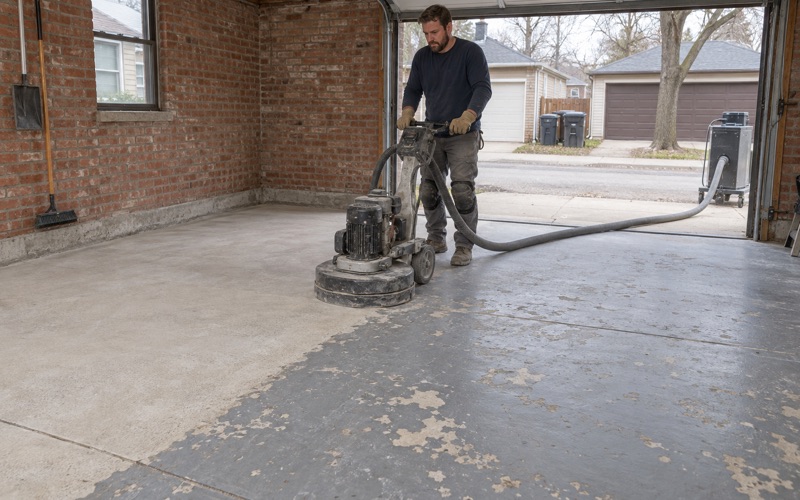
Alcohol does not only drip in nursing homes. A typical garage holds windshield washer fluid, brake cleaner, spray degreasers and often a pump bottle of hand sanitizer by the door to the house. Each of those lands on the floor sooner or later, and a cheap one-part garage paint softens or clouds under them just the way acrylic polish does in a corridor.
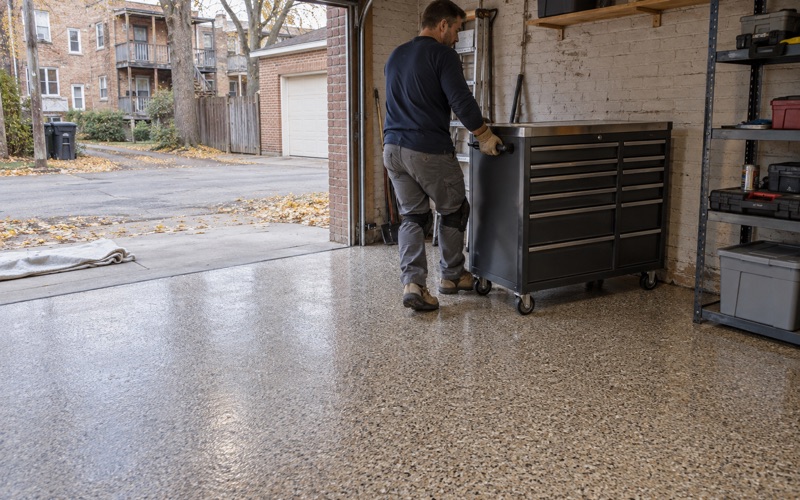
For that reason we finish garage floors with polyaspartic or urethane topcoats over a 100% solids epoxy base, with a vinyl flake or quartz aggregate broadcast between them. The topcoat is what meets the solvent drips, the hot tire pickup, and the calcium chloride and rock salt a Cook County winter tracks in on the tires. Every product is chosen within the Illinois limit on VOC content, which binds the installer as well as the manufacturer.
Old slabs, tested first
More than a third of the housing in La Grange was built in 1939 or earlier, and nearly two-thirds predates 1960. Every one of those slabs went down before ASTM E1745, first published in 1997, defined a modern under-slab vapor retarder. So we test a basement or garage slab for moisture before coating it rather than assuming it is dry, and the test is a line item in the quote, not something sold after a floor blisters.
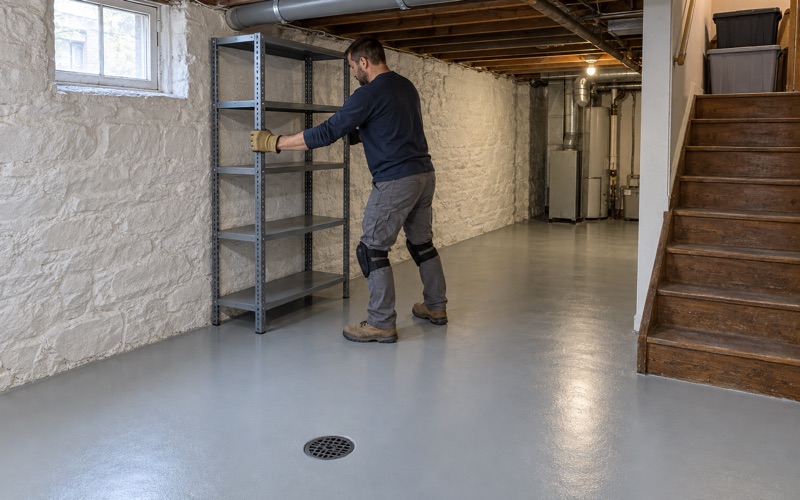
Basement floors in these older houses also get checked for paint, patches and old tile adhesive before a system is chosen, since a coating bonds only as well as what sits under it. Where a slab shows wide cracks or a failing old coating, we say plainly whether it can be repaired and coated or needs replacing first.
Cold garages and the paperwork
An unheated detached garage cannot be coated on a calendar date. We schedule curing against slab temperature and the dew point spread at the slab surface, and when the slab is too cold we say the job waits for spring rather than risk amine blush or a soft cure.
Illinois issues no state license for flooring or coatings work, so we confirm the village’s own contractor rules before a job is scheduled. The village’s permit page lists replacing existing flooring as work needing no permit but does not mention floor coatings, so we check with Community Development rather than assume. Every home job also gets a written contract and the Home Repair: Know Your Consumer Rights pamphlet before work begins, as the Illinois Home Repair and Remodeling Act requires.
- 20+ Years Coating Concrete
- Moisture Tested Before Quoting
- Written Contract on Every Home Job