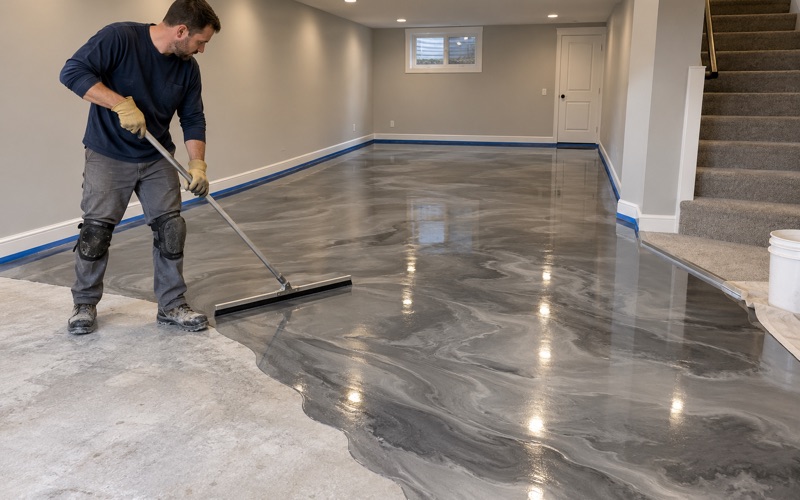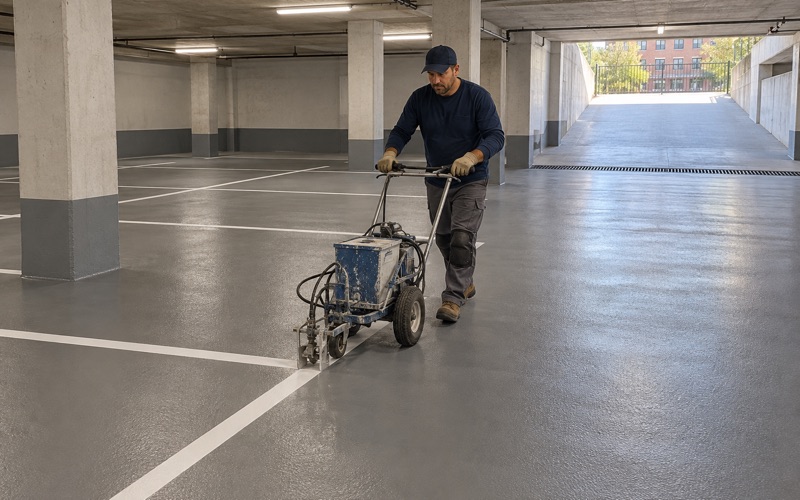
Oak Park Epoxy Flooring brings more than 20 years of resinous floor work to epoxy flooring in La Grange Park, and the jobs we think hardest about are the floors that get mopped every day. A surface washed on a schedule, with disinfectant and a wet mop, fails in different places than a garage slab that sees road salt a few months a year. Its finish has to tolerate the chemistry, and its edges have to leave dirt nowhere to settle.
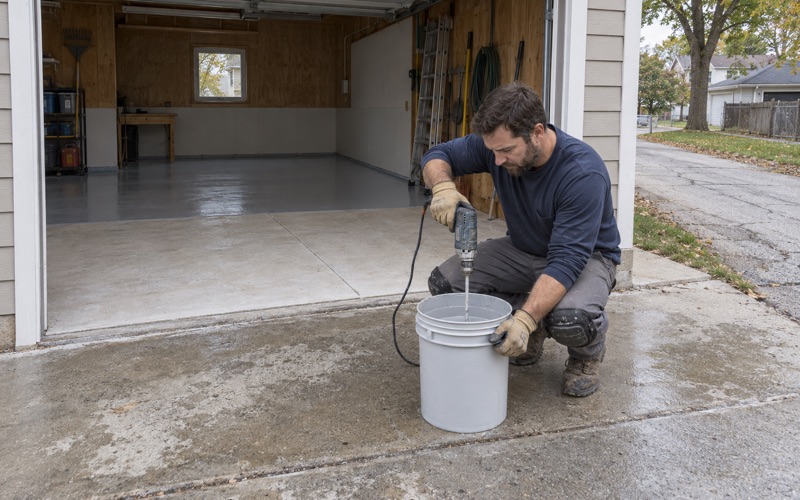
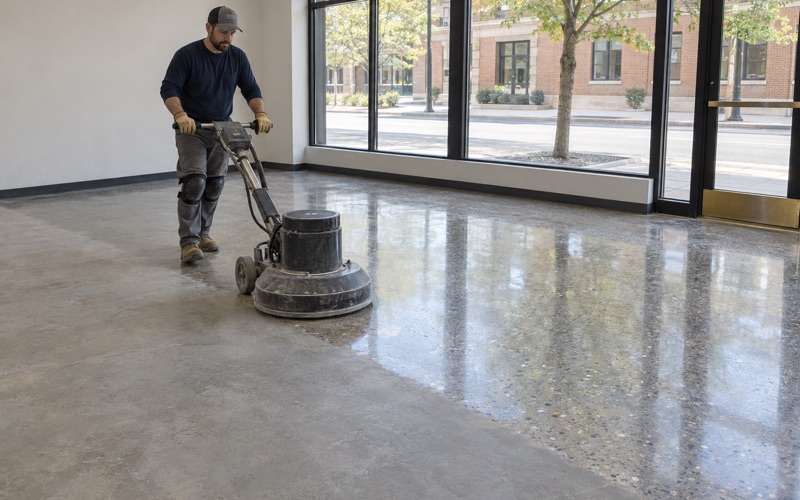
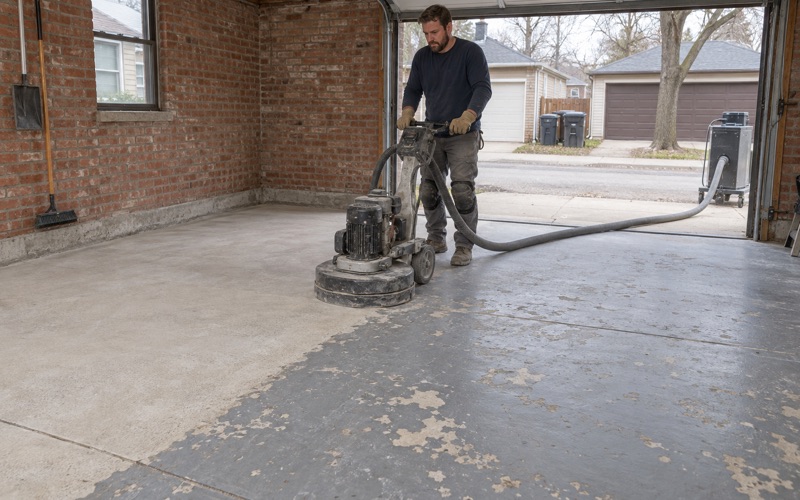
Every one of those floors starts the same way with us. We open the slab mechanically with a diamond grinder or shot blaster to a measured ICRI CSP profile, and we never acid etch. Moisture testing is written into the scope as its own line, using ASTM F2170 in-situ relative humidity probes or ASTM F1869 calcium chloride tests, so a vapor problem is found before the coating goes down rather than after it blisters.
Our proposal names the product, the system build and the finished thickness, so the floor you receive can be checked against the one you were quoted. Before we price anything, we read the cracks and any old coating on the slab and tell you plainly when repair or replacement has to come first. Warranty exclusions get read aloud before the job is sold, and moisture is the first one we name.
A Lockup Inside La Grange Park’s Village Hall
La Grange Park keeps a working jail under the same roof as its local government. The building at 447 N. Catherine Avenue holds Village Hall, the Police Department and Fire Station 1, and it sits inside the village in Proviso Township, Cook County. The police department even offers public tours, roughly half an hour long, that walk visitors through the front desk, the jail, the lockup room, the records section and the roll call room.
We mention it because few residents think of a holding cell as a floor problem, and it is one of the clearest examples of a floor shaped by cleaning. To be clear, the police station is a place on this page, not a customer of ours; we have not seen its lockup floor, its drains or the scope of its recent work. The village’s police station renovations were listed as a 2025 Paschen Prize finalist, and that listing names the project and nothing more.
What the State Asks of an Existing Jail
Illinois sets standards for municipal jails and lockups under 20 Ill. Adm. Code 720, and the part that governs an existing building does not write a floor specification at all. Section 720.40 asks that the building meet local, state and federal building, fire, safety and health requirements, and that heating and cooling routinely hold the space between 67 and 85 degrees. The detailed floor rules sit in a different section, 720.160, which governs new construction.
What the code does set for a working lockup is a routine. Under 720.90, cells and detention rooms are cleaned daily whenever they are occupied, the areas next to them are kept clean and orderly, and walkways and corridors may not be used as storage. The same section requires that a vermin and pest control program be implemented, which puts the floor inside a building that is checked for whatever hides in it.
Why the Routine Decides the Floor
When the rules describe a cleaning schedule instead of a material, the material has to be chosen for the schedule. A cell or corridor floor that is wet-mopped every day with disinfectant needs a finish that does not soften, haze or lose its gloss under that chemistry. It also needs to be continuous, because a surface cleaned daily is only as clean as its worst seam.
That reasoning is our reading of the standard, not a requirement the state places on any existing lockup. Illinois does not require epoxy, or any other coating, in a cell that is already built. A floor in this kind of room is a judgment about cleaning, pests and downtime, and the same judgment carries into every other room that gets mopped hard.
Looking for epoxy-flooring closer to Westchester? See Epoxy-Flooring in Westchester.
Seams, Drains and Wall Bases Where Dirt Sits
On a floor that gets cleaned daily, the open field is rarely where trouble starts. Grime, moisture and pests collect at the edges: around a floor drain, along the wall base, inside a crack that was never filled and at the line between two pours. Those are the details we look at first when a facility manager asks us to quote a hard-use room.
Drains
A drain is where every mop pass ends, so it takes more water and chemistry than any other square foot of the room. We grind right up to the drain body, build the coating into the collar instead of stopping short of it, and detail the transition so there is no lip for water to sit behind. A gap at the drain ring is a home for debris and a path for water under the coating.
Before any of that, we check the slab around the drain for moisture, since that is where older concrete is most often damp. An ASTM D4263 plastic sheet test can flag a problem quickly, but we rely on relative humidity probes or calcium chloride readings for a number we can hold a product to. If the readings call for it, a moisture-mitigation primer goes down first.
Wall Bases and Coves
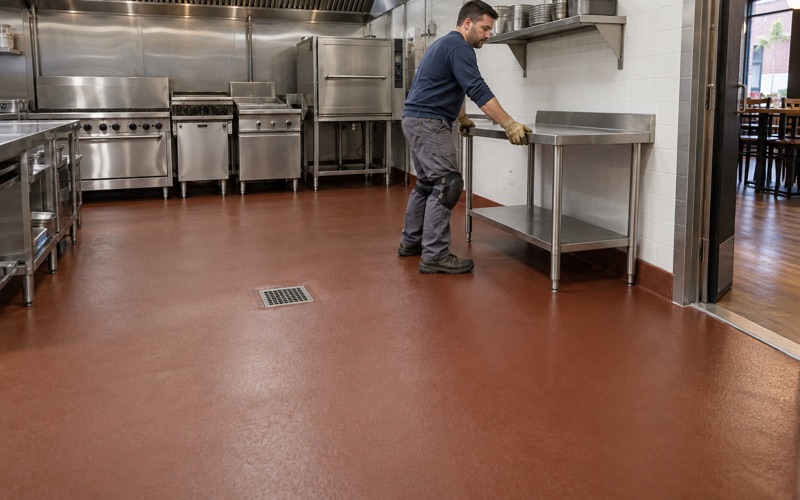
Where the floor meets the wall, a square corner collects whatever the mop pushes into it every day. Running the coating up the wall as an integral cove base, a curved transition with no seam at the floor line, removes that corner entirely. The FDA Food Code asks for coved floor and wall junctures in kitchens under 6-201.13, and the reason carries over to any washed room: a surface that can be cleaned in one pass.
Cracks, Joints and Hiding Places
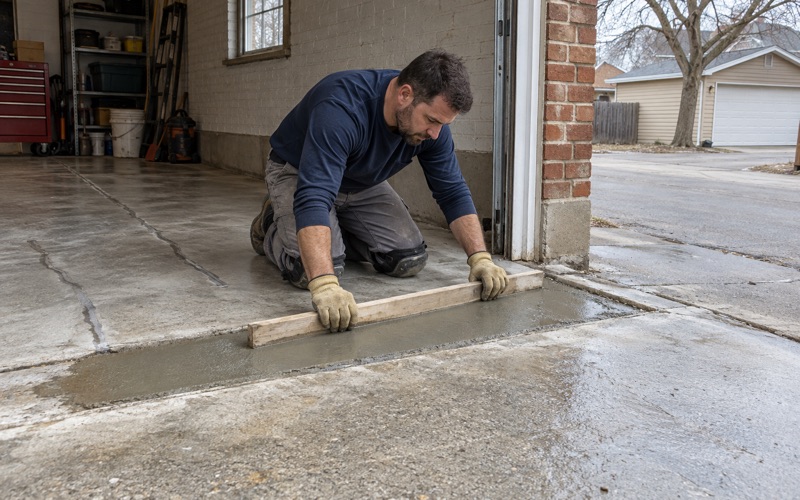
A crack left open under a coating usually shows back through it, and a broken edge is the first place a mop snags. We read every crack before quoting, fill static cracks with a rigid material, and treat moving joints so they can keep moving. When a slab is too far gone for a coating to make sense, we say so before the work is sold rather than after the floor fails.
Sealing these details does a quiet second job. A floor with no open cracks, no gap at the base and no void at the drain gives insects and debris fewer places to settle, which is the practical side of a standing pest-control program. A coating is not pest control, but it takes away the hiding spots that a pest program would otherwise have to chase.
Recoating a Holding Area That Cannot Close for Long
A lockup, a clinic, a restaurant kitchen and a school washroom share one problem: none of them can shut down for a week while a floor is redone. The answer is rarely one long closure. It is a plan that splits the floor into pieces small enough to prepare, coat, cure and return to service while the rest of the building keeps operating.
Working in Phases
We map the floor into zones that match how the room is actually used, such as one cell, one stretch of corridor or one side of a room at a time. Each zone is ground, primed, coated and cured before the next is opened, with grinding dust collected at the machine. Clinic, restaurant, school and storefront jobs are scheduled around operating hours, including overnight and weekend windows.
The joint between one phase and the next gets the same attention as a drain. We feather and profile the edge of the finished zone so the next pour bonds to it, rather than leaving a ridge that holds grime. A visible seam line is a cosmetic matter, but a raised one is a cleaning problem on a floor that is mopped every day.
Choosing a System That Returns Fast
Return-to-service time drives the material choice in an occupied building. A 100% solids epoxy base is tough and chemical resistant but needs time to cure, while polyaspartic and polyurea topcoats can take foot traffic much sooner and resist the yellowing that sunlight or bright lighting brings. In wet, hot or heavily washed areas, urethane cement is the system we look at for its tolerance of thermal shock and harsh cleaners.
Curing follows the slab, not the calendar. We measure slab temperature and the dew point spread at the surface, because a coating applied too close to the dew point can blush, leaving a greasy amine film that weakens the next coat. Inside a heated building that window is usually predictable, which is one more reason an occupied public space is easier to phase than a cold garage.
Odor and VOCs Next Door
People keep working in the next room while we coat, so a product’s emissions matter as much as its hardness. We choose floor coatings within the Illinois VOC limits for architectural coatings, 35 Ill. Adm. Code Part 223, which bind the installer as well as the manufacturer. Low-odor systems and a ventilation plan are part of the schedule from the first walkthrough.
The Same Logic for a La Grange Park Mudroom or Utility Room
Most of our calls in La Grange Park come from homes, not public buildings, and many are about a room that gets mopped as often as a corridor. A mudroom where boots drain, a laundry or utility room beside a sump pit, a basement workroom that takes pet traffic: each is cleaned constantly and fails first at its edges. The lockup lesson applies almost word for word.
What Is Already on the Floor
An older basement floor rarely arrives bare. We check for paint, patches and old adhesive before choosing a coating, because each one changes how the slab has to be prepared and whether a new system will bond. Grinding removes most of it, but some old mastics and paints call for testing first, and we tell you that before we quote.
Moisture is the bigger unknown below grade. Hydrostatic pressure under a basement slab can push vapor up through it, and efflorescence, the white mineral bloom on bare concrete, is often the first sign. That is why moisture testing sits in our scope as a priced line rather than an upsell, and why it leads the warranty exclusions we read to you.
Drains, Sump Pits and Honest Limits
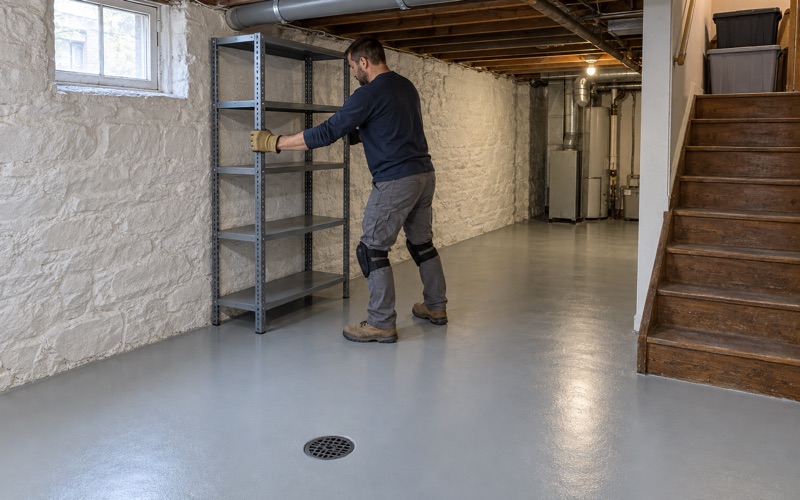
A utility room floor gets the same detailing as a lockup corridor, with the coating carried into the drain collar and a cove at the wall where it makes sense. Around a sump pit, we finish the edge cleanly so the lid seats and water cannot track under the coating. We also do not sell a floor coating as radon reduction; in Illinois that work takes a state radon mitigation license.
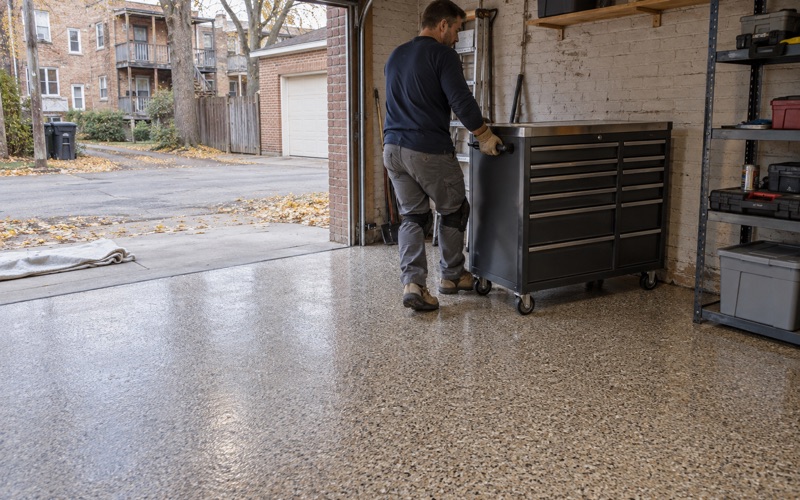
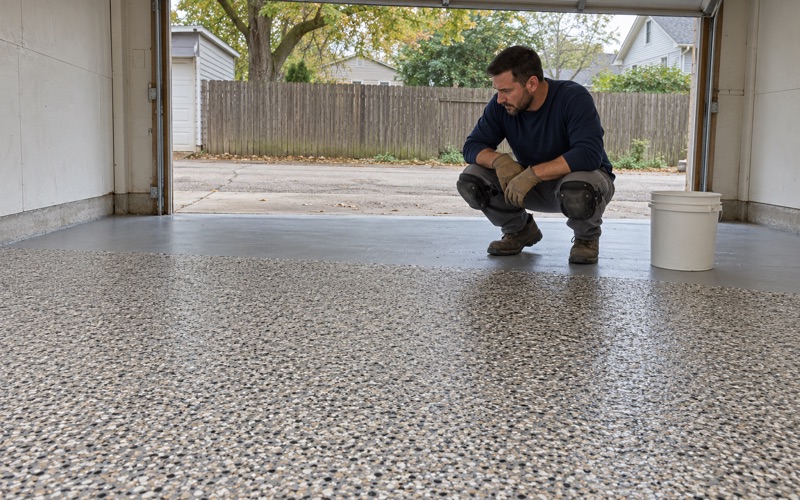
When the mudroom opens into an attached garage, the threshold takes the calcium chloride brine and rock salt a Cook County winter tracks in on tires and boots. We build that floor with a quartz or vinyl flake broadcast for grip and a topcoat that resists salt and hot tire pickup. The coating stays continuous across the door line, so slush has no seam to work into.
Permits and Paperwork
La Grange Park’s Building and Inspectional Services lists painting or surface coating as work exempt from permit, and Illinois issues no state license for flooring or coatings contractors. We still confirm the village’s own contractor rules before scheduling, since a job that grows into new concrete is a different matter. Every home job comes with a written contract and the Home Repair: Know Your Consumer Rights pamphlet, as the Illinois Home Repair and Remodeling Act requires.
- 20+ Years Coating Concrete
- Moisture Tested Before Quoting
- Written Contract on Every Home Job