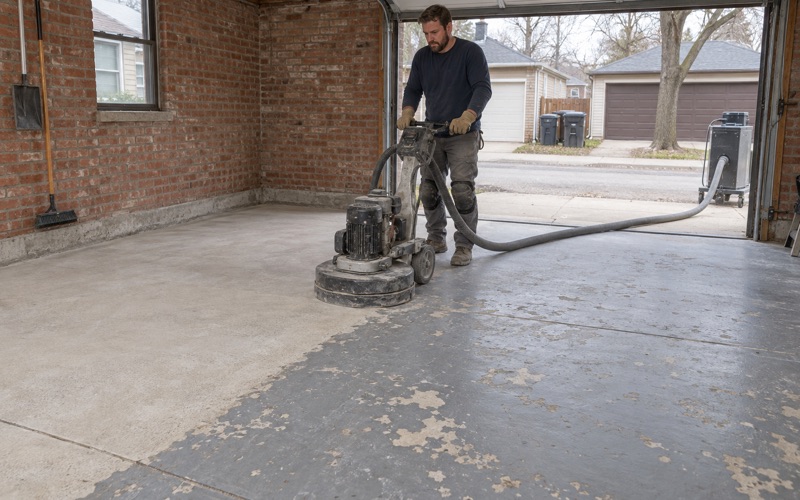
Oak Park Epoxy Flooring brings more than 20 years of work to epoxy flooring in Lyons, coating garages, basements and small shop floors for owners who want a surface they can keep clean without babying it. Every slab we take on is opened mechanically with a diamond grinder or shot blaster before any resin goes down. We do not acid etch, because a coating needs a real profile to grip, not a slab that has been rinsed and hoped over.
Our proposals name the product, the system build and the finished thickness in writing, so what you were quoted can be checked against what was installed. Moisture testing sits on that same proposal as its own line item, on a basement slab and a garage slab alike. A blistered floor is a poor moment to start asking whether the concrete was wet.
This page covers one hazard that a coated floor meets more often than most people expect: the solvents that come with gluing plastic pipe. A good coating is tough, but it is not immune to everything. The habits around a can of primer can matter as much to a floor’s future as the system underneath it.
A Plumbing Supply House on Ogden Avenue
Lyons is a village in Cook County with a population of 10,817 at the 2020 census, and it is home to the Chicago Portage National Historic Site. It is also a place where plenty of plumbing work is done by owners and small contractors who pick up their own fittings. That second fact is the one that matters to a floor.
Harlem Plumbing Supply at 8641 West Ogden
Harlem Plumbing Supply sits at 8641 West Ogden Avenue, open 7:30 a.m. to 6:00 p.m. on weekdays and 8:00 a.m. to 2:00 p.m. on Saturdays. Its own site lists more than 20,000 SKUs and categories that include PVF Supplies and Plumbing Chemicals, with copy addressed to residential and commercial projects alike. We have no connection to the store and have not seen which primer brands it carries.
We mention it because a supply house like that puts PVC primer and solvent cement within easy reach of anyone redoing a laundry drain or a utility sink. When that job happens in a garage or a basement with a coated floor, the can on the workbench becomes part of the floor’s story. Most of the damage we see from it is avoidable.
Why plumbing chemicals are a floor question
Most people think of a coated floor’s enemies as road salt, hot tires or a dropped wrench. Primer and solvent cement rarely make that list, yet they are among the most aggressive liquids a homeowner is likely to open indoors. They are made to soften plastic so two pieces fuse, and a cured resin floor is a plastic too.
That does not mean every drip ruins a floor. It means the way a spill is handled in its first minute decides whether it leaves a mark, a soft spot or nothing at all. Knowing what is in the can is the start of handling it well.
Looking for epoxy-flooring closer to Norridge? See Epoxy-Flooring in Norridge.
What Is in PVC Primer, and What One Resin Chart Says About It
Acetone, cyclohexanone, THF and MEK
Oatey’s safety data sheet for its purple and clear primers, version 1.1 issued October 19, 2023, lists the blend by weight. Acetone makes up 40 to 50 percent, cyclohexanone 20 to 30 percent, tetrahydrofuran 10 to 20 percent and methyl ethyl ketone 10 to 20 percent. The sheet classes the product as a highly flammable liquid and warns that it may form explosive peroxides.
Purple primer carries a dye so anyone checking the work can see that a joint was primed, while clear primer is the same solvent blend without the color. Solvent cement, the glue that follows the primer, is generally built on the same family of ketone and ether solvents. All of them are meant to evaporate quickly, which is part of why a puddle does its work fast.
Attacked on contact or within hours
Flowcrete publishes a chemical resistance table, dated 2021.12.06, built from coupons of its own products cured for ten days and then immersed. Its scale runs from 5, meaning no harmful action over the long term, down to 0, meaning attacked on contact or within 2-3 hours. White spirit scores 5 on every product group on the same chart, which shows the scale is not simply harsh across the board.
Acetone scores 0 on every column, from solvent-free epoxy coating through polyurethane coating to vinyl ester. MEK scores 0 everywhere except vinyl ester. THF scores 0 on all but the polyurethane screed, which rates 3, and cyclohexanone scores 0 on the epoxies but 5 on the polyurethanes.
Those are one manufacturer’s immersion tests on its own systems, not a verdict on every floor coating sold. The chart itself notes that real-world resistance should beat the table, thanks to good housekeeping combined with evaporation. Still, a primer is a blend of all four solvents, and the largest share of it rates 0 on every epoxy listed.
What that means for the system we choose
When we build a garage or shop floor, we pick the system for what that floor will actually see, and the proposal names the product and thickness so you can hold us to it. A polyaspartic or polyurethane topcoat can change how a floor handles some solvents, as the cyclohexanone column hints. No system lets a coated floor sit under a puddle of primer without consequence, and we will not sell one as if it does.
Why Acetone Is the Wrong Fix for a Purple Stain
How a primer stain sets
Guidance on purple primer spills is fairly consistent. A spill wiped up right away may leave little color, but once the solvent has evaporated the dye is hard to remove, and on bare concrete a shadow can remain. That advice is written for uncoated concrete, where the only question is appearance.
On a coated floor the solvent is doing two jobs at once. It carries the dye, and it is working on the surface of the resin, so a spill left to sit can soften the film and draw the color into it rather than leaving it on top. That is why speed matters more on a coating than on bare concrete.
The cleanup trap
The usual advice for lifting a purple stain is to reach for acetone, clear primer or MEK. Those are the same ketone solvents that rated 0 on the chart, simply without the dye. On a coated floor that approach adds more of the chemistry that caused the problem and spreads it across a wider patch.
We do not recommend scrubbing a coated floor with acetone, MEK or primer, and we do not recommend acid on one either. A finishing forum puts the acid point bluntly: etching bare concrete will remove any coating or sealer as well. If a stain has set into a coating, the honest repair is usually to abrade and recoat that area, which we can quote once we have seen it.
What to do in the first minute
The safety data sheet sets out the order. Remove any ignition source first, since the vapor is highly flammable, then contain and absorb the spill with vermiculite or another absorbent, wipe it up, and collect the residue in a flammable waste container. The sheet says to clean up all spills immediately, and on a resin floor that word carries the most weight.
Once the puddle is gone, a damp cloth with a mild household cleaner is enough to lift the film the absorbent left behind. If a dull ring or soft spot shows after the floor dries, leave it alone and call us rather than attacking it with something stronger. A small mark is a small repair, and chasing it with solvent is how it grows.
Gluing Pipe Over a Coated Floor in Lyons
Set up before the can is opened
Plenty of the garages and basements we coat in Lyons will see a plumbing repair at some point. When pipe is glued over a coated floor, we suggest working over a canvas drop cloth or a tray, with each fitting held above the cloth rather than above bare resin. A drop cloth is far cheaper to replace than a section of coating.
Keep the dauber in the can between joints, and set the can on the drop cloth instead of on the floor. A tipped can of primer can empty itself in seconds, and the purple will travel along any slight slope toward the low point of the slab. Wipe drips off the outside of the can before setting it down, too.
Keeping cans closed and off the floor
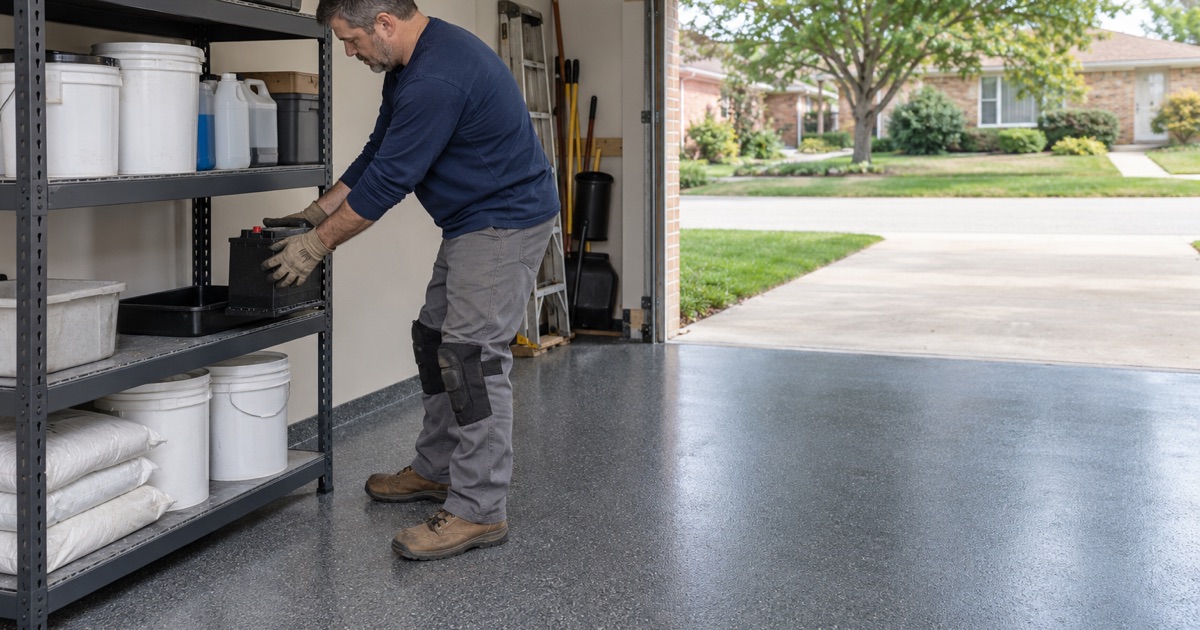
Primer and cement cans should be closed tight whenever they are not in use. An open can releases vapor the whole time it sits there, and a lid left loose is how a knocked can turns into a puddle. Storing them on a shelf rather than on the slab removes the most common cause of spills.
The Oatey sheet also says to store the product in its original container in an approved flame-proof area, and not in pits, depressions, basements or places where vapors may be trapped. For a Lyons homeowner, that means leftover primer from a basement repair should not live on the basement floor afterward. A closed cabinet in a detached garage, away from heat, is a better home for it.
What we check when a coated floor has met primer
If you call us about a floor that already has purple rings or soft patches, we look at the extent of the damage before we quote. A small, shallow mark can often be sanded and recoated within the existing system, while wider damage may mean grinding the area back and rebuilding it. We read the old coating and the cracks around it, and we say plainly which kind of job it is.
On any new floor in a basement that sits under supply lines or a water heater, we note where future repairs are likely before choosing a system. Moisture testing with ASTM F2170 in-situ probes or an ASTM F1869 calcium chloride test is part of that scope, since a slab that is damp underneath fails long before a primer spill could touch it. Curing is then scheduled against slab temperature and dew point, not the calendar.
Every home job comes with a written contract and the Home Repair: Know Your Consumer Rights pamphlet before work starts, as the Illinois Home Repair and Remodeling Act requires. Warranty exclusions are read out before anything is signed, with moisture named first. That way, nobody learns the limits of a floor from a purple stain or a blister.
- 20+ Years Coating Concrete
- Moisture Tested Before Quoting
- Written Contract on Every Home Job