Oak Park Epoxy Flooring installs metallic epoxy floors in Oak Park, IL, serving surrounding cities including River Forest, Forest Park, River Grove, Bellwood and Brookfield. A metallic floor is the most decorative system we build in more than 20 years of coating concrete, and it is also the one that most depends on a flat, carefully prepared slab.
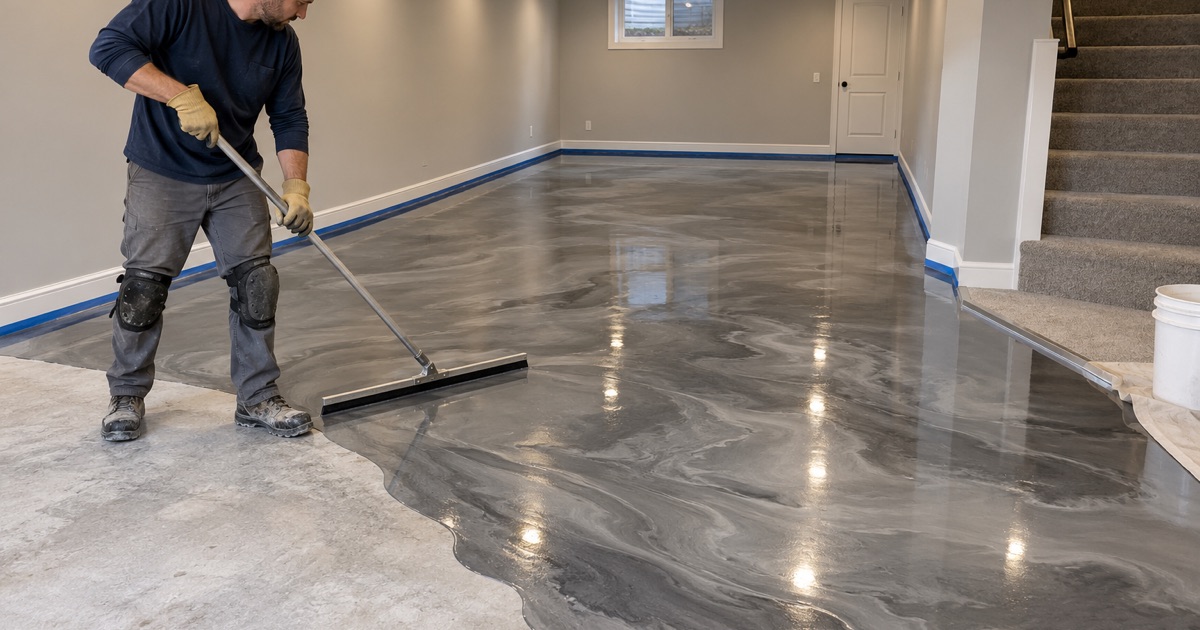
Metallic epoxy uses fine metallic pigments suspended in a clear or tinted epoxy. While the resin is still wet, the installer moves it with rollers, brushes, sprayed solvent or air to create swirls, veins and pools of light, so the finished floor reads like marble, poured stone, water or lava depending on the colors and technique.
Because the pattern is formed by hand in a short working window, every metallic floor is unique. That is the appeal, and it is also why we spend more time on samples, slab flattening and layout before the pour than on almost any other floor we install.
What Makes a Metallic Epoxy Floor Different
Metallic Pigments and How the Pattern Forms
The metallic pigment is made of tiny reflective flakes that align as the resin flows. Where the resin is moved, the flakes swirl and catch light differently, producing the depth and three-dimensional look that sets a metallic floor apart from flake or solid color.
The movement keeps happening for a short time after the installer stops working the resin, as the pigments settle and the coating levels. Our crews know how a given product continues to move, and they plan the final passes with that drift in mind.
Color Choices and Multi-Color Floors
Metallic floors can be a single color with a lighter or darker base coat beneath it, or two and three colors worked into each other. Silver and pewter tones read like brushed steel, coppers and bronzes look warm under incandescent light, and blues and greens can read like water.
We pour sample boards in your chosen colors with the same products and technique we will use on the floor. Color charts and online photos cannot show how two metallic tones will blend, so the boards are the decision point.
The Look You Can Expect, and What You Cannot Control
We agree on the general effect with you in advance: subtle and cloudy, bold and veined, or something between. What no installer can promise is an exact copy of a photo, because the pattern depends on the slab, the temperature, the humidity and the moment-to-moment movement of the resin.
That is why we talk about direction rather than a guaranteed pattern. Owners who want a predictable, repeatable look are usually happier with a flake or quartz floor, and we say so before the sale.
Borders, Inlays and Mixed Metallic Systems
A metallic field can be framed with a solid-color border, divided by saw-cut lines or broken up with inlaid logos and lettering placed between coats. In a basement bar or a showroom, that framing gives the free-flowing pattern a clear edge and keeps it from reading as unfinished at the walls.
Some owners pair a metallic floor in a living area with a flake floor in an adjoining laundry room or workshop. We plan the transition line in advance so the two systems meet cleanly at a door or a saw cut rather than in the middle of a room.
Preparing a Slab for a Metallic Floor
Grinding, Flattening and Surface Profile
A metallic floor shows every dip, ridge and trowel mark under it, because the reflective pigment highlights changes in surface plane. We diamond grind the slab to remove coatings and laitance, flatten high spots and open the surface to the profile the primer requires.
We never acid etch. On a decorative floor the uneven profile left by etching shows up as patchy color and an uneven bond, and it can show in the final surface as cloudy or dull areas.
Crack Filling and Skim Coats
Every crack, spall and pit has to be filled and ground flush before the metallic coat, because the resin will settle into any low spot and show it as a dark line. On slabs with many repairs, we apply a skim coat or a self-leveling epoxy to give the metallic coat a uniform base.
Moving cracks are a different matter. A crack that is still opening will reflect through any coating, and on a decorative floor it will be obvious, so we tell you when a slab needs repair or replacement before it is a good candidate for a metallic finish.
Moisture Testing Under a Decorative Floor
Moisture coming up through a slab can cause blisters, hazing and adhesion failure, and on a metallic floor even a small blister ruins the look. We test before quoting, with calcium chloride kits to ASTM F1869 or relative humidity probes to ASTM F2170, and we include the result in the proposal.
Where the slab tests high, a moisture-mitigation primer goes down before the metallic coat. That primer also serves as the base color, so it is chosen with the metallic design in mind.
Where Metallic Epoxy Floors Work Best
Finished Basements and Living Spaces
Metallic epoxy is a popular choice for finished basements, where it turns a gray slab into the main design feature of a family room, bar or media room. It is seamless, easy to clean and works well with area rugs.
Older basements need the same moisture and preparation work as any coated basement floor. We test, grind off old paint and adhesive and plan the layout around floor drains and sump pits before choosing colors.
Showrooms, Salons and Retail Spaces
Showrooms, salons, boutiques and restaurants use metallic floors to give a space a distinctive, high-end look that photographs well. The floor becomes part of the brand, and the glossy finish reflects lighting in a way few other floors can.
In commercial spaces we phase the work around business hours and plan pours by section, because the metallic coat in each area must be completed in one continuous session to avoid visible seams.
Garages and Workshops
A metallic garage floor is striking, but it is less forgiving than a flake floor. It shows salt residue, tire marks and scratches, and the gloss can be slippery when wet, so we only recommend it with a durable topcoat and an honest conversation about upkeep.
In detached garages, temperature matters more than usual. The metallic coat needs a warm slab to flow and level properly, and we schedule by slab temperature and dew point rather than by the calendar.
Topcoats, Care and Longevity
Polyaspartic and Urethane Topcoats
The metallic coat is usually protected with a clear topcoat. A polyaspartic or aliphatic urethane topcoat resists scratches and chemicals and does not yellow in sunlight the way standard epoxy does, which matters near windows and garage doors.
We can finish the topcoat in high gloss for maximum depth, or in satin to soften reflections and hide fine scratches. A fine grit can be added for traction in kitchens, entries and bathrooms.
Caring for a Metallic Floor
Dust mopping, a neutral cleaner and walk-off mats at entries keep a metallic floor looking right. Felt pads under furniture prevent scratches, and harsh or abrasive cleaners should be avoided because they dull the topcoat. When the topcoat wears in heavy traffic lanes after years of use, it can be lightly abraded and recoated without disturbing the metallic layer underneath.
Proposals, Warranties and Paperwork
Our proposal names every product in the system, from the primer to the metallic coat to the topcoat, along with the finished thickness. We read out the warranty exclusions before the job is sold, with moisture first, and every home job gets a written contract and the Illinois consumer-rights pamphlet before work starts.
- 20+ Years Coating Concrete
- Moisture Tested Before Quoting
- Written Contract on Every Home Job