Oak Park Epoxy Flooring brings more than 20 years of slab work to epoxy flooring in Norridge, and the floors that teach us the most are the ones under heavy equipment that never moves. A kitchen or a basement full of appliances is judged less by its color than by what happens at the feet of the machines standing on it. That narrow strip is where a coating either keeps going or quietly stops.
Our approach starts with the concrete rather than the brochure. Every slab is opened with a diamond grinder or a shot blaster, never acid etched, and moisture testing sits in the scope as its own priced line before any resin is mixed. The proposal names the product, the system build and the finished thickness, so an owner can hold what went down against what was quoted.
This page is about one detail most floor quotes skip: the space under and around equipment that does not move. Commercial kitchens, bakeries and basement workrooms all have it, and the rules a food business works under treat it as a cleaning question before anything else. Below we explain how the coating is planned around that question, and what a coating can and cannot do.
A Family Bakery on Irving Park Road and the Food Code’s Choice
Palermo Bakery sits at 7312 West Irving Park Road, inside the village of Norridge and Norwood Park Township. It describes itself as a small family business selling cakes, pastries, breads and savories, with wholesale accounts and nationwide shipping alongside the counter trade. Its doors are open Monday through Saturday from 8:00 a.m. to 5:00 p.m., and it closes on Sundays for family.
We have never worked there and have not seen the bakery’s equipment or floor, so nothing on this page describes them. We use it as an example because a bakery of that kind, baking for a shop counter and for wholesale orders at once, is exactly the operation that fills a room with heavy fixed pieces. Ovens, mixers, proofers and long worktables are not things anyone rolls aside to mop behind.
Sealed to the floor or 6 inches up
The FDA Food Code gives fixed floor equipment two choices in section 4-402.12. Equipment that is not easily movable must either be sealed to the floor or stand on legs that leave at least a 6 inch clearance between the floor and the unit. Norridge’s Health Department has worked from the 2022 edition of that code since January 1, 2025, so the rule is current here rather than a distant reference.
There is one narrower allowance written into the same section. Under 4-402.12(B), the clearance may drop to 4 inches when no part of the floor beneath the unit is more than 6 inches from the point where someone cleans. A shallow worktable can fit that description, while a deeper piece of equipment generally will not, because the back of its footprint sits out of reach.
Why the floor decides whether it works
Both options put the floor in charge. Raised equipment only works if the surface under the legs is as continuous and cleanable as the open aisle, and sealed equipment only works if the base it sits on is sound and the seal around it has something solid to bond to. A coating cannot make an installation meet the code, but a weak one can undo either choice.
The equipment itself is placed, leveled and anchored by the equipment installer or the kitchen contractor, not by us. Our part is the surface under and around it, and we plan that surface around whichever route the owner and their installer have chosen. Knowing that decision before we quote is what lets us price the right details instead of guessing at them.
Looking for epoxy-flooring closer to Franklin Park? See Epoxy-Flooring Services in Franklin Park.
Under the Legs: A Floor a Mop Can Reach
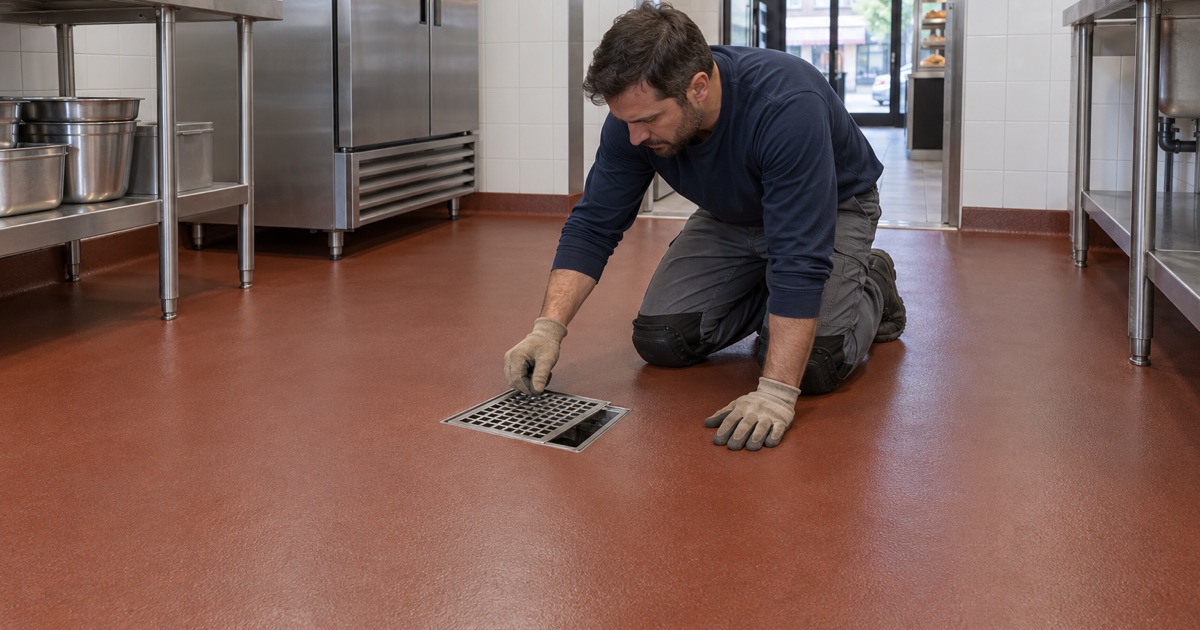
Raised equipment creates a low, dark strip of floor that sees little foot traffic and a great deal of debris. In a bakery, flour and crumbs drift under worktables and mixer stands all day, and the floor beneath has to take a wet mop, a scrub brush and repeated cleaning chemicals without breaking down. That strip is often where an older coating fails first, because nobody looks at it until it has already lifted.
Run the coating continuous
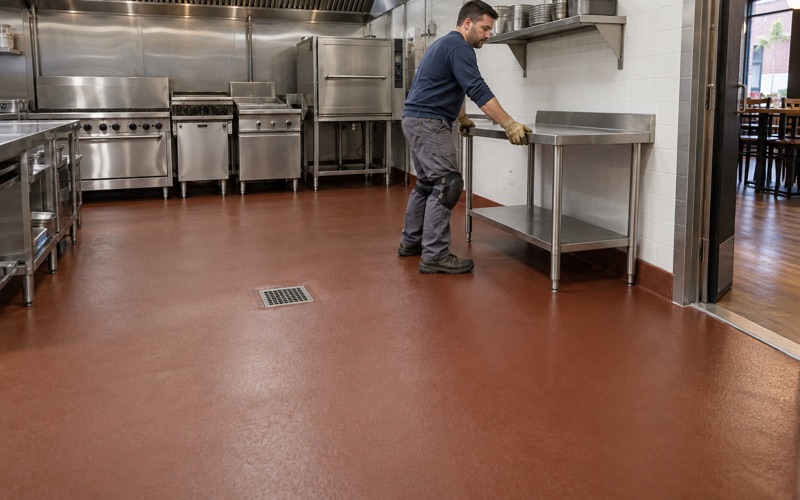
We carry the system straight through under raised equipment rather than stopping at the outline of each piece. When a coating ends at the leg line, the bare concrete behind it absorbs water and soil, and the edge of the coating becomes a small ledge that catches flour paste. A continuous floor leaves nothing for a mop to snag on and no seam for water to find.
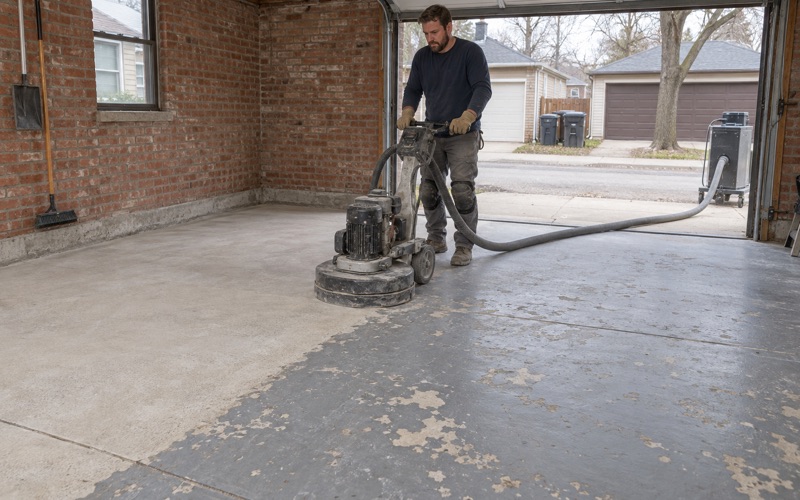
Doing that means the equipment has to come out, or at least be lifted, while the slab is prepared. We grind the full area, including the strip under each piece, and edges and tight corners get a hand grinder so the profile under the legs matches the profile in the aisle. Skipping that step is how a floor ends up bonded well in the open and poorly where the cleaning is hardest.
Texture that still cleans
Food Code section 6-201.11 asks for floors that are smooth, durable and easily cleanable, and it allows antislip applications used for safety. That exception is why a textured kitchen floor is acceptable at all. How much texture to use is still a judgment, and we would rather place it deliberately than broadcast one grade of quartz aggregate across the whole room.
A coarse profile gives traction where water and flour mix in the walking lanes, but under equipment the same profile holds dirt that a mop slides right over. We usually tighten the texture in the strips beneath raised pieces and keep more grip where people work and carry trays. We talk that tradeoff through with the owner before the system is written up.
Moisture under the footprint
Equipment footprints hide moisture problems, since a slab under a proofer or a cooler can stay damp longer than the aisle beside it. We test before quoting with ASTM F1869 calcium chloride kits or ASTM F2170 relative humidity probes, and the readings decide the primer. Where they call for it, a moisture-mitigation primer goes down first, and the warranty exclusions, with moisture named first, are read out before the job is sold.
Sealed Bases and the Coved Joint the Coating Ties Into
Sealed equipment is the other route under 4-402.12, and it asks more of the floor along one specific line. Where a unit sits on a concrete or masonry curb, or is set down and sealed directly, the coating has to meet that base cleanly. If the joint opens, flour, water and cleaning solution creep under the edge, out of sight of anyone holding a mop.
The base underneath
Before anything is coated, we look closely at the base the equipment will sit on. A crumbling curb, a hollow patch or a crack running into the base will keep moving, and any seal laid over it moves with it. We read the cracks and the old coating when we quote, and we say plainly when a base needs repair before it can be coated rather than covering the problem over.
A cove that belongs to the floor
Food Code section 6-201.13 asks for floor and wall junctures to be coved and closed rather than left as an open corner. We build the same profile where the floor meets a curb or a sealed equipment base: a resin cove, troweled up the face and tied into the floor system so floor and base read as one piece. A cove that is merely caulked on afterward is the version that peels.
Urethane cement is often the right resin where a cove sits beside ovens or hot wash water, because it tolerates heat and thermal shock better than standard epoxy. The proposal names the product and the finished thickness of both the cove and the floor. That way an owner, or a later contractor setting new equipment, can check exactly what was installed and where it stops.
Working around a bakery’s hours
A busy bakery cannot close for a week while a floor cures. We schedule kitchen work around the hours a business has to keep running, including overnight and weekend windows, and we sequence the room so the line can return in stages. Curing is timed against slab temperature and the dew point spread at the surface, not against a promise made on a calendar.
Freezers, Workbenches and Shelving on Norridge Basement Floors
The same logic applies at home on a smaller scale. Norridge is a village of owner-occupied houses, most of them built in the 1950s and 1960s, and plenty of those basements hold a chest freezer, a second refrigerator, steel shelving and a workbench. None of that is governed by the Food Code, but each piece traps the same strip of floor that rarely gets cleaned.
Raise it or coat under it
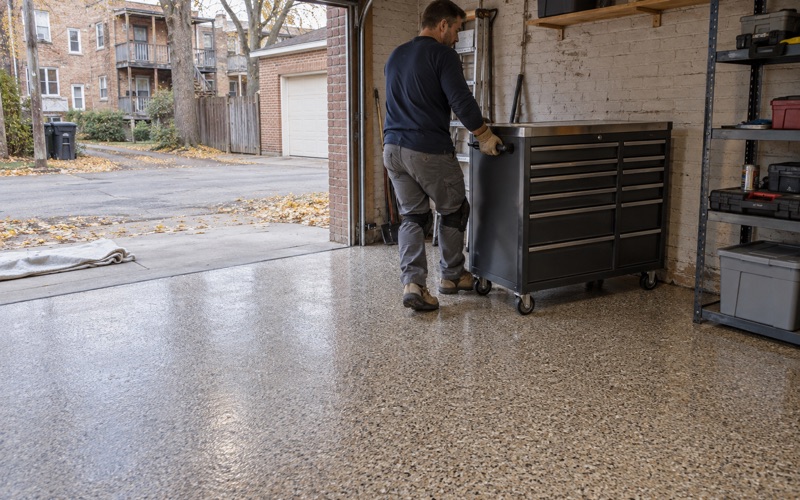
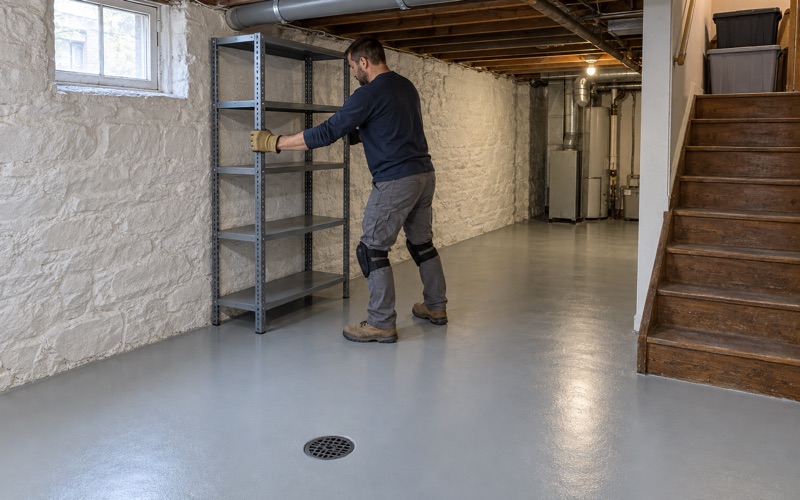
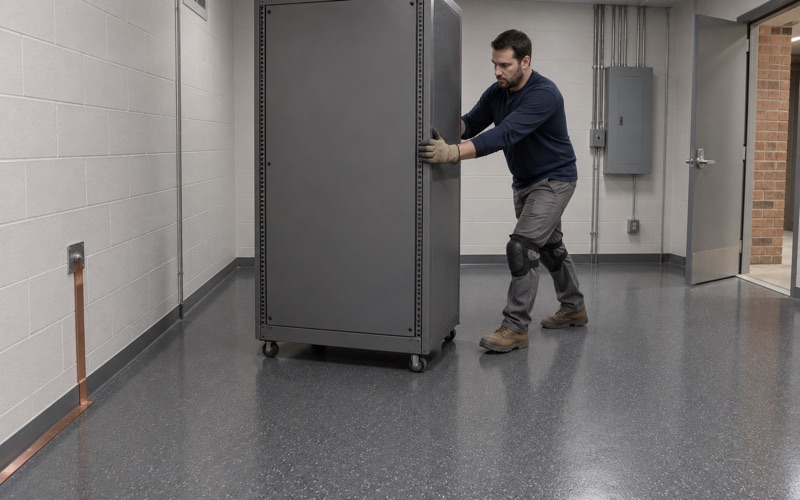
We often suggest setting heavy basement items on legs or a low platform before the coating goes down, so the floor under them can be wiped and checked. A freezer sitting directly on concrete hides any seepage until the damage shows somewhere else, and shelving feet can scuff through a thin film over time. Where an item stays on the floor, the coating runs under its full footprint.
Check the old floor first
Basement slabs in older houses often carry layers of paint, patches and old tile adhesive, and we check for each before a system is chosen. An ASTM D4263 plastic sheet test gives a first read, and a calcium chloride or probe test follows where the slab warrants it. Grinding then removes the old layers so the new coating bonds to sound concrete instead of to somebody else’s paint.
What a coating will not do
A coated basement floor is easier to clean after a leak, but it does not stop a sewer backup. If water comes up through the floor drain, the drain and the backflow question come first, and we say so before quoting. We also never sell a coating as radon reduction, because that work takes a state radon mitigation license in Illinois.
Permits and paperwork
Norridge’s Building Department registers contractors by calendar year, requires registration for basement remodels and commercial projects, and asks for a permit on construction, remodeling or upgrading work. Illinois issues no state license for floor coating, so we confirm the village’s current rules before a job is scheduled. Home jobs also get a written contract and the Home Repair: Know Your Consumer Rights pamphlet before any work starts.
Whether the floor sits under a mixer stand or a basement freezer, the question is the one the Food Code asks of a bakery: can someone reach it and clean it. We build the coating to answer yes. Where the slab, the drain or the equipment setup has to be dealt with first, we tell you that up front.
- 20+ Years Coating Concrete
- Moisture Tested Before Quoting
- Written Contract on Every Home Job