Oak Park Epoxy Flooring has spent more than 20 years installing epoxy flooring in Palos Hills and across the southwest suburbs, and the jobs that teach us the most are the ones with big windows. A resin floor that sits in daylight all day has a different job than one under a garage door. We build those floors for color stability as much as for wear, and we say so in the proposal.
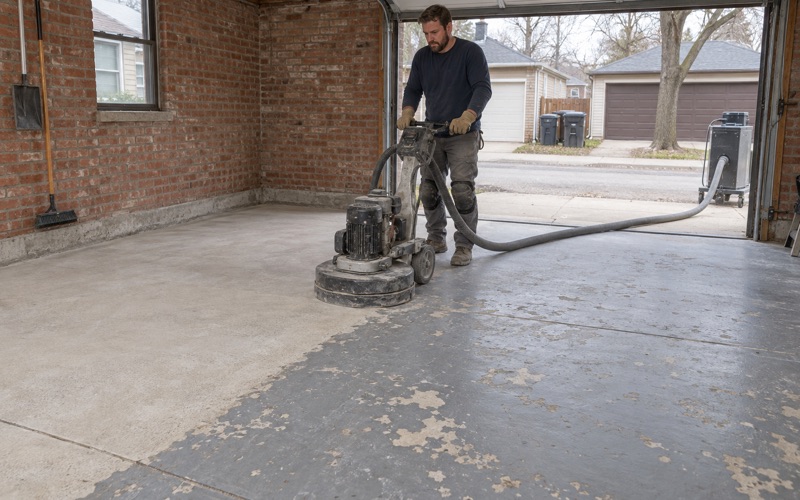
Every slab we coat is opened mechanically with a diamond grinder or shot blaster, never acid etched, and moisture testing is written into the scope before anyone talks about color. The proposal names the product, the system build and the finished thickness. That way an owner can check what went down against what was quoted, line by line.
Commercial floors here go down under the city’s own contractor registration, which carries a bond and an insurance certificate. We confirm those rules before a job is scheduled, because Illinois issues no state license for flooring or coatings work. Lobbies, storefronts and clinic entries are scheduled around the hours the building has to stay open, including overnight and weekend windows.
A Two-Story Glass Atrium at Moraine Valley
Moraine Valley Community College’s campus sits inside Palos Hills, in Palos Township, Cook County, and its Fine and Performing Arts Center is the clearest local example of the problem this page is about. The college describes north and south entrances that open into a two-story, glass-enclosed atrium showered with natural light. That light highlights display cases for student, staff and community artwork.
The building is mainly known for its stages. The 575-seat Dorothy Menker Theater is the center’s main attraction, and the 125-seat Oremus black box sits alongside it with flexible seating. For a floor contractor, though, the interesting room is the bright one people walk through to reach them.
What we know and what we do not
We have not read what the atrium floor actually is. It could be terrazzo, tile, stone or resin, and the college is a local landmark to us, not a customer. We use it here because it shows, in a building many people in the city have walked through, what daylight does to a floor every single day.
A floor under two stories of glass takes direct and reflected sun for hours, across every season. For a resin system, that exposure is a chemistry question before it is a wear question. Foot traffic scuffs a topcoat slowly, while ultraviolet light works on the resin film from the first sunny morning after the job is handed over.
Why a lobby is not a garage
Most epoxy goes down in places the sun rarely reaches, like basements, garage interiors and warehouse aisles. A standard system was built for those rooms, and it performs well in them. Put the same build behind a glass front and the weak point shifts from abrasion and hot tire pickup to the resin’s response to ultraviolet light.
That is why our commercial walkthroughs ask about windows, not just about traffic and cleaning. Which way does the glass face, how many hours of sun reach the floor, and does light land in a band across the entry? Those answers change the system we write into the proposal.
Looking for epoxy-flooring closer to Worth? See Worth Epoxy-Flooring.
Why Epoxy Yellows, and Why Light Colors Show It First
Standard epoxy floor resins are aromatic, which means they are built on bisphenol-A chemistry with ring structures in the polymer. Ultraviolet light degrades those aromatic rings, and the film turns amber as it does. This is a chemical change inside the coating itself. It cannot be scrubbed, buffed or stripped off with a cleaner.
Practitioners across the trade say the same thing plainly: no epoxy, clear or pigmented, is fully UV resistant. That includes 100% solids epoxy, which earns its place on a floor for build thickness and chemical resistance, not for color stability. A clear epoxy topcoat actually shows ambering more, not less, because nothing in the film hides the shift.
Lighter colors amber first
Altro’s technical guide for its epoxy flooring says it directly: in common with other epoxy products, lighter colors are prone to cosmetic yellowing on exposure to UV light. A white, light gray or pale beige floor shows the change first. A darker body color carries the same chemistry but hides a slow shift far better.
That matters in a lobby, because owners often pick a light color precisely to brighten an entry. We walk through that tradeoff at the color-chip stage. If a client wants a pale floor in a sunlit room, the topcoat has to carry the color stability, and if a client prefers to skip that layer, a forgiving color is the honest alternative.
Where the sun lands matters
The same Altro guide tells installers to consider external influences on the finished floor, including the direction of light from windows. We take that literally. A band of sun across the front of an entry will age differently from the shaded floor behind it, and the line between them shows up over time on an unprotected epoxy.
So we map the light before we pick the build. On a glass-front room we note where the sun falls at different hours and whether furniture, mats or display cases will shade parts of the floor. Uneven exposure is one more reason to protect the whole surface rather than gamble on a color that hides the difference.
Aliphatic Topcoats: The UV-Stable Layer Over the Epoxy
The fix is not to abandon epoxy. Epoxy is still an excellent base coat for bonding to a properly profiled slab and building thickness. The answer is to finish it with an aliphatic layer, either an aliphatic polyurethane or a polyaspartic topcoat, whose chemistry lacks the aromatic rings that amber under ultraviolet light.
Sika describes its Sikafloor-315 N as an aliphatic polyurethane coating with UV blocker technology that provides superior ultraviolet screening. According to the data sheet, it significantly improves the color retention of the underlying resin floor system. It can go down as a clear coat over epoxy or polyurethane, and the maker lists museums, stadiums and education among its typical uses.
What an aliphatic topcoat does and does not do
No coating holds its color forever under sunlight, and we will not promise otherwise. An aliphatic topcoat improves color retention; it does not stop all change over the life of a floor. What it does is take the ultraviolet load that would otherwise land on the epoxy, so the color underneath holds far longer than it would if left bare.
Polyaspartic topcoats also cure quickly, which helps on a lobby that has to reopen. Many products are walkable within hours, though full hardness takes several days and the schedule depends on the product and the room. We name the exact product and its cure schedule in the proposal rather than quoting a generic figure.
How the build goes down
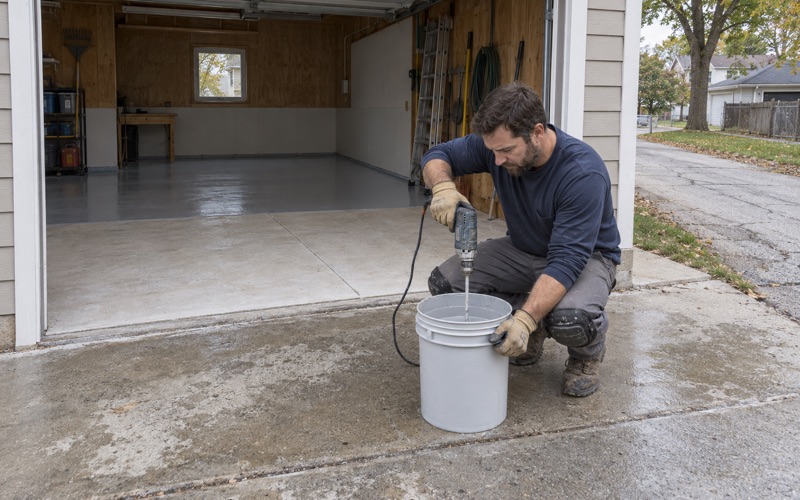
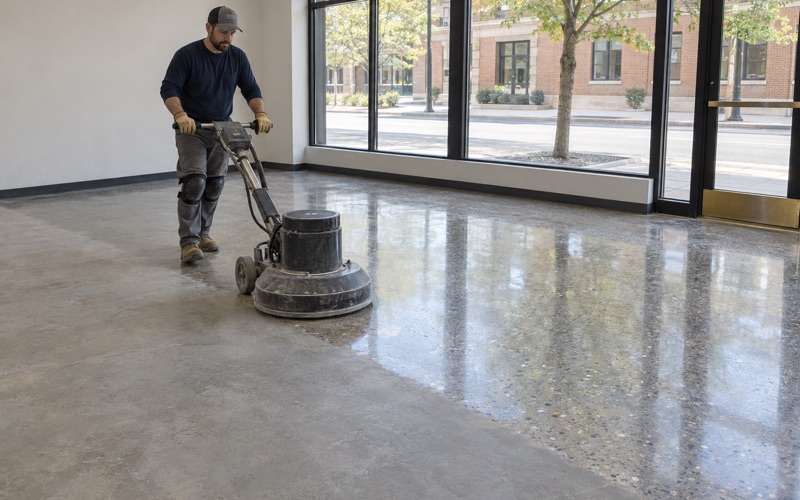
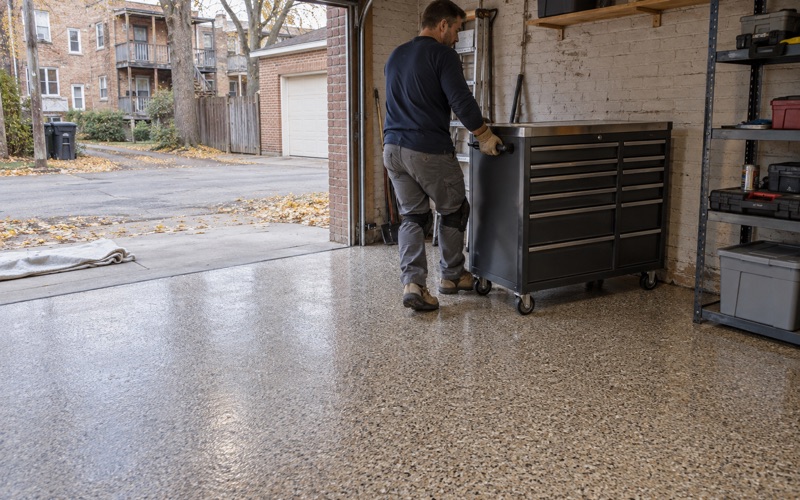
On a sunlit entry the sequence starts the same as anywhere. We grind the slab to the profile the primer needs, read the cracks and the old coating, and run moisture testing with ASTM F2170 in-situ relative humidity probes or ASTM F1869 calcium chloride tests. Then the epoxy base and any vinyl flake or quartz broadcast go down, and the aliphatic topcoat seals the system.
Curing is scheduled against slab temperature and dew point at the surface, not the calendar. A glass-front room in winter can sit cold at night and warm fast once the sun hits it, and that swing matters for amine blush and recoat windows. We watch the dew point spread before each coat rather than assuming the room behaves like a steadily heated interior.
Sunlit Lobbies and Glass-Front Entries Across Palos Hills
Palos Hills counted 18,530 residents at the 2020 census on 4.29 square miles, and most of its building took place from the late 1970s through the early 1990s. The city is now land locked, so most floor work here is renovation rather than new construction. Office lobbies, storefront entries, clinic waiting rooms and multi-unit vestibules with glass doors are where the UV question comes up most.
Storefronts and commercial entries
A storefront entry takes daylight through the glass and road grit through the door, so it needs both a UV-stable finish and a texture that holds up to salt season. We build those floors for the calcium chloride and rock salt a Cook County winter tracks in. A polyaspartic or aliphatic polyurethane topcoat with a fine aggregate handles both jobs in one layer.
Commercial property here needs a registered contractor under the city’s own permit rules. A general contractor registers with the City of Palos Hills Building Department for $50, good for two years, and posts a $25,000 surety bond with a certificate of liability insurance. We treat those as requirements to meet before scheduling, not as credentials to advertise.
Condominium lobbies and common areas
Owner households in buildings of three or more units outnumber renter households in such buildings here, so much of the multi-unit stock is condominium-form housing. A common-area lobby with a glass entry is often an association’s decision rather than one owner’s. We write the proposal so a board can compare an epoxy-only option and an aliphatic-topcoat option side by side, with the product, build and thickness named.
Warranty exclusions get read out before the job is sold, with moisture named first. On a sunlit floor we also say plainly what color change the chosen build can and cannot prevent. An owner who picks a pale epoxy without an aliphatic topcoat should hear before the job, not after the first summer, that ambering is the expected result.
Scheduling around an open building
Lobbies and entries rarely close for long. We stage the work in sections, collect grinding dust at the machine, and schedule around the hours the building has to keep running, including overnight and weekend windows. A quick-cure aliphatic topcoat often lets an entry reopen to foot traffic the next morning, depending on the product and slab conditions.
If your lobby, shop entry or glass-front room in Palos Hills takes daylight on the floor, start the conversation with the windows. Tell us which way the glass faces and what color you have in mind. We will tell you whether the build needs an aliphatic topcoat, a darker color, or both.
- 20+ Years Coating Concrete
- Moisture Tested Before Quoting
- Written Contract on Every Home Job