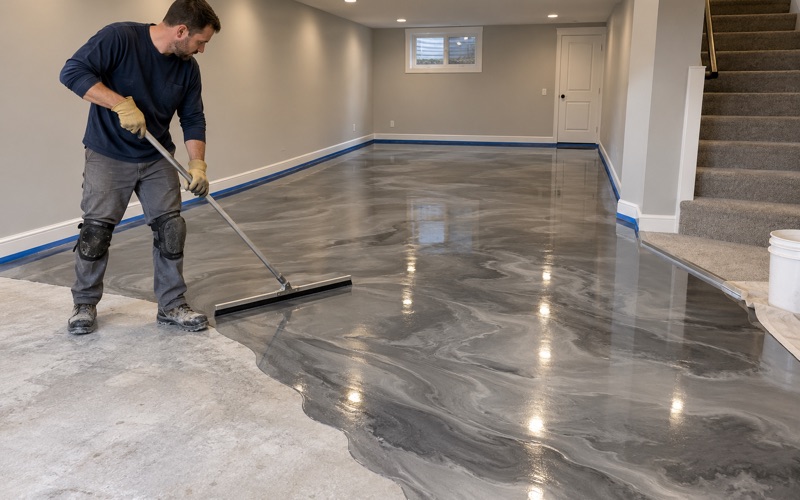
Oak Park Epoxy Flooring has spent more than 20 years putting down epoxy flooring in Summit garages, basements and working shops, and this page is about one corner of those floors that rarely gets planned: the place where a car battery sits. A leaking or tipped battery puts a strong acid on the slab, and the coating that faces it decides whether the spill becomes a quick wipe-up or a repair.
Most garage floor quotes talk about color, flake and gloss. We start with what will actually land on the floor, because a coating rated for oil and road salt can still lose its clear top layer to one splash from a cracked battery case. That is a product choice, and it gets made on paper before the grinder ever starts.
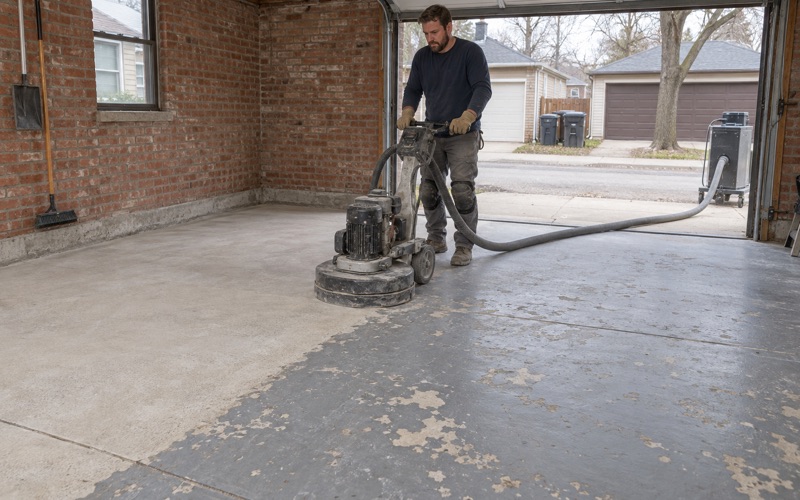
Every slab we coat is opened mechanically with a diamond grinder or shot blaster, never acid etched, and our proposal names the product, the system build and the finished thickness. If the battery corner needs a different topcoat from the rest of the garage, the written scope says so, and you can check it against what went down.
Batteries Swapped on Harlem Avenue, and What They Hold
Summit has an easy place to deal with a dead battery. The Advance Auto Parts store at 5944 S. Harlem Avenue lists battery installation, battery recycling and charging and starting system testing among its free in-store services, along with recycling for coolant, motor oil, oil filters and transmission fluid. That makes it simple for a home mechanic to buy, swap and return a battery the same afternoon.
We have no connection to that store, and we have not seen how it handles returned batteries or what its floor is. What matters for a Summit homeowner is the trip on either side of the counter: the old battery riding home in a trunk, sitting on the garage floor overnight, or waiting on a shelf for the next run up Harlem.
Lead, Plastic and Sulfuric Acid
One lead-acid battery maker’s safety data sheet lists the contents plainly. Lead and lead oxide make up 50 to 62 percent of the battery, the polypropylene case 6 to 10 percent, and the electrolyte, sulfuric acid and water, 28 to 35 percent. That is one manufacturer’s product rather than a figure for every battery on the shelf, but it is a fair picture of what a car battery holds.
The same sheet says the electrolyte causes severe skin burns and eye damage, and its handling advice is short: do not tip a filled battery, because it will spill. A cracked case, an overfilled cell or a battery set down hard on its side is how that acid usually reaches a garage floor. For most households it is the strongest chemical the garage will ever hold.
Why Acid Is Easy to Miss
Gasoline, motor oil and antifreeze get the attention because they are visible and they smell. Battery acid is quieter, often leaving only a damp ring or a white crust near the terminals, and it keeps working on whatever it touches until someone neutralizes it. On a coated floor, that slow and unnoticed contact is the exposure we plan for.
Looking for epoxy-flooring closer to La Grange? See Epoxy-Flooring Services in La Grange.
Epoxy Versus Polyurethane on One Maker’s Sulfuric-Acid Row
Coating manufacturers publish chemical-resistance charts, and they differ more than a brochure suggests. One resin maker’s chart, dated 2021, rates its products after immersion tests on cured samples, from 5 for no harmful effect after long-term contact down to 0 for attacked on contact or within two to three hours. A rating of 3 means unaffected after one month.
At 30 percent sulfuric acid, about the strength of battery electrolyte, that chart rates the maker’s solvent-free epoxy coating a 3. Its polyurethane coating and its flexible polyurethane coating are both rated 0 at that strength, while its vinyl ester is rated 5. At 10 percent acid the polyurethane coating moves up to a 3, which is why a heavily diluted spill and a fresh leak are not the same event.
Why the Clear Coat Is the Weak Layer
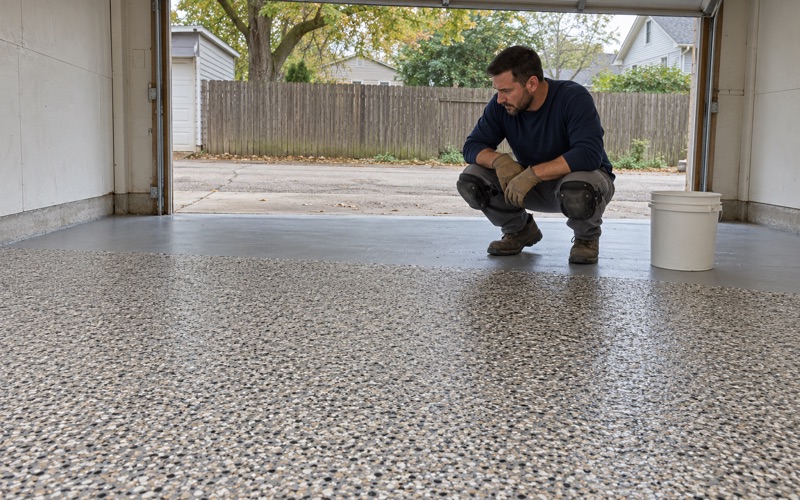
Many garage systems are built as a 100% solids epoxy base with a broadcast of vinyl flake or quartz aggregate, then sealed under a clear polyurethane, polyaspartic or polyurea topcoat for gloss and wear. That top film is what the acid touches first. If it is the layer a maker rates as attacked within hours, the damage shows up as a dull, etched patch right where the battery sat.
That chart is one manufacturer’s immersion test of its own product groups, and immersion is harsher than a splash wiped up the same day. Another maker’s topcoat may rate differently, and the chart itself warns that higher temperatures reduce resistance and that some chemicals concentrate as they evaporate. Battery acid left to dry on a floor is exactly that second case.
How We Choose the Topcoat for a Battery Corner
When a customer tells us batteries are charged or stored in the garage, we look up the sulfuric-acid row on the data sheet of the exact topcoat we plan to use, at the strength a battery actually holds. A general chemical-resistant label is not enough to go on. If the clear coat rates poorly there, we change the build or treat that corner differently, and the proposal names which.
Prep is the other half of the answer. We open the slab mechanically to a measured ICRI surface profile, so the base coat bonds into the concrete rather than sitting on top of it. Acid that finds an edge where a coating has lifted gets underneath the film, and a well-bonded system gives it far fewer edges to find.
Neutralize and Rinse: The Spill Routine That Spares the Floor
The battery maker’s safety data sheet gives a spill routine that works on a coated garage floor as well as anywhere. Contain a small spill with dry sand, earth or vermiculite, avoid combustible absorbents, and carefully neutralize the electrolyte with soda ash, sodium bicarbonate or lime. Sodium bicarbonate is ordinary baking soda, which is why we suggest keeping a box near wherever batteries live.
Baking Soda First, Then a Wipe and Rinse
Sprinkle baking soda over the wet area until the fizzing stops, which tells you the acid has been neutralized. Then pick up the residue and clean the spot with fresh water on a mop or rag, working from the edges in. Gloves and eye protection are worth the trouble, because the same sheet warns of severe burns.
Do not let a spill dry in place on the theory that it will evaporate. The water leaves, but the acid stays behind and grows stronger, and the chart we described notes that concentration makes a chemical more aggressive. A five-minute cleanup the same day is the difference between a clean topcoat and a sanded, recoated patch.
Never Down the Floor Drain
The data sheet is direct: do not allow un-neutralized acid to reach a sewer, and keep it out of waterways, basements and confined areas. That rules out hosing a fresh spill toward the floor drain. In Summit it matters twice, because the village’s 2024 hazard mitigation annex says sewer and rainwater are combined into one sewer, so whatever goes down a garage or basement drain joins that shared system.
Neutralized residue picked up with a rag or absorbent is a much smaller problem than acid poured into a drain. When we lay out a garage, we also note where the slab pitches and where the drain sits, so a battery shelf is not placed upslope of it. Grinding dust from our own work is collected at the machine and never washed toward a drain either.
What OSHA Asks of a Charging Room
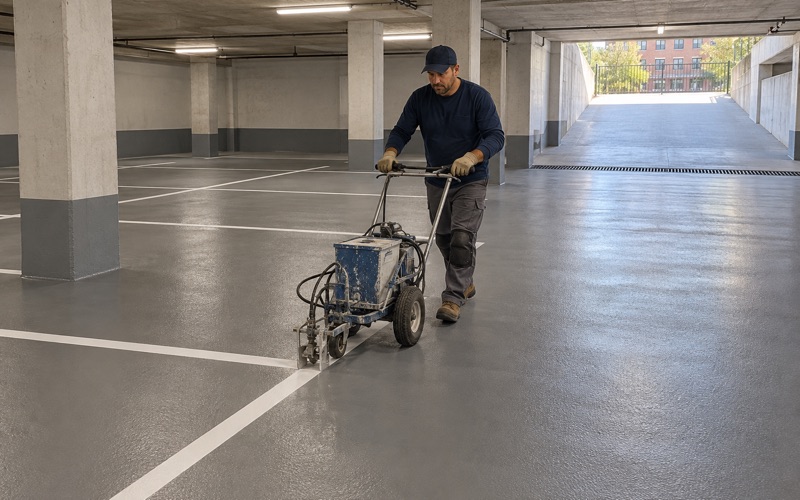
Shops that charge forklift and other industrial truck batteries fall under OSHA 29 CFR 1910.178(g). It requires charging in designated areas, with facilities for flushing and neutralizing spilled electrolyte, fire protection, protection of the chargers from trucks and ventilation for gassing batteries, and it says acid is poured into water, never water into acid.
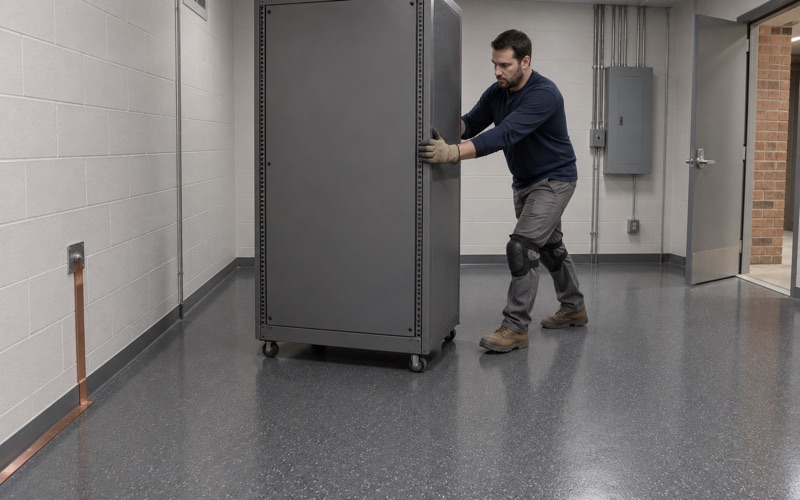
That paragraph names no floor material, and a floor coating does not satisfy it. A coating is not a way to contain a spill and does not replace the flushing and neutralizing equipment the rule asks for. What a well-chosen floor can do in a Summit shop or warehouse charging area is make those neutralized spills easier to clean and less likely to leave a mark.
Chargers and Spare Batteries in a Summit Garage
Most of the batteries in Summit are not in shops. They are in home garages, on a trickle charger for a mower or a car that sits through winter, or on the floor beside the door waiting for the trip to recycling. Every one of those spots is a place where a slow leak can sit unnoticed for weeks.
Trays and Impervious Shelves
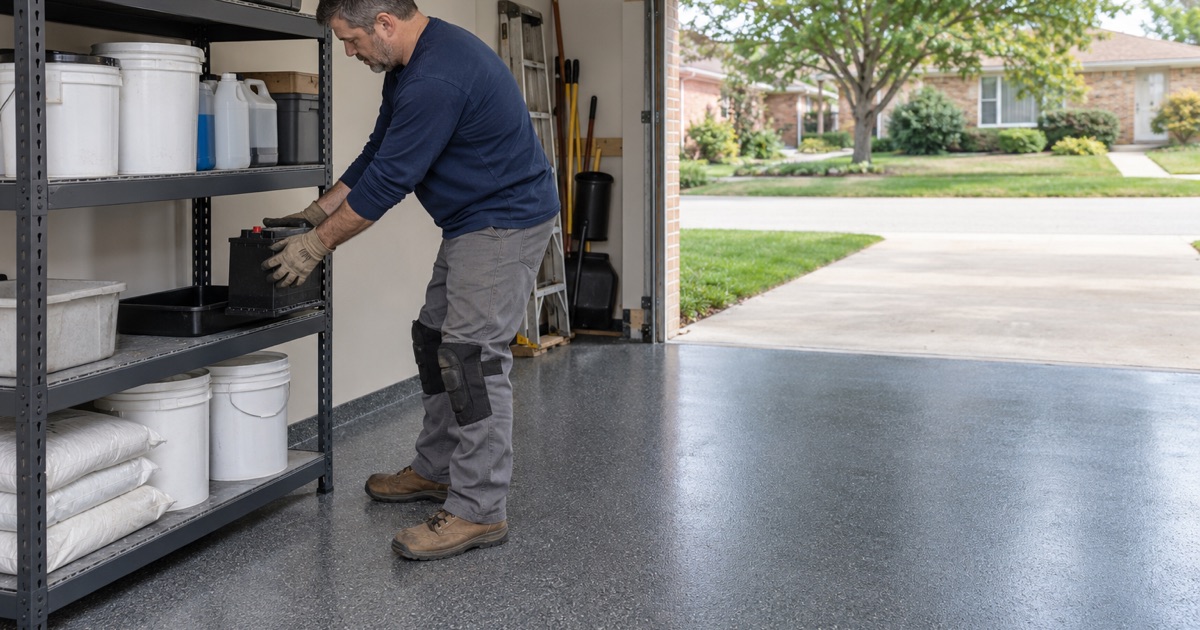
The safety data sheet says to store batteries on an impervious surface, and the simplest version is a plastic battery tray with a raised lip. A tray catches a weep from a terminal or a cracked case before it reaches the floor, and it can be lifted out, neutralized and wiped clean. Set it on a sturdy shelf, off the floor and out of foot traffic.
A charger should sit where the battery cannot be knocked over and where its cables do not cross the path of a car. We often suggest making the battery corner the far end of a workbench rather than open floor. That one decision does more for the topcoat than any product upgrade we could sell you.
Older Slabs and Floodplain Basements
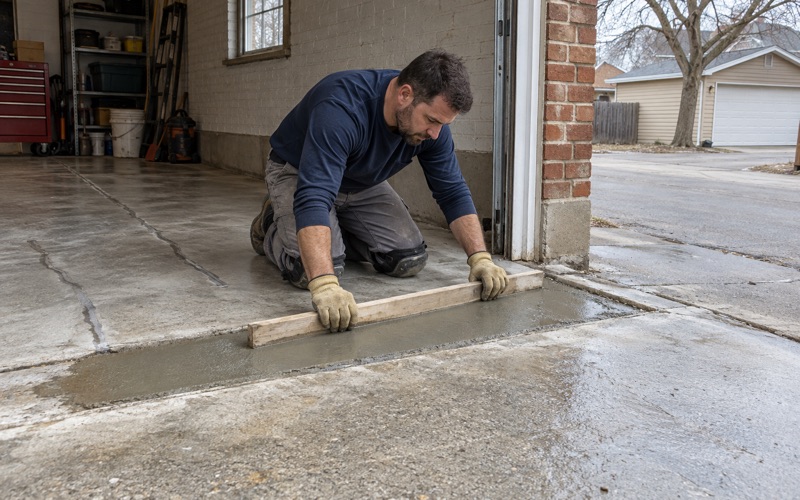
Most Summit homes were built before 1980, with the largest groups from the 1950s and 1960s and 845 units dating to 1939 or earlier, so nearly every job here is an existing slab. We read the cracks and the old coating before quoting, check for paint, patches and old adhesive, and say plainly when a slab needs repair before it can be coated.
The village’s own annex says most of Summit lies in the Des Plaines River floodplain and ranks flood as its number-one hazard. That is why moisture testing is a line item in our scope on a basement or garage slab, using methods such as relative humidity probes set into the slab under ASTM F2170, and why we say plainly that no floor coating stops a sewer backup. The floor drain and the backflow question come first.
Scheduling, Contracts and Village Rules
Curing is scheduled against slab temperature and the dew point spread at the surface, not the calendar, and an unheated detached garage may have to wait for spring. Warranty exclusions are read out before the job is sold, with moisture named first, and damage from a spill left un-neutralized is discussed in the same conversation.
With 39.1 percent of Summit’s homes rented, a garage floor here is often scheduled around a tenant turnover, and the owner deciding on it may not be the person parking on it. In that case we walk the owner through the battery corner and the baking-soda routine so it can be passed on to whoever uses the space.
Every home job gets a written contract and the Home Repair: Know Your Consumer Rights pamphlet before work starts, as the Illinois Home Repair and Remodeling Act requires. Illinois issues no state license for flooring or coatings work, so we confirm the rules of the Village of Summit Building and Public Works department at 7321 W. 59th Street before a job is scheduled.
- 20+ Years Coating Concrete
- Moisture Tested Before Quoting
- Written Contract on Every Home Job