Oak Park Epoxy Flooring has spent more than 20 years on epoxy flooring in Western Springs and across the western suburbs, and on any floor that still carries old tile we start with one question before a grinder is unloaded: what is that tile made of? A coating can only be as sound as the slab underneath it, and the slab under an old resilient floor is not ready until its covering has been identified. That order shapes every quote we write here.
Our proposals name the product, the system build and the finished thickness, so the floor that goes down can be checked against the floor that was quoted. Every slab is opened mechanically with a diamond grinder or shot blaster, never acid etched, and moisture testing appears as its own line item. When old flooring is still in place, the testing that settles its contents comes before any of that surface work.
Basements, garages, kitchens and community rooms all reach us with different histories. Some are bare concrete that only needs profiling, and some hide two or three generations of tile, mastic and paint. We read the cracks and the old coating before pricing anything, and we say plainly when a slab needs repair, replacement or a specialist before it can be coated.
From the 1885 Grand Avenue School to a 2025 Flooring Contract
A schoolhouse that became the village’s community center
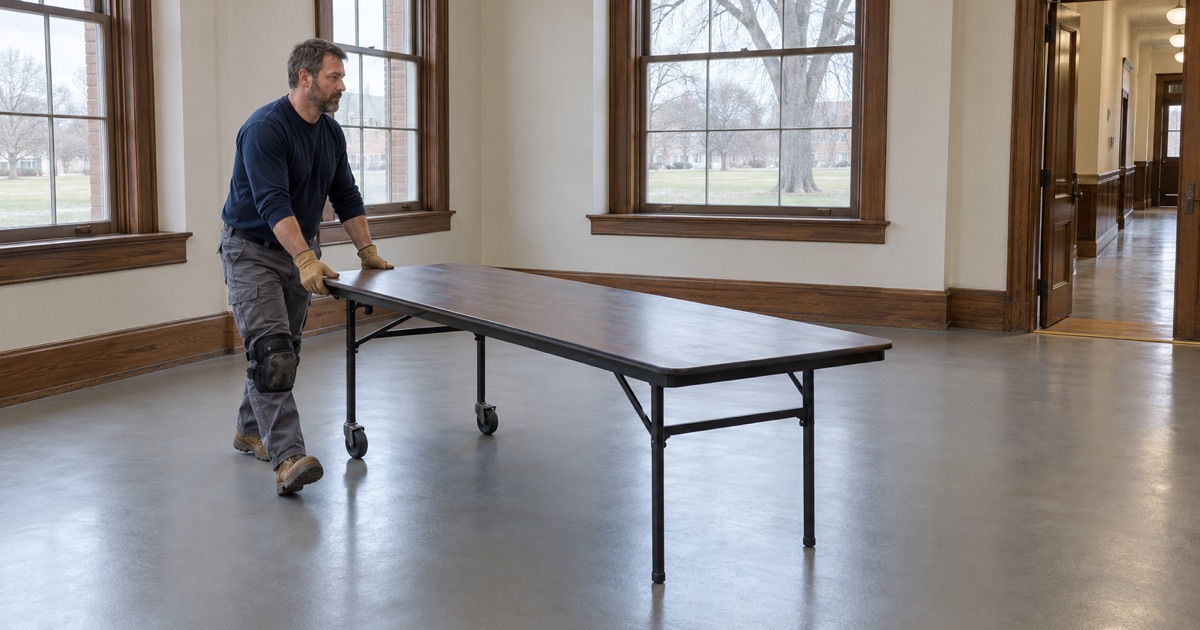
Few buildings in Western Springs have lived as many lives as the Grand Avenue Community Center at 4211 Grand Avenue. It was built in 1885 as the Grand Avenue School, replacing a smaller schoolhouse on the same site, and the village board met there until the Water Tower went up in 1892. A second floor, a north wing, an interior remodel and a new gymnasium followed as the school district grew.
The school closed a few years after its last major renovation, and a not-for-profit was later formed to acquire the property as a community center before it was transferred to the village. Today the building, in Lyons Township, Cook County, holds a preschool and daycare, dance and music lessons, a gym, a senior center and the Historical Society’s archives. Few floors anywhere carry that many different uses under one roof.
1977 and the last complete interior renovation
According to the Western Springs Historical Society, the State of Illinois funded a complete interior renovation of the school in 1977, including steel support columns and beams. The school closed about four years later. That makes 1977 the last date anyone documented a full interior rebuild, and the floor finishes of that era sit squarely in the years federal safety rules treat with caution.
The Historical Society’s account does not describe the floor materials, and we do not guess at them. What matters for anyone planning floor work in a building of that age is that the written history cannot settle what lies under a finished floor or inside an adhesive layer. Only sampling can.
The 2025 flooring replacement
The village bid a flooring replacement for the center with a bid date of February 4, 2025. At its April 28, 2025 meeting the Village Board approved Ordinance No. 25-3262, a change order to the contract with NPN Flooring of Brookfield that raised the price from $44,105.79 to $56,603.85 for the Grand Avenue Community Center flooring replacement project.
The public record does not say which rooms were covered, which products went down or why the change order was needed. We had no part in that work, and we mention it because it shows the village treating flooring at a community building as a planned public project. Any contractor taking up old floors in a building like this one inherits the same question the next section answers.
Looking for epoxy-flooring closer to Lincolnwood? See Epoxy-Flooring in Lincolnwood.
What OSHA Presumes About Floor Tile Laid by 1980
The presumption in 29 CFR 1926.1101
Federal construction rules do not wait for a lab report to treat old resilient flooring as hazardous. Under OSHA’s asbestos standard for construction, 29 CFR 1926.1101, asphalt and vinyl flooring material installed no later than 1980 must be considered asbestos-containing. The same standard says resilient flooring, including its associated mastic and backing, is assumed to contain asbestos unless an industrial hygienist determines otherwise using recognized analytical techniques.
That is a presumption, not a finding. Nothing in the record says the Grand Avenue building contains asbestos flooring, and plenty of old tile tests clean. The point is that nobody, ourselves included, gets to decide a floor from that era is harmless by looking at it.
Flooring shall not be sanded
The work-practice rules that follow the presumption are blunt. The standard says flooring or its backing shall not be sanded, and resilient sheeting has to be removed by cutting with the snip point wetted and wetting during delamination, with rip-up prohibited. All scraping of residual adhesive or backing has to use wet methods.
Dry sweeping is prohibited, and mechanical chipping is allowed only inside a negative pressure enclosure. Read against what a coating installer does for a living, those lines rule out exactly the tools that open a slab: the grinder, the shot blaster and the scraper run dry. That is why the order of operations matters more on an aging floor than any product choice.
Who the rule binds
OSHA’s standard binds employers doing the work, which is why we follow it on every job that touches old resilient flooring. It does not make sanding old tile safe for anyone else. We never tell a homeowner it is fine to sand, grind or dry-scrape old tile or black mastic themselves, and we would not do it in our own homes.
We are also clear about what we are not. Oak Park Epoxy Flooring is not an asbestos abatement contractor, we do not remove asbestos-containing material, and a floor coating is never a way to deal with it. When a sample comes back positive, the next call goes to a licensed abatement firm, not to us.
Test, Then Abate or Clear, and Only Then Grind
Step one: sampling by a qualified party
On any floor where old tile, sheet goods or mastic may date from 1980 or earlier, sampling comes first. A qualified party takes samples of each layer, because tile, backing and the adhesive under them can differ. We schedule nothing at the slab until that answer is in hand.
The result sets the path. If the material is found asbestos-free, the floor goes onto our ordinary preparation schedule; if it is not, an abatement contractor removes it under the federal work practices and the area is cleared before we return. Either way, the paperwork travels with the job so the next trade knows what was under the floor.
Step two: abatement or clearance
Abatement is its own trade, with its own crews, containment and disposal. We do not price it, subcontract it quietly or blend it into a coating scope, and we would rather lose a schedule week than start a grinder over an unanswered question. Clearance is what hands the floor back to us.
In a working building, that sequence also has to fit around people. A community center with a preschool, a dance studio and a senior program cannot close every room at once, so testing and any abatement are usually phased. We plan coating work around the hours a building has to stay open, including overnight and weekend windows.
Step three: opening the slab
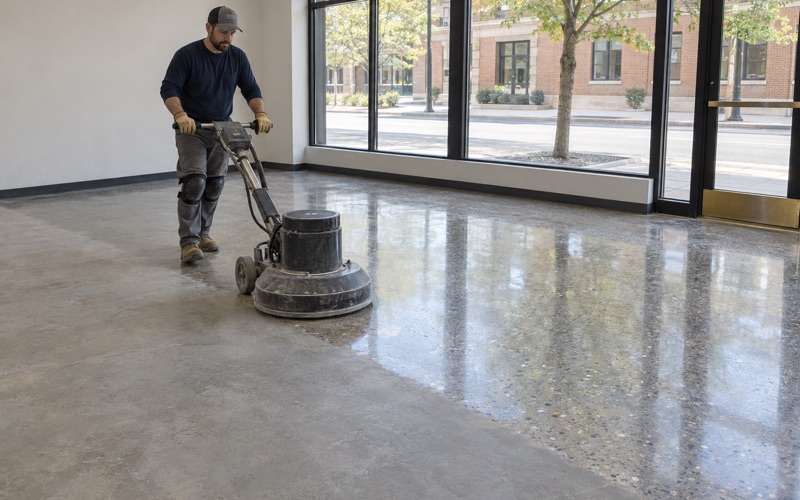
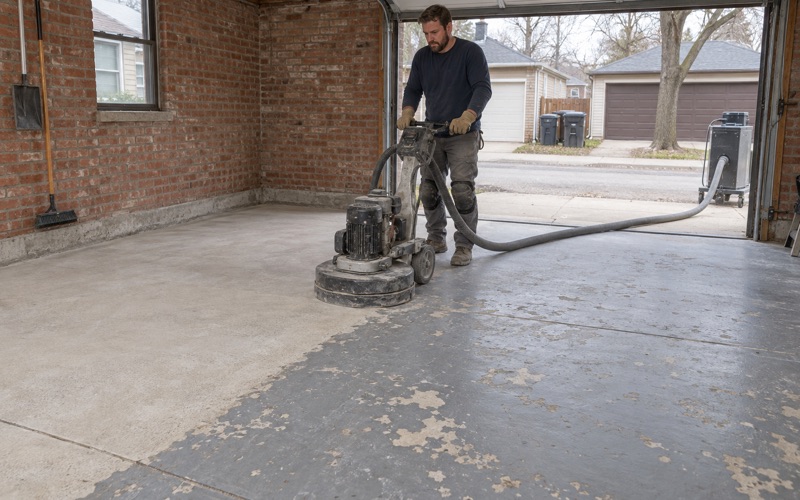
Only after the floor has been cleared does preparation begin. We open the slab mechanically with diamond grinding or shot blasting and never acid etch, because a chemical etch leaves a weak, contaminated surface and does nothing about what an old floor left behind. Grinding brings the concrete to the profile the chosen system calls for.
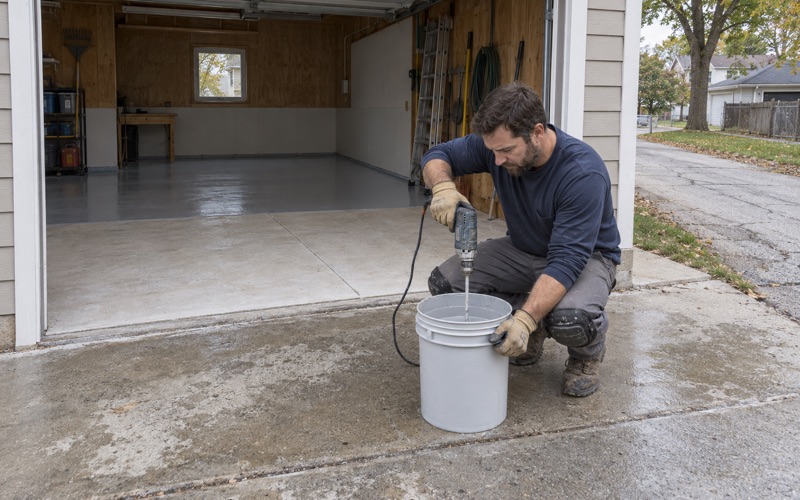
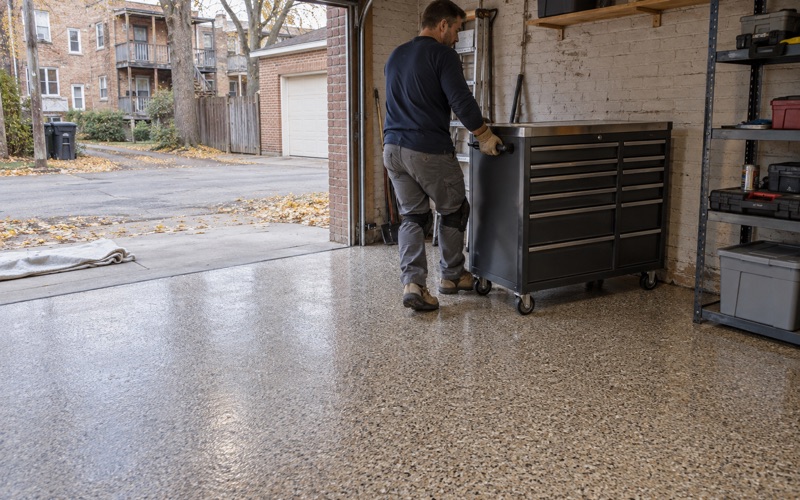
Then comes the moisture question, which we test rather than assume. ASTM F2170 relative humidity probes or ASTM F1869 calcium chloride tests show what the slab is giving off, and that reading decides whether a moisture-mitigation primer goes down first. The proposal then names the product, such as 100% solids epoxy with a polyaspartic topcoat, along with the system build and finished thickness.
Old Tile and Black Mastic in Western Springs Basements
Where old tile turns up
The same logic applies well beyond civic buildings. Western Springs basements, recreation rooms and laundry areas often carry square resilient tile glued down with black mastic, sometimes under carpet or a newer floating floor. Owners usually find it while pulling up the top layer, which is the moment to stop and call for sampling rather than reaching for a scraper.
Western Springs is overwhelmingly a village of owners, with 95.6 percent of occupied units owner-occupied, so the person making this decision usually lives right above the floor in question. That makes the dust question personal. A sample is a small step next to cleaning up after a dry scrape that should never have happened.
What we check before quoting a basement
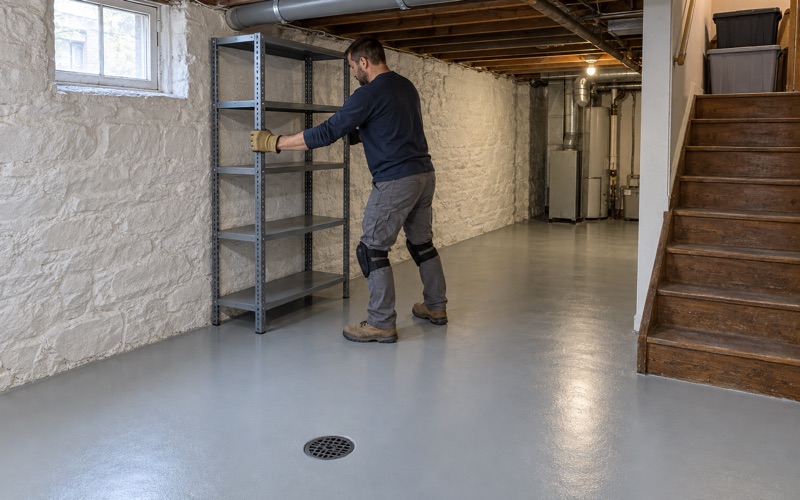
Basement floors in older homes get a close look for paint, patches and old adhesive before we recommend any system. We note where tile has already been removed, whether mastic residue remains and how the floor drain and sump pit sit, since a coating has to be detailed around both. We also say plainly that a coating does not stop a sewer backup, so the floor drain and the backflow question come first.
Moisture testing is a line item in every basement scope, not an upsell after a blister appears. Hydrostatic pressure, efflorescence and vapor moving up through the slab all show up in the readings, and warranty exclusions are read out before the job is sold, with moisture named first. If a slab cannot hold a coating, we say so.
Radon, contractor rules and paperwork
We do not sell a floor coating as radon reduction, because in Illinois that work takes a state radon mitigation license from IEMA. Illinois issues no state license for flooring or coatings work at all, so we confirm the village’s own contractor rules with Western Springs Community Development before scheduling. Its detached-garage guide, for one, requires every contractor to be registered.
Every home job gets a written contract and the Home Repair: Know Your Consumer Rights pamphlet before work begins, as the Illinois Home Repair and Remodeling Act requires. Coatings are chosen within the Illinois VOC limits that bind installers as well as manufacturers. Once the old floor has been tested, cleared and opened, the new one can finally go down.
- 20+ Years Coating Concrete
- Moisture Tested Before Quoting
- Written Contract on Every Home Job