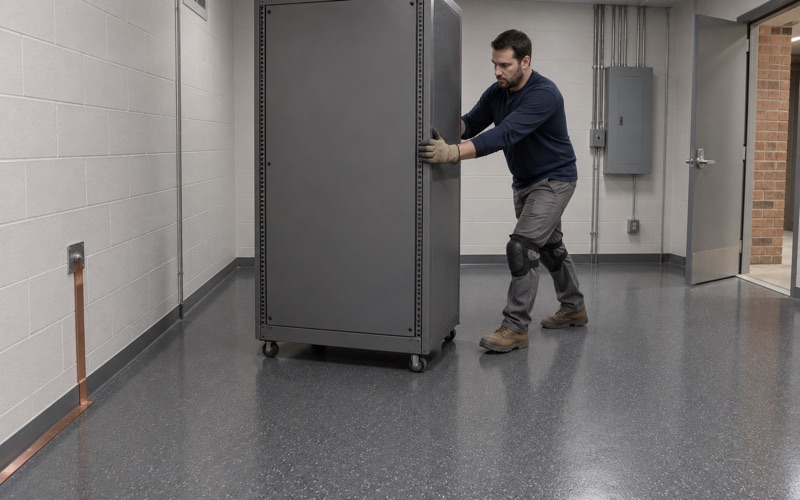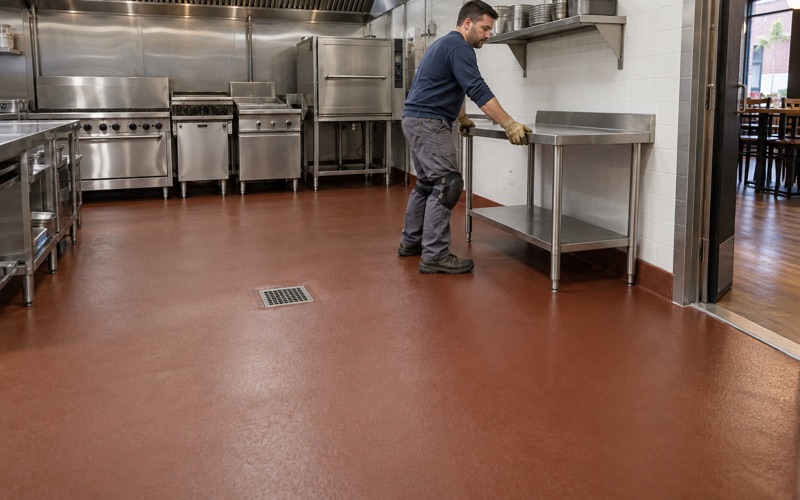
Oak Park Epoxy Flooring has spent more than 20 years on epoxy flooring in Worth and across suburban Cook County, and a good share of that work starts with one question: where is the coating going? Indoors, on a garage or basement slab, a 100% solids epoxy is often the right answer. Outdoors, on a porch, patio or front stoop, it usually is not, and we say so before any quote is written.
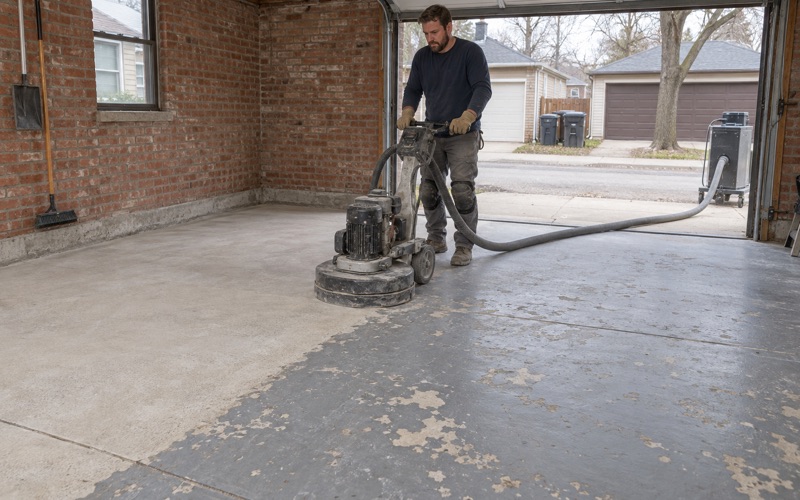
That distinction shapes everything below. Every slab we touch is opened mechanically with a diamond grinder or shot blaster, never acid etched, and moisture testing appears as its own line on the scope. The proposal names the product, the system build and the finished thickness, so a homeowner can hold what was quoted up against what actually went down.
When a slab needs repair before it can take any finish, we say that plainly and price the repair as a separate step. We also read the warranty exclusions aloud before a job is sold, and moisture is the first one named. On an outdoor slab that conversation tends to be short, because the right product is often not an epoxy at all.
A Village Hall Porch on Worth’s Capital Plan
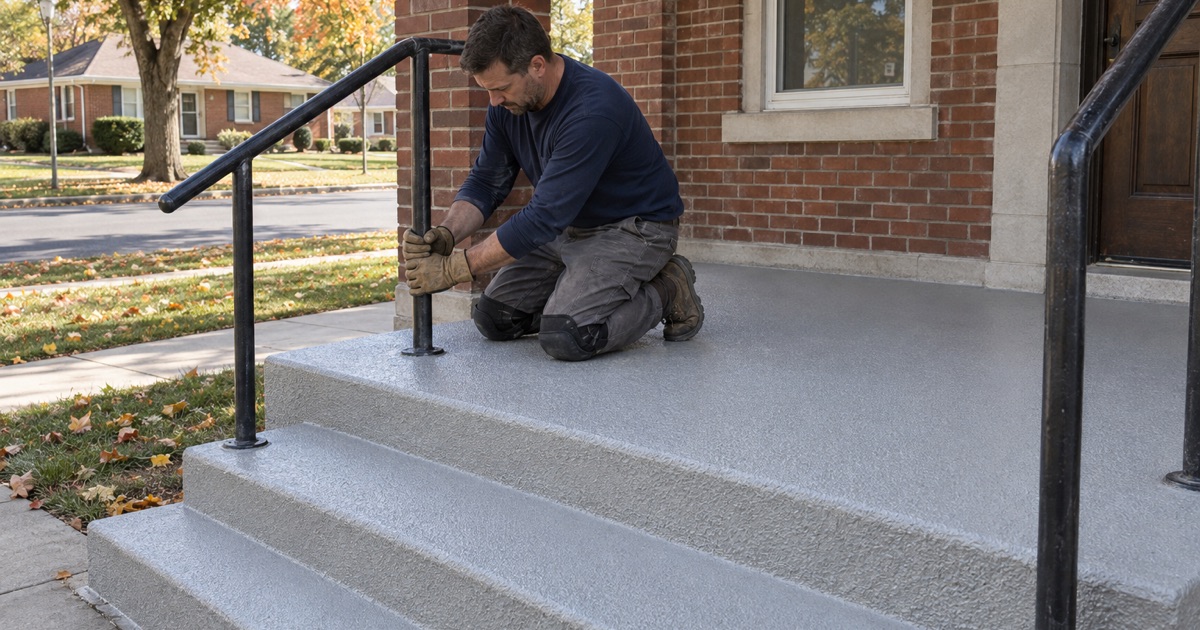
Worth’s own municipal building shows the problem neatly. The village’s Capital Improvement Plan for fiscal years 2027 through 2031, prepared with CMAP and Jacobs, includes a project to replace the railings and restore the concrete porch at Village Hall, 7112 W 111th Street. Village Hall and the Police Department share that building, which sits in Worth Township, Cook County.
What the Plan Lists
The porch entry carries a General Fund estimate of $120,000 and describes its purpose as improving safety and access to Village Hall. A separate entry, Village Hall Back Patio Improvements, calls for concrete repair on the back patio of the same building, slotted for fiscal 2028-2029 with the cost still marked to be determined. Both sit alongside window replacement, brick repair and landscaping on that building’s list.
The plan itself says adoption is a statement of intent, not an appropriation of funds. These are planned projects, not finished or funded ones, and neither entry names a coating, a sealer or any finish material. What the list does show is that even a maintained public building eventually needs its exterior concrete put right before anything goes on top of it.
Why a Porch Is a Different Slab
A porch is the clearest example of a slab where an indoor floor epoxy is the wrong product. It sits outside, takes rain and snowmelt on its face, and usually rests on grade with soil directly underneath. Homeowners ask us about the same thing on a smaller scale every season, usually after seeing a glossy garage floor and wanting the front steps to match.
Our answer on those calls follows the same order the village’s plan implies. The concrete gets repaired first, and then it gets a finish built for exterior exposure. A garage coat carried out the front door looks good for a season and then turns into a peeling, slippery repair job of its own, on the one surface every visitor has to cross.
Looking for epoxy-flooring closer to Alsip? See Epoxy-Flooring in Alsip.
Why an Indoor Floor Epoxy Is Not an Outdoor Coating
Manufacturers are direct about this in their own literature. The product data sheet for GacoFloor E10, a 100 percent solids floor epoxy, states that the product is not designed for exterior use, immersion, or any use where moisture can reach the underside of the flooring. The same sheet says not to apply it to slabs on grade unless a heavy, unruptured vapor barrier sits under the slab or over the substrate.
Other makers say the same thing in their own words. Some data sheets limit their epoxies to interior use and keep them out of direct sunlight, while others warn of chalking, discoloration and fading on exterior applications. That is manufacturer guidance about the products, not a statement about any particular porch in Worth, but it is guidance we follow on every outdoor quote we write.
Moisture From Below
An exterior slab on grade takes water from two directions. Rain and melting snow land on the surface, and ground moisture works up through the concrete from the soil beneath it. Most porches and patios were poured without the kind of under-slab vapor retarder, tested to ASTM E1745, that a modern interior slab might have, so nothing stops that vapor on its way up.
A dense, film-forming epoxy traps that moisture at the bond line. Vapor pressure builds under the film, the coating lifts in blisters, and water then gets under the edges and spreads the failure outward. Indoors we test for this with ASTM F2170 relative humidity probes or an ASTM F1869 calcium chloride test, but an outdoor slab is wet and dry by turns, so a single reading tells us very little.
Sunlight as a Secondary Concern
Sunlight adds a second problem on a porch that faces south or west. Epoxy resins chalk and yellow under UV, which is why the same data sheet recommends the maker’s polyaspartic topcoat for enhanced UV protection. Even so, a topcoat over an interior epoxy does nothing about moisture rising from underneath, so it never turns a garage system into a porch system.
Repair First: Spalls, Cracks and Railing Posts
Every exterior quote we write begins with reading the concrete. We look at the cracks, any old paint or sealer, and the way the surface has worn, and we tell the owner plainly when a slab needs repair or replacement before any finish can go on. A finish only lasts as long as the concrete holding it, and no product changes that.
Spalls and Surface Loss
Spalled areas, where the top layer has broken away, have to be cut back to sound concrete and patched with a repair mortar suited to exterior use. Shallow surface loss can sometimes be ground out, while deeper loss needs to be built back up in layers. We open the surface with a diamond grinder or shot blaster to the ICRI CSP profile the chosen finish calls for.
Cracks and Movement
Cracks get sorted by type before anything is filled. A dormant shrinkage crack can be routed and filled, but a crack that is still moving will reflect through any finish laid over it. Where a slab has settled or heaved enough to change its pitch, that is a concrete contractor’s job rather than ours, and we say so instead of coating over it.
The Concrete Around Railing Posts
Railing posts are where many porches break down first. Water collects at the base of each post, runs down along the metal into the concrete, and as the metal corrodes it pushes the surrounding concrete apart. We do not fabricate or replace railings, but the concrete around an existing post has to be sound before any finish meets it.
Where posts are being reset by others, we coordinate the order of work so the repair mortar and finish go down after the posts are set. The joint between post and slab then gets a sealant detail that sheds water away from the metal instead of holding it there. That small detail decides how long the concrete around each post stays intact.
Worth Front Stoops and Back Patios
Worth’s housing stock makes this a common conversation. About three-quarters of the village’s homes were built between 1950 and 1979, so most front stoops and back patios here are concrete that has been outdoors for 45 to 75 years. Many have been painted, patched or sealed more than once, and every one of those layers has to be identified before we choose what goes on next.
Choosing an Exterior Finish
For a stoop or patio that only needs protection, a penetrating sealer is often the right call. It soaks into the concrete rather than forming a film on top, so moisture can still move through the slab and escape without lifting anything. It also keeps the concrete’s own texture underfoot, which matters on steps that see wet shoes all winter.
Where an owner wants color or a finished look, we use a system the manufacturer rates for exterior exposure, typically with a polyaspartic or polyurea topcoat and a broadcast aggregate for texture. Quartz aggregate gives a gritty surface that holds wet shoes far better than a smooth gloss. A coating is not waterproofing, though, and we never sell one as a fix for water coming through a slab.
Either way, the proposal names the product, the system build and the finished thickness, and the schedule follows slab temperature and dew point rather than the calendar. An outdoor slab is more exposed to both than any garage, so some exterior jobs simply wait for a run of suitable days. We say that up front rather than putting down a finish that cannot cure properly.
Condominium Stoops and Shared Concrete
A large share of Worth’s housing sits in apartment and condominium buildings, with 1,060 units in buildings of 10 to 19 units. In those buildings the entry stoops, common walks and patios are decided by the association or owner, not by the person living in the unit. We quote to whoever holds that decision and walk through the scope with them before any work is scheduled.
Working in the Village
Illinois issues no state license for flooring or coatings work, but Worth requires contractors to register with the village. That means a $110 annual registration, a certificate of insurance naming the village and a $10,000 surety bond. The building department’s permit list names remodeling projects without mentioning floor finishes either way, so we ask before starting rather than assume the answer.
On every home job, the owner gets a written contract and the Home Repair: Know Your Consumer Rights pamphlet before work begins, as the Illinois Home Repair and Remodeling Act requires. Our coatings are chosen within the Illinois limits on VOC content, which bind the installer as well as the manufacturer. If the same visit includes an attached garage or a basement, those slabs get their own moisture test and their own interior system, quoted separately from the stoop.
The order never changes, whether the slab is a village porch on a capital list or a short stoop on a side street. Repair the concrete, test what can be tested, then choose a finish rated for where the slab actually sits. That is the difference between a porch that holds up and one that needs the same repair twice.
- 20+ Years Coating Concrete
- Moisture Tested Before Quoting
- Written Contract on Every Home Job